Remote Sensing and Geographic Information Science Research Group, Faculty of Earth Sciences and Technology, Institut Teknologi Bandung, Bandung, Indonesia.
Center for Remote Sensing, Institut Teknologi Bandung, Bandung, Indonesia.
PLoS One. 2023 Oct 20;18(10):e0293190. doi: 10.1371/journal.pone.0293190. eCollection 2023.
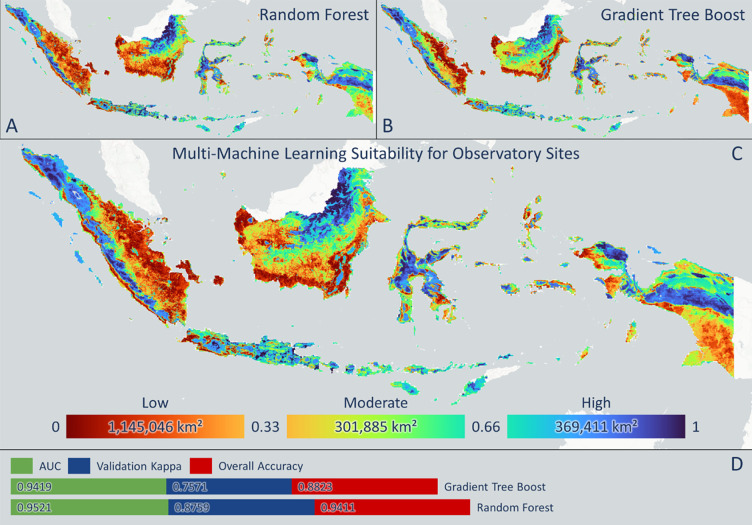
Astronomical observatory construction plays an essential role in astronomy research, education, and tourism development worldwide. This study develops siting distribution scenarios for astronomical observatory locations in Indonesia using a suitability analysis by integrating the physical and atmospheric observatory suitability indexes, machine learning models, and long-term climate models. Subsequently, potential sites are equalized based on longitude and latitude zonal divisions considering air pollution disturbance risks. The study novelty comes from the integrated model development of physical and socio-economic factors, dynamic spatiotemporal analysis of atmospheric factors, and the consideration of equitable low air-pollution-disturbance-risk distribution in optimal country-level observatory construction scenarios. Generally, Indonesia comprises high suitability index and low multi-source air pollution risk areas, although some area has high astronomical suitability and high-medium air pollution risk. Most of Java, the east coast of Sumatra, and the west and south coasts of Kalimantan demonstrate "low astronomical suitability-high air pollution risk." A total of eighteen locations are recommended for new observatories, of which five, one, three, four, two, and three are on Sumatra, Java, Kalimantan, Nusa Tenggara, Sulawesi, and Papua, respectively. This study provides a comprehensive approach to determine the optimal observatory construction site to optimize the potential of astronomical activities.
天文观测站的建设在全球范围内的天文学研究、教育和旅游发展中起着至关重要的作用。本研究通过整合物理和大气观测站适宜性指数、机器学习模型和长期气候模型,对印度尼西亚的天文观测站位置进行选址分布情景开发,采用适宜性分析。随后,根据考虑空气污染干扰风险的经度和纬度带分区,对潜在站点进行均衡化处理。本研究的新颖之处在于综合考虑了物理和社会经济因素的模型开发、大气因素的动态时空分析以及在最优的国家级观测站建设方案中考虑公平的低空气污染干扰风险分布。一般来说,印度尼西亚既有高适宜性指数和低多源空气污染风险地区,也有一些地区具有高天文适宜性和高中等空气污染风险。爪哇岛大部分地区、苏门答腊岛东海岸以及加里曼丹岛西海岸和南岸都表现出“低天文适宜性-高空气污染风险”的特征。共推荐了 18 个新观测站的位置,其中苏门答腊岛、爪哇岛、加里曼丹岛、努沙登加拉岛、苏拉威西岛和巴布亚岛分别有 5、1、3、4、2 和 3 个观测站。本研究提供了一种综合方法来确定最佳观测站建设地点,以优化天文活动的潜力。