Centro de Biotecnología y Genómica de Plantas (Universidad Politécnica de Madrid (UPM) - Instituto Nacional de Investigación y Tecnología Agraria y Alimentaria - CSIC (INIA-CSIC)), Madrid, Spain.
Centro de Biotecnología y Genómica de Plantas (Universidad Politécnica de Madrid (UPM) - Instituto Nacional de Investigación y Tecnología Agraria y Alimentaria - CSIC (INIA-CSIC)), Madrid, Spain.
Plant Commun. 2023 Nov 13;4(6):100737. doi: 10.1016/j.xplc.2023.100737. Epub 2023 Oct 20.
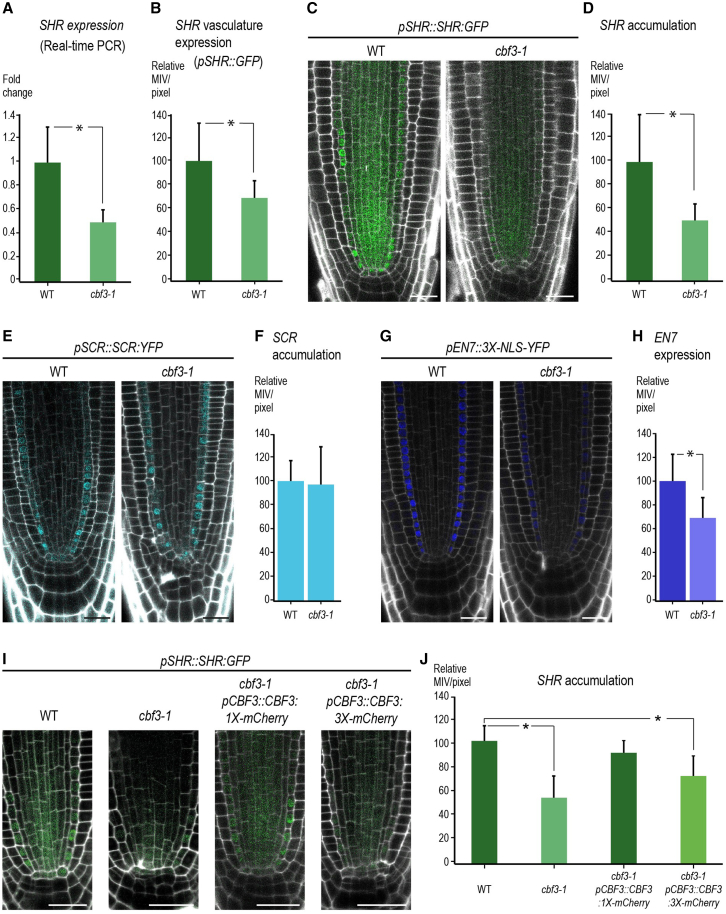
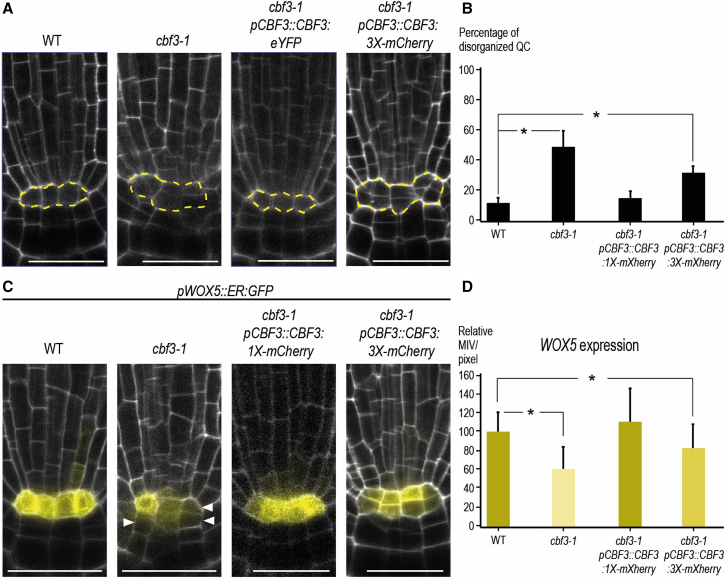
Plant growth and development involve the specification and regeneration of stem cell niches (SCNs). Although plants are exposed to disparate environmental conditions, how environmental cues affect developmental programs and stem cells is not well understood. Root stem cells are accommodated in meristems in SCNs around the quiescent center (QC), which maintains their activity. Using a combination of genetics and confocal microscopy to trace morphological defects and correlate them with changes in gene expression and protein levels, we show that the cold-induced transcription factor (TF) C-REPEAT BINDING FACTOR 3 (CBF3), which has previously been associated with cold acclimation, regulates root development, stem cell activity, and regeneration. CBF3 is integrated into the SHORT-ROOT (SHR) regulatory network, forming a feedback loop that maintains SHR expression. CBF3 is primarily expressed in the root endodermis, whereas the CBF3 protein is localized to other meristematic tissues, including root SCNs. Complementation of cbf3-1 using a wild-type CBF3 gene and a CBF3 fusion with reduced mobility show that CBF3 movement capacity is required for SCN patterning and regulates root growth. Notably, cold induces CBF3, affecting QC activity. Furthermore, exposure to moderate cold around 10°C-12°C promotes root regeneration and QC respecification in a CBF3-dependent manner during the recuperation period. By contrast, CBF3 does not appear to regulate stem cell survival, which has been associated with recuperation from more acute cold (∼4°C). We propose a role for CBF3 in mediating the molecular interrelationships among the cold response, stem cell activity, and development.
植物的生长和发育涉及干细胞龛(SCN)的特化和再生。尽管植物暴露在不同的环境条件下,但环境线索如何影响发育程序和干细胞尚不清楚。根干细胞位于静止中心(QC)周围的分生组织中的 SCN 中,静止中心维持其活性。我们使用遗传学和共聚焦显微镜相结合的方法来追踪形态缺陷,并将其与基因表达和蛋白质水平的变化相关联,结果表明,先前与冷驯化相关的冷诱导转录因子(TF)C-重复结合因子 3(CBF3)调节根发育、干细胞活性和再生。CBF3 整合到SHORT-ROOT(SHR)调控网络中,形成一个反馈环,维持 SHR 的表达。CBF3 主要在根内皮层中表达,而 CBF3 蛋白定位于其他分生组织中,包括根 SCN。使用野生型 CBF3 基因和具有降低迁移能力的 CBF3 融合蛋白对 cbf3-1 进行互补表明,CBF3 的运动能力对于 SCN 模式形成是必需的,并调节根的生长。值得注意的是,低温诱导 CBF3,影响 QC 活性。此外,在恢复期内,10°C-12°C 左右的适度低温以 CBF3 依赖的方式促进根再生和 QC 再特化。相比之下,CBF3 似乎不调节与更急性冷(约 4°C)恢复相关的干细胞存活。我们提出 CBF3 在介导冷反应、干细胞活性和发育之间的分子相互关系方面的作用。