Yu Chengdong, Xu Jiawei, Xu Siyi, Peng Huoping, Tang Lei, Sun Zhengkui, Chen Wen
Department of breast surgery, Affiliated Cancer Hospital of Nanchang University, Jiangxi cancer hospital, The Second Affiliated Hospital of Nanchang Medical College, 330029, China.
Heliyon. 2023 Oct 14;9(10):e20980. doi: 10.1016/j.heliyon.2023.e20980. eCollection 2023 Oct.
Previous studies have discovered an association between dietary factors and breast cancer. However, few studies have used Mendelian randomization (MR) to assess the potential causal relationship between dietary factors and breast cancer.
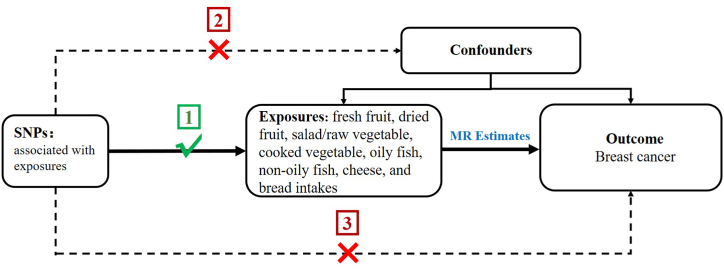
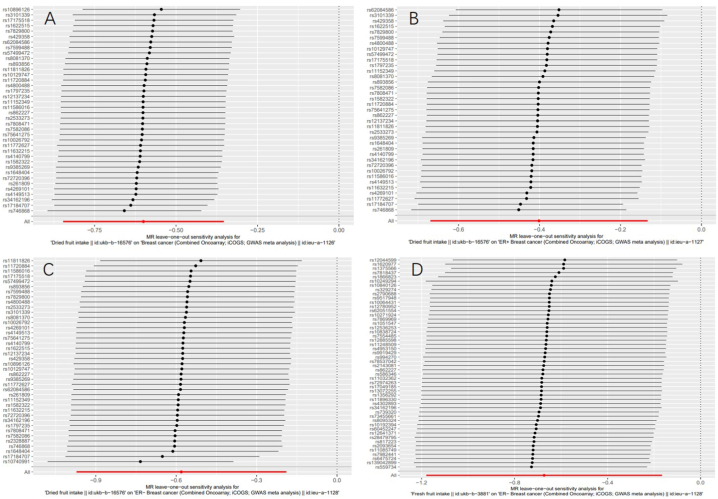
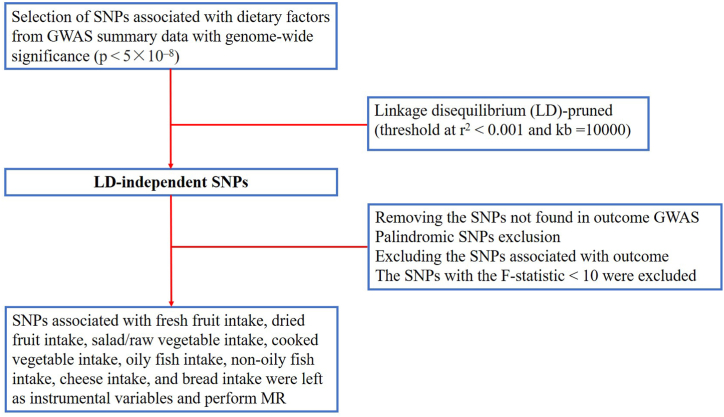
The exposure datasets for fresh fruit intake, dried fruit intake, salad/raw vegetable intake, cooked vegetable intake, oily fish intake, non-oily fish intake, cheese intake, and bread intake were obtained from the UK Biobank. The outcome dataset was extracted from the Breast Cancer Association Consortium (BCAC). We used the inverse variance weighted (IVW) method as the primary approach for the two-sample MR analysis. To ensure the accuracy of the results, we conducted heterogeneity and horizontal pleiotropy analyses. Additionally, multivariable MR analysis was conducted to ensure the stability of the results.
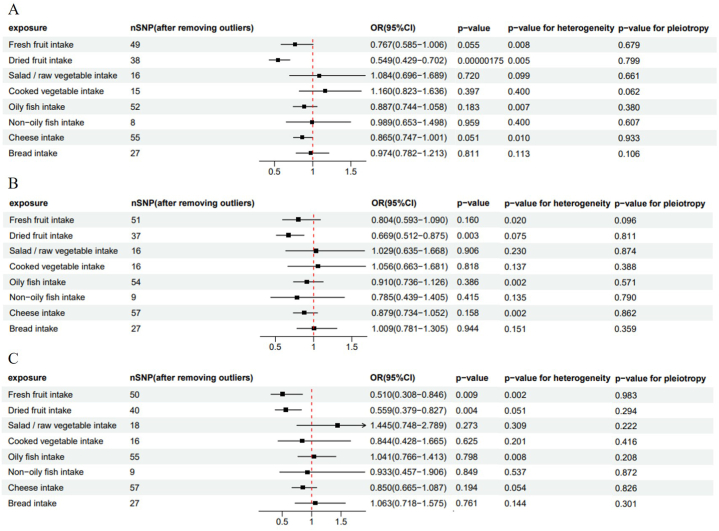
Dried fruit intake was found to be a protective factor for overall breast cancer (outliers excluded: OR: 0.549; 95 % CI: 0.429-0.702; p = 1.75 × 10). Subtype analyses showed that dried fruit intake was inversely associated with both estrogen receptor-positive (ER+) breast cancer (outliers excluded: OR: 0.669; 95 % CI: 0.512-0.875; p = 0.003) and ER-negative (ER-) breast cancer (OR: 0.559; 95 % CI: 0.379-0.827; p = 0.004), while fresh fruit intake was inversely associated with ER- breast cancer (excluded outliers: OR: 0.510; 95 % CI: 0.308-0.846; p = 0.009). No significant causal relationship was found between other dietary intakes and breast cancer. After adjusting for the effects of possible confounders, the causal relationships found by the two-sample MR analysis remained.
Our study provides evidence that dried fruit intake may reduce the risk of both ER+ and ER- breast cancer, and fresh fruit intake may reduce the risk of ER- breast cancer. Other factors included in this study were not linked to breast cancer.
先前的研究发现饮食因素与乳腺癌之间存在关联。然而,很少有研究使用孟德尔随机化(MR)来评估饮食因素与乳腺癌之间的潜在因果关系。
新鲜水果摄入量、干果摄入量、沙拉/生蔬菜摄入量、熟蔬菜摄入量、油性鱼类摄入量、非油性鱼类摄入量、奶酪摄入量和面包摄入量的暴露数据集来自英国生物银行。结果数据集从乳腺癌协会联盟(BCAC)提取。我们使用逆方差加权(IVW)方法作为两样本MR分析的主要方法。为确保结果的准确性,我们进行了异质性和水平多效性分析。此外,进行了多变量MR分析以确保结果的稳定性。
发现干果摄入量是总体乳腺癌的保护因素(排除异常值:比值比:0.549;95%置信区间:0.429 - 0.702;p = 1.75×10)。亚组分析表明,干果摄入量与雌激素受体阳性(ER +)乳腺癌(排除异常值:比值比:0.669;95%置信区间:0.512 - 0.875;p = 0.003)和ER阴性(ER -)乳腺癌(比值比:0.559;95%置信区间:0.379 - 0.827;p = 0.004)均呈负相关,而新鲜水果摄入量与ER -乳腺癌呈负相关(排除异常值:比值比:0.510;95%置信区间:0.308 - 0.846;p = 0.009)。未发现其他饮食摄入量与乳腺癌之间存在显著因果关系。在调整可能的混杂因素的影响后,两样本MR分析发现的因果关系仍然存在。
我们的研究提供了证据,表明干果摄入量可能降低ER +和ER -乳腺癌的风险,新鲜水果摄入量可能降低ER -乳腺癌的风险。本研究中包括的其他因素与乳腺癌无关。