Pino Alejandro, Lee Justin J, Hashmi Nazish K, Brucker Amanda, Chow Shein-Chung, Mahmood Kamran
Division of Pulmonary, Critical Care and Allergy, Department of Medicine, Duke University, Durham, NC, USA.
Rutgers New Jersey Medical School, Newark, NJ, USA.
J Thorac Dis. 2023 Sep 28;15(9):4717-4724. doi: 10.21037/jtd-22-1510. Epub 2023 Aug 29.
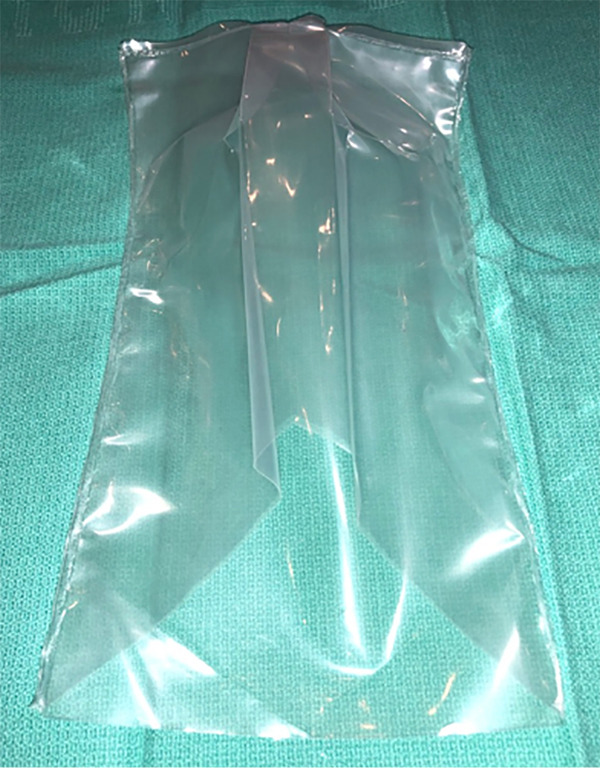
Contamination of work surfaces by used laryngoscopes after endotracheal intubation is a serious infection control concern but no strategies are available to address it. We assessed if contamination of the surfaces after endotracheal intubation would be reduced when providers used a dedicated, self-erected, disposable plastic sleeve (BladePouch) to store the used laryngoscope as compared to using single gloves or double gloves and sheathing the laryngoscope with the outer gloves.
Twenty participants were recruited including attending physicians, trainees and allied health care professionals. They performed endotracheal intubation on a mannequin with oral cavity coated with a dye and stored the used laryngoscope blade using single gloves, double gloves or BladePouch. Each participant used both direct and video laryngoscopes. Following intubation, dye contamination of gloves, gown and work surface was evaluated.
There was no difference in the contamination of gloves or gowns between the single gloves, double gloves or BladePouch groups. However, work surface contamination was significantly reduced when using BladePouch compared to single or double gloves (13% 100% 80% respectively, P<0.001). The odds of work surface contamination were significantly lower with BladePouch single or double gloves, even when adjusted for intubation device, role and experience of participants with an adjusted odds ratio of 0.0054 (95% confidence interval: 0.0009-0.0314), P<0.001.
In conjunction with standard precautions, the use of a dedicated plastic sleeve to store contaminated laryngoscope blade after endotracheal intubation may reduce the work surface contamination, independent of intubation device, role and experience of providers.
气管插管后使用过的喉镜污染工作表面是感染控制方面的一个严重问题,但目前尚无应对策略。我们评估了与使用单层手套或双层手套并用外层手套包裹喉镜相比,在气管插管后,如果医护人员使用专用的、可自行搭建的一次性塑料套管(喉镜套)来存放用过的喉镜,工作表面的污染情况是否会减少。
招募了20名参与者,包括主治医师、实习生和辅助医疗专业人员。他们在口腔涂有染料的人体模型上进行气管插管,并使用单层手套、双层手套或喉镜套来存放用过的喉镜叶片。每位参与者都使用了直接喉镜和视频喉镜。插管后,评估手套、手术衣和工作表面的染料污染情况。
单层手套、双层手套或喉镜套组之间手套或手术衣的污染情况没有差异。然而,与单层或双层手套相比,使用喉镜套时工作表面的污染显著减少(分别为13%、100%、80%,P<0.001)。即使在对插管设备、参与者的角色和经验进行调整后,使用喉镜套时工作表面污染的几率也显著低于单层或双层手套,调整后的优势比为0.0054(95%置信区间:0.0009-0.0314),P<0.001。
结合标准预防措施,气管插管后使用专用塑料套管存放受污染的喉镜叶片可能会减少工作表面的污染,这与插管设备、医护人员的角色和经验无关。