College of Environment, Zhejiang University of Technology, Hangzhou, 310032, P. R. China.
Key Laboratory of Microbial Technology and Bioinformatics of Zhejiang Province, Hangzhou, 310012, P. R. China.
Adv Sci (Weinh). 2023 Nov;10(33):e2303925. doi: 10.1002/advs.202303925. Epub 2023 Oct 23.
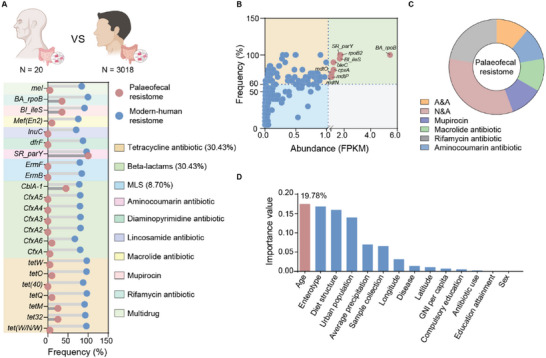
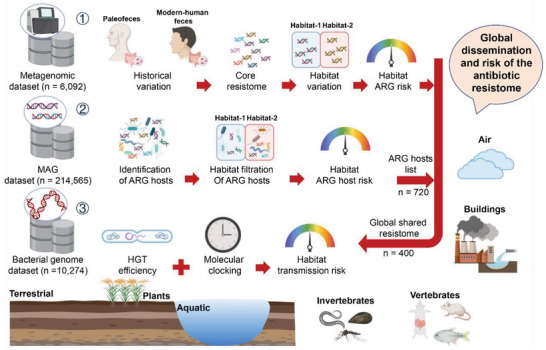
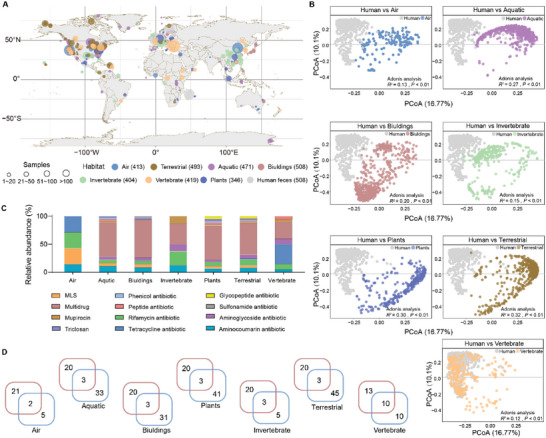
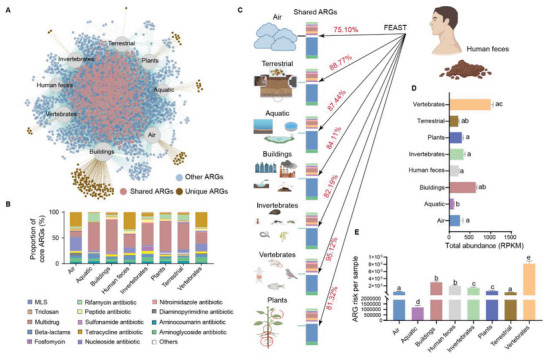
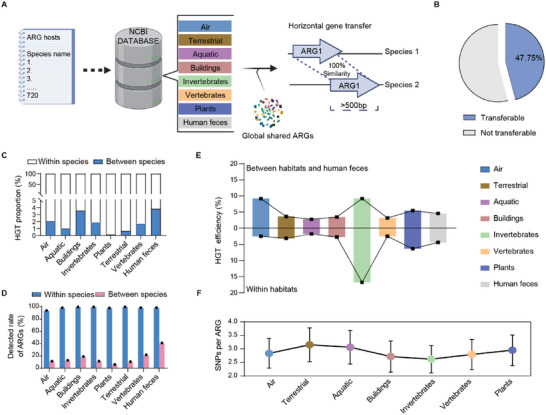
The global crisis in antimicrobial resistance continues to grow. Estimating the risks of antibiotic resistance transmission across habitats is hindered by the lack of data on mobility and habitat-specificity. Metagenomic samples of 6092 are analyzed to delineate the unique core resistomes from human feces and seven other habitats. This is found that most resistance genes (≈85%) are transmitted between external habitats and human feces. This suggests that human feces are broadly representative of the global resistome and are potentially a hub for accumulating and disseminating resistance genes. The analysis found that resistance genes with ancient horizontal gene transfer (HGT) events have a higher efficiency of transfer across habitats, suggesting that HGT may be the main driver for forming unique but partly shared resistomes in all habitats. Importantly, the human fecal resistome is historically different and influenced by HGT and age. The most important routes of cross-transmission of resistance are from the atmosphere, buildings, and animals to humans. These habitats should receive more attention for future prevention of antimicrobial resistance. The study will disentangle transmission routes of resistance genes between humans and other habitats in a One Health framework and can identify strategies for controlling the ongoing dissemination and antibiotic resistance.
全球抗生素耐药性危机持续加剧。由于缺乏关于移动性和栖息地特异性的数据,因此难以评估抗生素耐药性在不同栖息地之间传播的风险。本研究分析了 6092 个宏基因组样本,以描绘来自人类粪便和其他七个栖息地的独特核心耐药组。研究发现,大多数耐药基因(≈85%)在外部栖息地和人类粪便之间传播。这表明人类粪便广泛代表了全球耐药组,并且可能是积累和传播耐药基因的中心。分析还发现,具有古老水平基因转移(HGT)事件的耐药基因在不同栖息地之间的转移效率更高,这表明 HGT 可能是形成所有栖息地中独特但部分共享耐药组的主要驱动因素。重要的是,人类粪便的耐药组在历史上是不同的,并受到 HGT 和年龄的影响。耐药基因最重要的交叉传播途径是从大气、建筑物和动物到人类。这些栖息地应该在未来的抗生素耐药性预防中得到更多关注。该研究将在一个大健康框架内阐明人类和其他栖息地之间耐药基因的传播途径,并可以确定控制正在进行的传播和抗生素耐药性的策略。