
急性冠状动脉综合征后患者对其心血管药物的认知:一项前瞻性观察研究。
Patients' Beliefs About Their Cardiovascular Medications After Acute Coronary Syndrome: A Prospective Observational Study.
作者信息
Barry Arden R, Wang Erica H Z, Chua Doson, Zhou Lucy, Hong Kevin M H, Safari Abdollah, Loewen Peter
机构信息
Faculty of Pharmaceutical Sciences, The University of British Columbia, Vancouver, British Columbia, Canada.
Jim Pattison Outpatient Care and Surgery Centre, Lower Mainland Pharmacy Services, Surrey, British Columbia, Canada.
出版信息
CJC Open. 2023 Jul 10;5(10):745-753. doi: 10.1016/j.cjco.2023.07.004. eCollection 2023 Oct.
BACKGROUND
Adherence to secondary preventive pharmacotherapy after an acute coronary syndrome (ACS) is generally poor and is associated with recurrent cardiovascular events. Patients' beliefs about their medications are a strong predictor of intentional nonadherence.
METHODS
This prospective, observational study assessed adult patients' beliefs about their post-ACS medications, using the Beliefs About Medicines Questionnaire (BMQ), and adherence, using the Medication Adherence Report Scale (MARS-5) at St. Paul's Hospital in Vancouver, Canada during May-December, 2022. The BMQ and MARS-5 were administered in-hospital and at 4 weeks after discharge. Outcomes included difference in BMQ necessity-concerns differential (BMQ-NCD) from hospitalization to 4-week follow-up and factors associated with the BMQ-NCD.
RESULTS
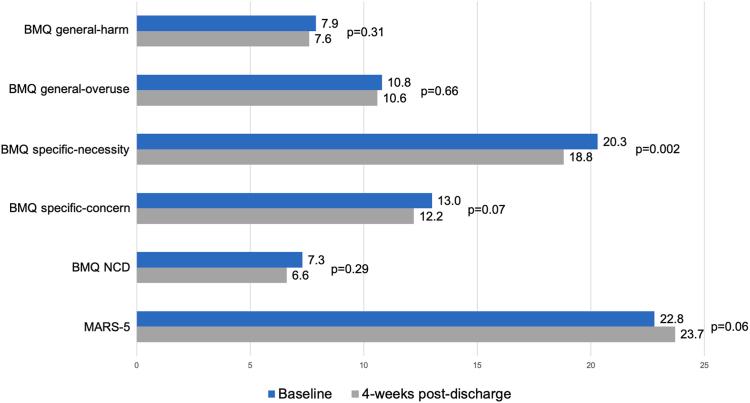
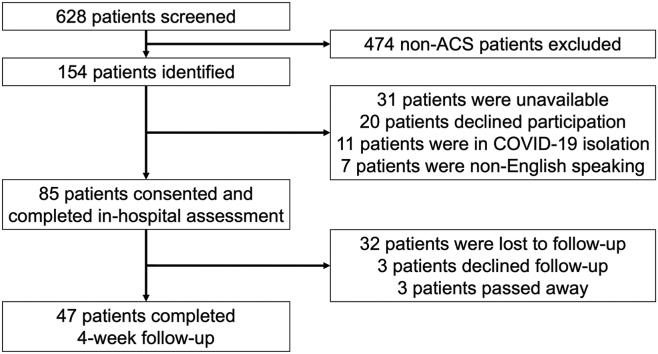
Forty-seven participants completed the 4-week follow-up. The mean age was 64 years, and 83% were male. Most presented with a non-ST-segment-elevation ACS. No difference occurred in BMQ-NCD (7.3 vs 6.6, = 0.29) or MARS-5 scores from discharge to 4 weeks (22.8 vs 23.7, = 0.06); however, the BMQ specific-necessity subscale score decreased significantly (20.3 vs 18.8, = 0.002). South Asian and Middle Eastern ethnic origins, compared to European, were associated with a higher BMQ-NCD. Part-time employment and male sex were associated with a lower BMQ-NCD.
CONCLUSIONS
Participants held favourable beliefs about their post-ACS medications, which were largely unchanged from hospitalization to 4 weeks postdischarge, except for beliefs about the necessity of taking their medications. Those of European descent, those with part-time employment, and males had the lowest BMQ-NCD. Self-reported adherence was high. Ongoing reassessment of patients' beliefs about the necessity of taking their post-ACS medications may be warranted to mitigate further decline in BMQ-NCD.
背景
急性冠状动脉综合征(ACS)后二级预防药物治疗的依从性普遍较差,且与心血管事件复发相关。患者对其药物的信念是故意不依从的有力预测因素。
方法
这项前瞻性观察性研究于2022年5月至12月在加拿大温哥华圣保罗医院,使用药物信念问卷(BMQ)评估成年患者对其ACS后药物的信念,并使用药物依从性报告量表(MARS-5)评估依从性。BMQ和MARS-5在住院期间和出院后4周进行。结局包括从住院到4周随访期间BMQ必要性-担忧差异(BMQ-NCD)的差异以及与BMQ-NCD相关的因素。
结果
47名参与者完成了4周随访。平均年龄为64岁,83%为男性。大多数表现为非ST段抬高型ACS。从出院到4周,BMQ-NCD(7.3对6.6,P = 0.29)或MARS-5评分无差异(22.8对23.7,P = 0.06);然而,BMQ特定必要性子量表评分显著降低(20.3对18.8,P = 0.002)。与欧洲裔相比,南亚和中东族裔与更高的BMQ-NCD相关。兼职工作和男性与较低的BMQ-NCD相关。
结论
参与者对其ACS后药物持有积极信念,从住院到出院后4周基本未变,但对服药必要性的信念除外。欧洲裔、兼职工作者和男性的BMQ-NCD最低。自我报告的依从性较高。可能有必要持续重新评估患者对服用ACS后药物必要性的信念,以减轻BMQ-NCD的进一步下降。
 Zotero 插件