Department of Clinical Sciences, Swedish University of Agricultural Sciences, Uppsala, Sweden.
Department of Anatomy, Physiology and Biochemistry, Swedish University of Agricultural Sciences, Uppsala, Sweden.
Microbiologyopen. 2023 Oct;12(5):e1383. doi: 10.1002/mbo3.1383.
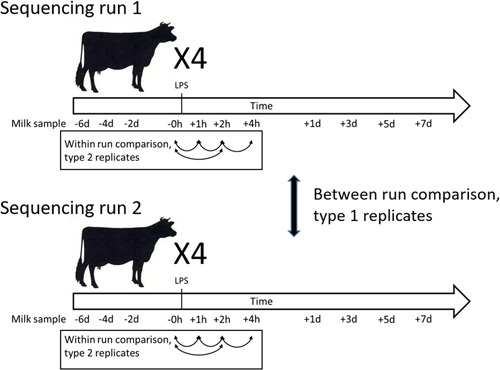
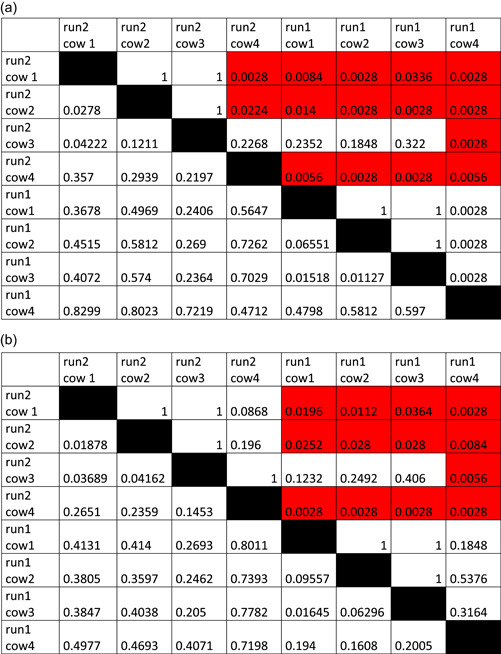
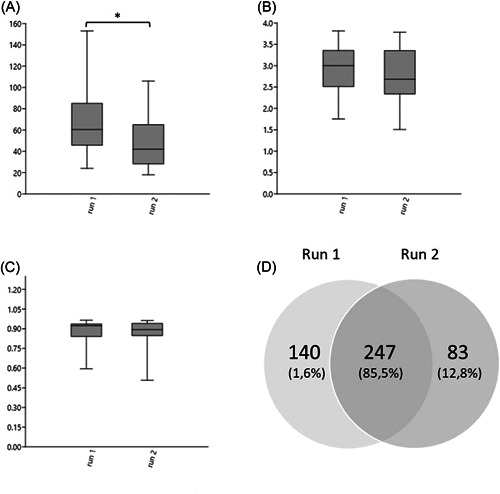
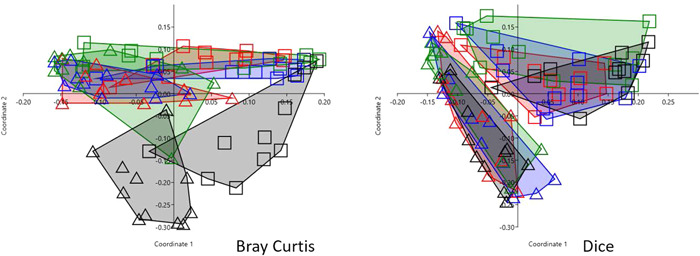
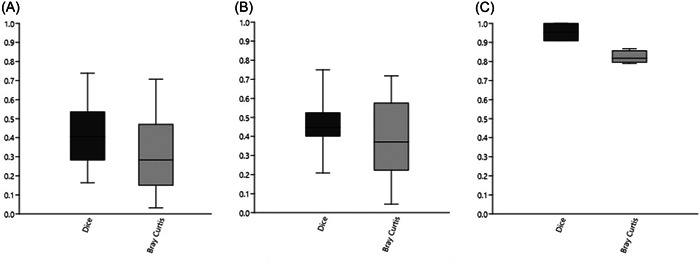
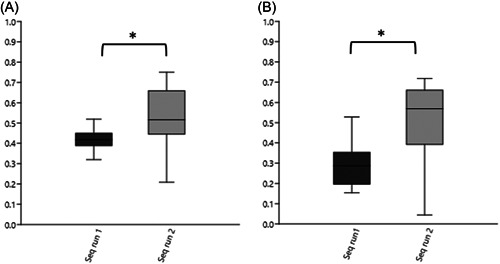
Receiving the same results from repeated analysis of the same sample is a basic principle in science. The inability to reproduce previously published results has led to discussions of a reproducibility crisis within science. For studies of microbial communities, the problem of reproducibility is more pronounced and has, in some fields, led to a discussion on the very existence of a constantly present microbiota. In this study, DNA from 44 bovine milk samples were extracted twice and the V3-V4 region of the 16S rRNA gene was sequenced in two separate runs. The FASTQ files from the two data sets were run through the same bioinformatics pipeline using the same settings and results from the two data sets were compared. Milk samples collected maximally 2 h apart were used as replicates and permitted comparisons to be made within the same run. Results show a significant difference in species richness between the two sequencing runs although Shannon and Simpson's diversity was the same. Multivariate analyses of all samples demonstrate that the sequencing run was a driver for variation. Direct comparison of similarity between samples and sequencing run showed an average similarity of 42%-45% depending on whether binary or abundance-based similarity indices were used. Within-run comparisons of milk samples collected maximally 2 h apart showed an average similarity of 39%-47% depending on the similarity index used and that similarity differed significantly between runs. We conclude that repeated DNA extraction and sequencing significantly can affect the results of a low microbial biomass microbiota study.
从同一样本的重复分析中获得相同的结果是科学的基本原则。无法重现先前发表的结果导致科学界讨论了可重复性危机。对于微生物群落的研究,可重复性问题更加明显,在某些领域,甚至对始终存在的微生物组的存在提出了质疑。在这项研究中,从 44 份牛牛奶样中提取了两次 DNA,并在两个单独的运行中对 16S rRNA 基因的 V3-V4 区域进行了测序。两个数据集的 FASTQ 文件通过相同的生物信息学管道运行,使用相同的设置,并比较了两个数据集的结果。将相隔最长 2 小时收集的牛奶样本作为重复样本,允许在同一运行中进行比较。结果表明,尽管 Shannon 和 Simpson 的多样性相同,但两个测序运行之间的物种丰富度存在显著差异。对所有样本的多元分析表明,测序运行是变异的驱动因素。直接比较样本和测序运行之间的相似性,根据使用的二进制或丰度相似性指数,平均相似性为 42%-45%。在相隔最长 2 小时收集的运行内牛奶样本比较中,根据使用的相似性指数,平均相似性为 39%-47%,并且相似性在运行之间存在显著差异。我们得出结论,重复的 DNA 提取和测序会显著影响低微生物生物量微生物群研究的结果。