Mohsen Farida, Al-Absi Hamada R H, Yousri Noha A, El Hajj Nady, Shah Zubair
College of Science and Engineering, Hamad Bin Khalifa University, Qatar Foundation, 34110, Doha, Qatar.
Genetic Medicine, Weill Cornell Medicine-Qatar, Qatar Foundation, Doha, Qatar.
NPJ Digit Med. 2023 Oct 25;6(1):197. doi: 10.1038/s41746-023-00933-5.
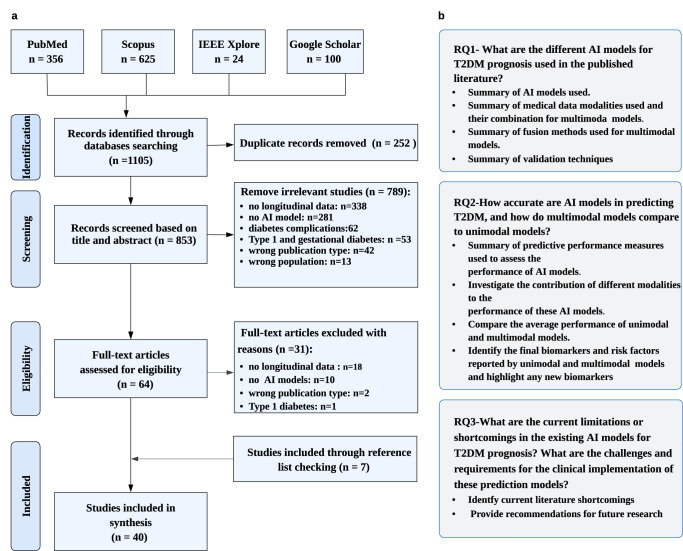
The increasing prevalence of type 2 diabetes mellitus (T2DM) and its associated health complications highlight the need to develop predictive models for early diagnosis and intervention. While many artificial intelligence (AI) models for T2DM risk prediction have emerged, a comprehensive review of their advancements and challenges is currently lacking. This scoping review maps out the existing literature on AI-based models for T2DM prediction, adhering to the PRISMA extension for Scoping Reviews guidelines. A systematic search of longitudinal studies was conducted across four databases, including PubMed, Scopus, IEEE-Xplore, and Google Scholar. Forty studies that met our inclusion criteria were reviewed. Classical machine learning (ML) models dominated these studies, with electronic health records (EHR) being the predominant data modality, followed by multi-omics, while medical imaging was the least utilized. Most studies employed unimodal AI models, with only ten adopting multimodal approaches. Both unimodal and multimodal models showed promising results, with the latter being superior. Almost all studies performed internal validation, but only five conducted external validation. Most studies utilized the area under the curve (AUC) for discrimination measures. Notably, only five studies provided insights into the calibration of their models. Half of the studies used interpretability methods to identify key risk predictors revealed by their models. Although a minority highlighted novel risk predictors, the majority reported commonly known ones. Our review provides valuable insights into the current state and limitations of AI-based models for T2DM prediction and highlights the challenges associated with their development and clinical integration.
2型糖尿病(T2DM)的患病率不断上升及其相关的健康并发症凸显了开发早期诊断和干预预测模型的必要性。虽然已经出现了许多用于T2DM风险预测的人工智能(AI)模型,但目前缺乏对其进展和挑战的全面综述。本范围综述按照PRISMA扩展的范围综述指南,梳理了关于基于AI的T2DM预测模型的现有文献。我们在四个数据库中进行了纵向研究的系统检索,包括PubMed、Scopus、IEEE-Xplore和谷歌学术。对40项符合我们纳入标准的研究进行了综述。经典机器学习(ML)模型在这些研究中占主导地位,电子健康记录(EHR)是主要的数据模式,其次是多组学,而医学成像的使用最少。大多数研究采用单峰AI模型,只有10项采用多峰方法。单峰和多峰模型都显示出有前景的结果,后者更优。几乎所有研究都进行了内部验证,但只有5项进行了外部验证。大多数研究使用曲线下面积(AUC)进行判别测量。值得注意的是,只有5项研究对其模型的校准提供了见解。一半的研究使用可解释性方法来识别其模型揭示的关键风险预测因素。虽然少数研究强调了新的风险预测因素,但大多数报告的是常见的因素。我们的综述为基于AI的T2DM预测模型的现状和局限性提供了有价值的见解,并突出了其开发和临床整合相关的挑战。