Department of Psychiatry, University of Minnesota, Minneapolis, Minnesota, United States of America.
Laureate Institute for Brain Research, Tulsa, Oklahoma, United States of America.
PLoS Comput Biol. 2023 Oct 26;19(10):e1011572. doi: 10.1371/journal.pcbi.1011572. eCollection 2023 Oct.
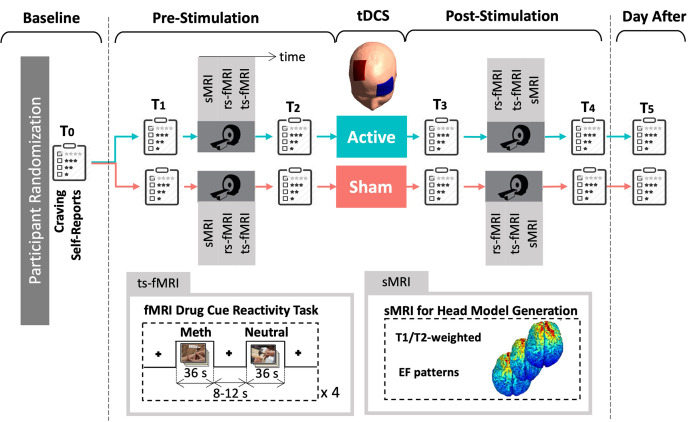
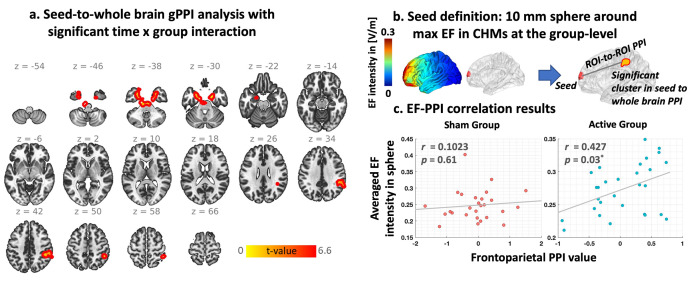
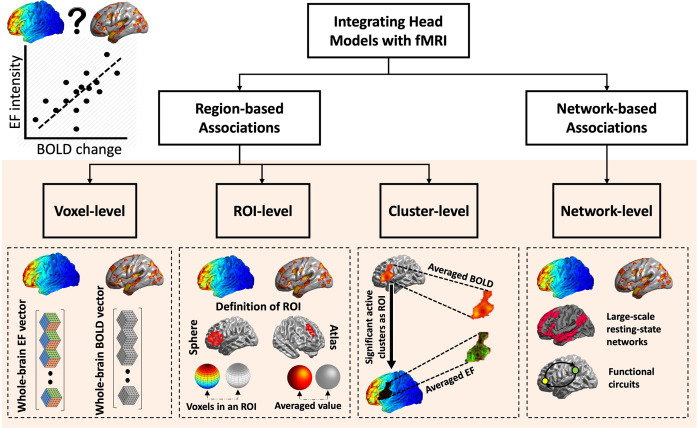
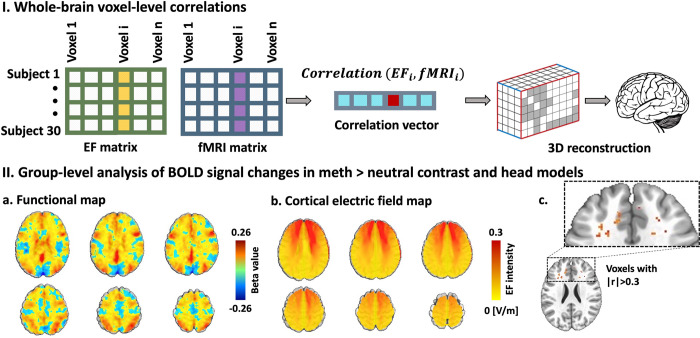
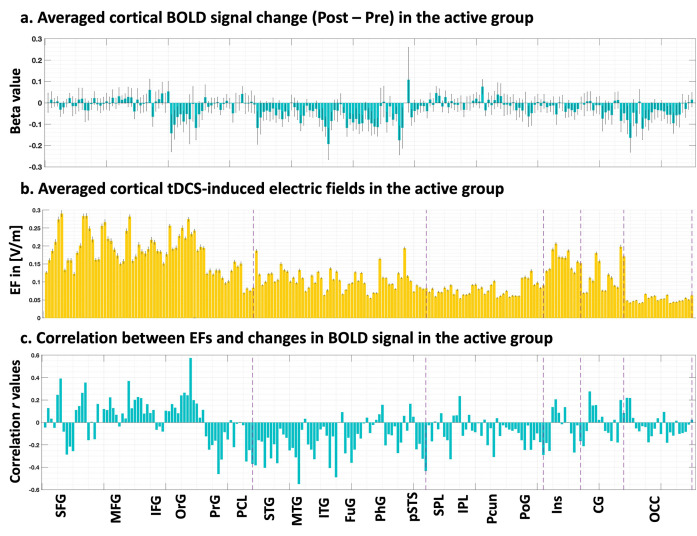
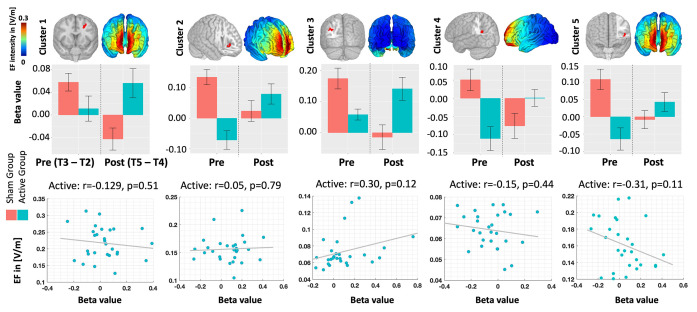
Understanding the dose-response relationship is crucial in studying the effects of brain stimulation techniques, such as transcranial direct current stimulation (tDCS). The dose-response relationship refers to the relationship between the received stimulation dose and the resulting response, which can be described as a function of the dose at various levels, including single/multiple neurons, clusters, regions, or networks. Here, we are focused on the received stimulation dose obtained from computational head models and brain responses which are quantified by functional magnetic resonance imaging (fMRI) data. In this randomized, triple-blind, sham-controlled clinical trial, we recruited sixty participants with methamphetamine use disorders (MUDs) as a sample clinical population who were randomly assigned to receive either sham or active tDCS. Structural and functional MRI data, including high-resolution T1 and T2-weighted MRI, resting-state functional MRI, and a methamphetamine cue-reactivity task fMRI, were acquired before and after tDCS. Individual head models were generated using the T1 and T2-weighted MRI data to simulate electric fields. In a linear approach, we investigated the associations between electric fields (received dose) and changes in brain function (response) at four different levels: voxel level, regional level (using atlas-based parcellation), cluster level (identifying active clusters), and network level (task-based functional connectivity). At the voxel level, regional level, and cluster level, no FDR-corrected significant correlation was observed between changes in functional activity and electric fields. However, at the network level, a significant positive correlation was found between frontoparietal connectivity and the electric field at the frontopolar stimulation site (r = 0.42, p corrected = 0.02; medium effect size). Our proposed pipeline offers a methodological framework for analyzing tDCS effects by exploring dose-response relationships at different levels, enabling a direct link between electric field variability and the neural response to tDCS. The results indicate that network-based analysis provides valuable insights into the dependency of tDCS neuromodulatory effects on the individual's regional current dose. Integration of dose-response relationships can inform dose optimization, customization, or the extraction of predictive/treatment-response biomarkers in future brain stimulation studies.
理解剂量-反应关系对于研究脑刺激技术的效果至关重要,例如经颅直流电刺激(tDCS)。剂量-反应关系是指所接受的刺激剂量与产生的反应之间的关系,可以描述为各种水平(包括单个/多个神经元、簇、区域或网络)的剂量函数。在这里,我们专注于从计算头模型获得的接受刺激剂量和通过功能磁共振成像(fMRI)数据量化的大脑反应。在这项随机、三盲、假刺激对照临床试验中,我们招募了 60 名患有甲基苯丙胺使用障碍(MUD)的参与者作为样本临床人群,他们被随机分配接受假刺激或真刺激 tDCS。在 tDCS 前后采集了结构和功能磁共振成像数据,包括高分辨率 T1 和 T2 加权 MRI、静息态功能 MRI 和甲基苯丙胺线索反应任务 fMRI。使用 T1 和 T2 加权 MRI 数据生成个体头部模型以模拟电场。在线性方法中,我们研究了电场(接受剂量)与四个不同水平的大脑功能变化(反应)之间的关联:体素水平、区域水平(使用基于图谱的分割)、簇水平(识别活跃簇)和网络水平(基于任务的功能连接)。在体素水平、区域水平和簇水平,功能活动的变化与电场之间没有经过 FDR 校正的显著相关性。然而,在网络水平上,额顶连接与额极刺激部位的电场之间存在显著的正相关(r = 0.42,p 校正= 0.02;中等效应大小)。我们提出的方法提供了一种分析 tDCS 效果的方法学框架,通过在不同水平探索剂量-反应关系,为电场变异性与 tDCS 对神经的反应之间建立直接联系。结果表明,基于网络的分析为 tDCS 神经调节效应对个体区域电流剂量的依赖性提供了有价值的见解。剂量-反应关系的整合可以为未来的脑刺激研究提供剂量优化、定制或提取预测/治疗反应生物标志物的信息。