Xie Yan, Shi Liuqing, Cheng Keke, Li Yang, Yu Shixiao
Department of Ecology, School of Life Sciences/State Key Laboratory of Biocontrol, Sun Yat-sen University, Guangzhou 510275, China.
J Fungi (Basel). 2023 Oct 23;9(10):1040. doi: 10.3390/jof9101040.
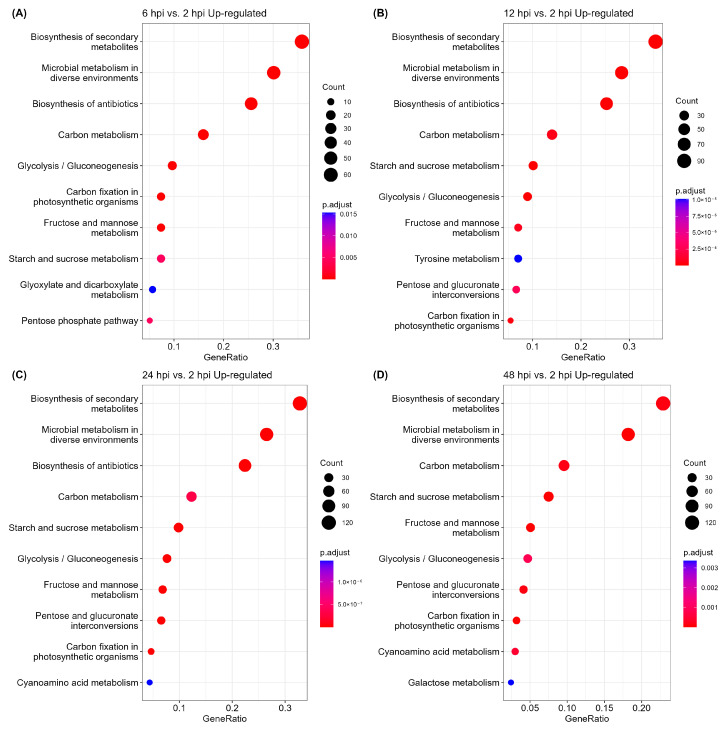
Coevolution between the pathogen and host plant drives pathogenic effector diversity. However, the molecular mechanism behind host-specific pathogenesis remains to be explored. Here, we present a 43 Mb whole-genome sequence of strain LS29, a host-specific pathogen of the common subtropical tree . We described its genome annotations and identified its effector candidates. By performing temporal transcriptome sequencing of on during early infection, we found that repressed other microbes in order to attack the tissue of the host by producing antibiotics earlier than 24 h post-inoculation (hpi). Simultaneously, a variety of effectors were secreted to recognize the host plant, but most of them showed a significantly opposing expression regulation trend after 24 hpi, indicating that 24 hpi represents a key time point between host recognition and specific infection. Furthermore, a comparison of isoenzymes showed that only a few effectors were identified as specific effectors, which were involved in hydrolyzing the compounds of the plant cell wall and releasing fatty acids during the early infection of . Our results determined host recognition timing and identified a specific catalog of effectors, which are crucial for revealing the molecular mechanism of host-specific pathogenesis.
病原体与寄主植物之间的协同进化推动了致病效应子的多样性。然而,寄主特异性致病背后的分子机制仍有待探索。在此,我们展示了菌株LS29的43 Mb全基因组序列,LS29是一种常见亚热带树木的寄主特异性病原体。我们描述了其基因组注释并鉴定了其效应子候选物。通过在早期感染期间对寄主进行时间转录组测序,我们发现该病原体通过在接种后24小时(hpi)之前产生抗生素来抑制其他微生物,从而攻击寄主组织。同时,分泌了多种效应子以识别寄主植物,但其中大多数在24 hpi后呈现出明显相反的表达调控趋势,这表明24 hpi代表了寄主识别与特异性感染之间的关键时间点。此外,同工酶比较表明,只有少数效应子被鉴定为特异性效应子,它们在病原体早期感染期间参与水解植物细胞壁的化合物并释放脂肪酸。我们的结果确定了寄主识别时间,并鉴定了一个特定的效应子目录,这对于揭示寄主特异性致病的分子机制至关重要。