Cognitive Neuropsychiatry Lab, Department of Psychiatry and Psychotherapy, Philipps Universität Marburg, Marburg, Germany.
Center for Mind, Brain, and Behavior (CMBB), University of Marburg and Justus Liebig University Giessen, Marburg, Germany.
Mol Psychiatry. 2024 Jan;29(1):74-84. doi: 10.1038/s41380-023-02302-w. Epub 2023 Oct 27.
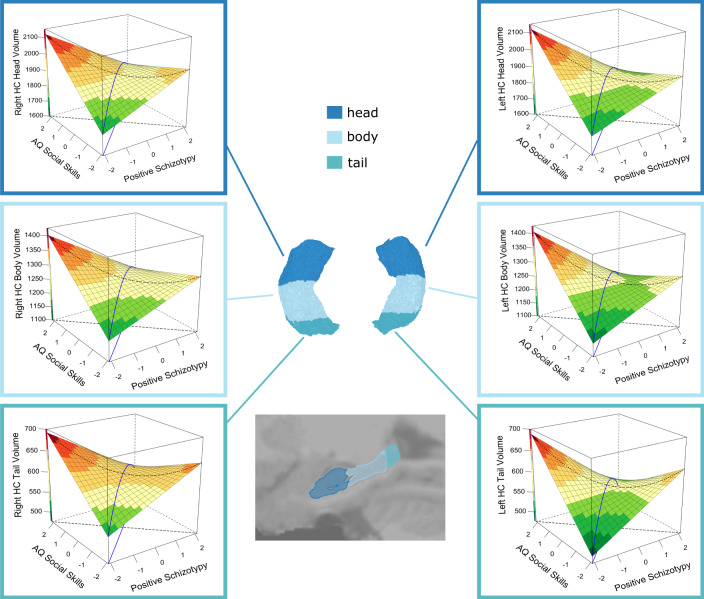
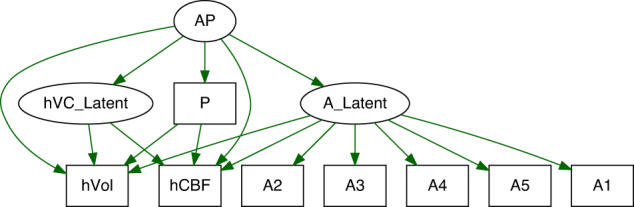
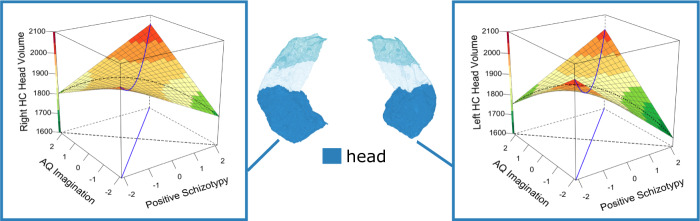
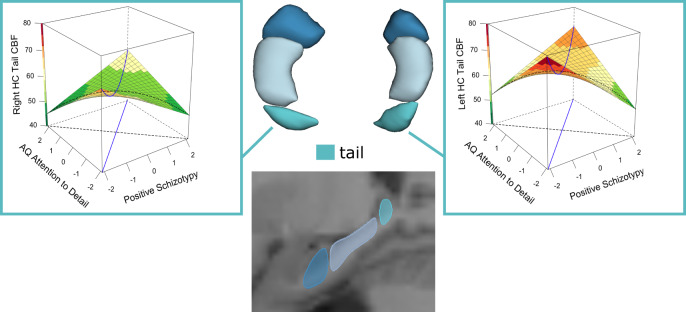
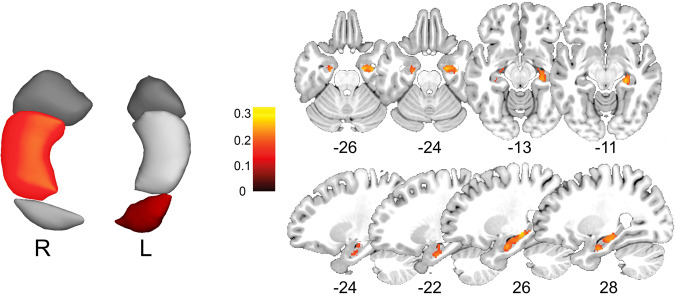
Psychiatric disorders show high co-morbidity, including co-morbid expressions of subclinical psychopathology across multiple disease spectra. Given the limitations of classical case-control designs in elucidating this overlap, new approaches are needed to identify biological underpinnings of spectra and their interaction. We assessed autistic-like traits (using the Autism Quotient, AQ) and schizotypy - as models of subclinical expressions of disease phenotypes and examined their association with volumes and regional cerebral blood flow (rCBF) of anterior, mid- and posterior hippocampus segments from structural MRI scans in 318 and arterial spin labelling (ASL) in 346 nonclinical subjects, which overlapped with the structural imaging sample (N = 298). We demonstrate significant interactive effects of positive schizotypy and AQ social skills as well as of positive schizotypy and AQ imagination on hippocampal subfield volume variation. Moreover, we show that AQ attention switching modulated hippocampal head rCBF, while positive schizotypy by AQ attention to detail interactions modulated hippocampal tail rCBF. In addition, we show significant correlation of hippocampal volume and rCBF in both region-of-interest and voxel-wise analyses, which were robust after removal of variance related to schizotypy and autistic traits. These findings provide empirical evidence for both the modulation of hippocampal subfield structure and function through subclinical traits, and in particular how only the interaction of phenotype facets leads to significant reductions or variations in these parameters. This makes a case for considering the synergistic impact of different (subclinical) disease spectra on transdiagnostic biological parameters in psychiatry.
精神障碍表现出较高的共病性,包括多种疾病谱中亚临床心理病理学的共病表现。鉴于经典病例对照设计在阐明这种重叠方面的局限性,需要新的方法来确定疾病表型谱及其相互作用的生物学基础。我们评估了自闭症样特征(使用自闭症评定量表,AQ)和精神分裂症倾向-作为疾病表型亚临床表达的模型,并检查了它们与 318 名非临床受试者的结构 MRI 扫描中前、中、后海马节段的体积和局部脑血流(rCBF)以及 346 名非临床受试者的动脉自旋标记(ASL)之间的关联,其中重叠结构成像样本(N=298)。我们证明了积极的精神分裂症倾向和 AQ 社交技能以及积极的精神分裂症倾向和 AQ 想象力对海马亚区体积变化的显著交互作用。此外,我们表明 AQ 注意力转换调节了海马头部 rCBF,而 AQ 对细节的注意力与积极的精神分裂症倾向相互作用调节了海马尾部 rCBF。此外,我们在感兴趣区和体素水平分析中都显示了海马体积和 rCBF 的显著相关性,这些相关性在去除与精神分裂症倾向和自闭症特征相关的方差后仍然稳健。这些发现为通过亚临床特征调节海马亚区结构和功能提供了经验证据,特别是只有表型特征的相互作用才会导致这些参数的显著减少或变化。这使得我们有理由考虑不同(亚临床)疾病谱对精神病学中转诊断生物参数的协同影响。