School of Psychology, Western Sydney University, Penrith, NSW, 2751, Australia.
School of Medical Science, Western Sydney University, Penrith, NSW, 2751, Australia.
Syst Rev. 2023 Oct 28;12(1):200. doi: 10.1186/s13643-023-02358-3.
Dementia is associated with cognitive and functional decline that significantly impacts quality of life. There is currently no cure for dementia, thus, it is important to manage dementia in the early stages and delay deterioration. Previous studies have documented a range of health benefits of Tai Chi in people with early-stage dementia, however, none have systematically integrated these effects with their underlying mechanisms. The aims of this study were to (1) identify the neurocognitive, psychological, and physical health benefits of Tai Chi oi people with early-stage dementia, and (2) explore the underlying mechanisms of these effects.
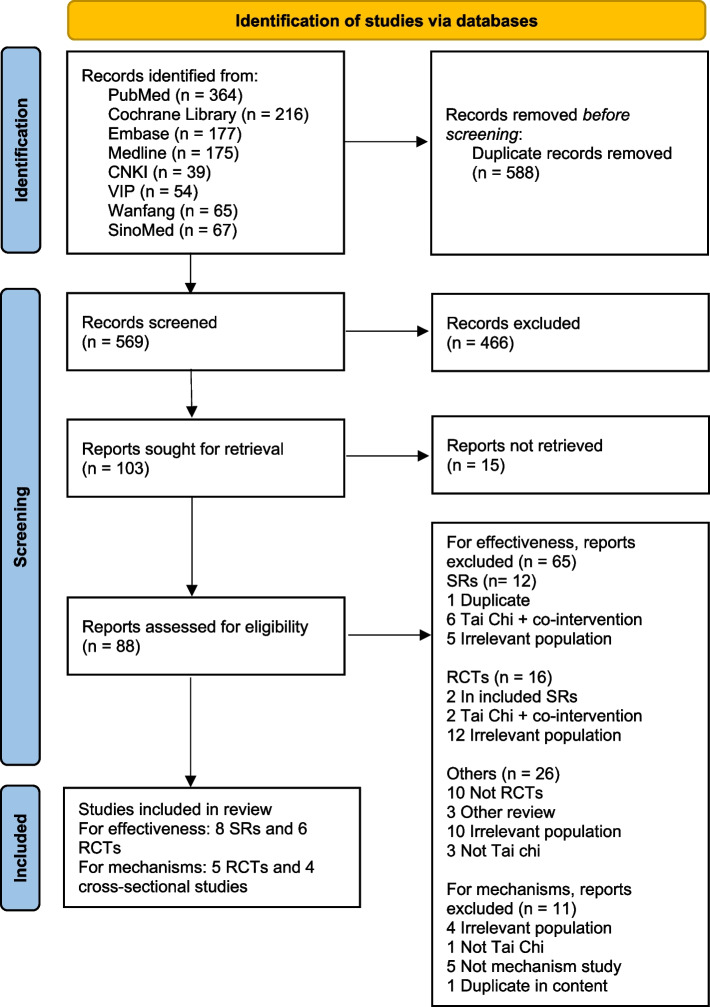
We searched systematic reviews (SRs) and randomised control trials (RCTs) on Tai Chi for adults aged 50 years and older with mild cognitive impairment (MCI) or early-stage dementia in MEDLINE, PubMed, Cochrane Library, EMBASE, and major Chinese databases. No language or publication restrictions were applied. Risk of bias was assessed.
Eight SRs with meta-analyses and 6 additional published RCTs revealed inconsistent findings of Tai Chi on improving global cognitive function, attention and executive function, memory and language, and perceptual-motor function. There was no significant between-group difference in depressive symptoms. The results from the RCTs showed that Tai Chi can reduce arthritis pain and slow the progress of dementia. No studies on MCI or early-stage dementia investigating the underlying mechanisms of Tai Chi were identified. Instead, nine mechanistic studies on healthy adults were included. These suggested that Tai Chi may improve memory and cognition via increased regional brain activity, large-scale network functional connectivity, and regional grey matter volume.
The effects of Tai Chi on neurocognitive outcomes in people with MCI and early-stage dementia are still inconclusive. Further high-quality clinical trials and mechanistic studies are needed to understand if and how Tai Chi may be applied as a successful intervention to delay deterioration and improve the quality of life in people with an increased risk of cognitive decline.
痴呆症与认知和功能下降有关,严重影响生活质量。目前尚无治疗痴呆症的方法,因此,重要的是在早期阶段管理痴呆症并延缓其恶化。先前的研究记录了太极拳对早期痴呆症患者的一系列健康益处,但没有一项研究系统地将这些益处与其潜在机制结合起来。本研究的目的是:(1)确定太极拳对早期痴呆症患者的神经认知、心理和身体健康益处;(2)探讨这些影响的潜在机制。
我们在 MEDLINE、PubMed、Cochrane 图书馆、EMBASE 和主要中文数据库中搜索了针对 50 岁及以上患有轻度认知障碍(MCI)或早期痴呆症的成年人的太极拳的系统评价(SRs)和随机对照试验(RCTs)。没有语言或出版限制。评估了偏倚风险。
八项具有荟萃分析的 SRs 和另外六项已发表的 RCTs 显示,太极拳对改善整体认知功能、注意力和执行功能、记忆和语言以及感知运动功能的影响不一致。抑郁症状无显著组间差异。RCT 的结果表明,太极拳可以减轻关节炎疼痛并减缓痴呆症的进展。没有发现针对 MCI 或早期痴呆症研究太极拳潜在机制的研究。相反,纳入了九项针对健康成年人的机制研究。这些研究表明,太极拳可能通过增加局部脑活动、大规模网络功能连接和局部灰质体积来改善记忆和认知。
太极拳对 MCI 和早期痴呆症患者神经认知结果的影响仍不确定。需要进一步进行高质量的临床试验和机制研究,以了解太极拳是否以及如何可以作为一种成功的干预措施,延缓认知能力下降并提高有认知能力下降风险的人的生活质量。