Donno Lucia, Galluzzo Alessandro, Pascale Valerio, Sansone Valerio, Frigo Carlo Albino
Movement Biomechanics and Motor Control Lab, Department of Electronics, Information and Bioengineering, Politecnico di Milano, I-20133 Milan, Italy.
IRCCS Istituto Ortopedico Galeazzi, I-20161 Milan, Italy.
Bioengineering (Basel). 2023 Oct 11;10(10):1178. doi: 10.3390/bioengineering10101178.
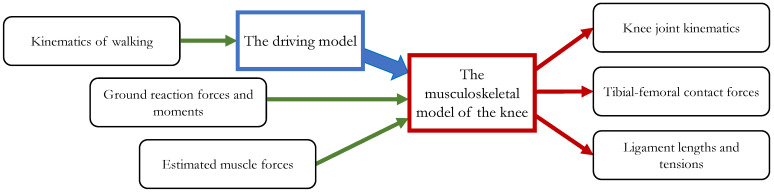
The understanding of the changes induced in the knee's kinematics by a Posterior Cruciate Ligament (PCL) injury is still rather incomplete. This computational study aimed to analyze how the internal loads are redistributed among the remaining ligaments when the PCL is lesioned at different degrees and to understand if there is a possibility to compensate for a PCL lesion by changing the hamstring's contraction in the second half of the swing phase. A musculoskeletal model of the knee joint was used for simulating a progressive PCL injury by gradually reducing the ligament stiffness. Then, in the model with a PCL residual stiffness at 15%, further dynamic simulations of walking were performed by progressively reducing the hamstring's force. In each condition, the ligaments tension, contact force and knee kinematics were analyzed. In the simulated PCL-injured knee, the Medial Collateral Ligament (MCL) became the main passive stabilizer of the tibial posterior translation, with synergistic recruitment of the Lateral Collateral Ligament. This resulted in an enhancement of the tibial-femoral contact force with respect to the intact knee. The reduction in the hamstring's force limited the tibial posterior sliding and, consequently, the tension of the ligaments compensating for PCL injury decreased, as did the tibiofemoral contact force. This study does not pretend to represent any specific population, since our musculoskeletal model represents a single subject. However, the implemented model could allow the non-invasive estimation of load redistribution in cases of PCL injury. Understanding the changes in the knee joint biomechanics could help clinicians to restore patients' joint stability and prevent joint degeneration.
对后交叉韧带(PCL)损伤引起的膝关节运动学变化的理解仍然相当不完整。这项计算研究旨在分析当PCL在不同程度受损时,内部负荷如何在其余韧带之间重新分配,并了解在摆动期后半段通过改变腘绳肌收缩是否有可能补偿PCL损伤。使用膝关节的肌肉骨骼模型通过逐渐降低韧带刚度来模拟渐进性PCL损伤。然后,在PCL残余刚度为15%的模型中,通过逐渐降低腘绳肌的力量进一步进行步行动态模拟。在每种情况下,分析韧带张力、接触力和膝关节运动学。在模拟的PCL损伤膝关节中,内侧副韧带(MCL)成为胫骨后移的主要被动稳定器,外侧副韧带协同募集。这导致与完整膝关节相比,胫股接触力增强。腘绳肌力量的降低限制了胫骨后滑,因此,补偿PCL损伤的韧带张力降低,胫股接触力也降低。本研究并不代表任何特定人群,因为我们的肌肉骨骼模型代表的是单个个体。然而,所实施的模型可以在PCL损伤情况下进行无创负荷再分配估计。了解膝关节生物力学的变化有助于临床医生恢复患者的关节稳定性并预防关节退变。