Whulanza Yudan, Nathani Rithwik Chandur, Adimillenva Klaugusta, Irwansyah Ridho, Wahyu Nurhayati Retno, Utomo Muhammad Satrio, Abdullah Abdul Halim
Department of Mechanical Engineering, Faculty of Engineering, Universitas Indonesia, Depok 16424, Indonesia.
Research Center for Biomedical Engineering, Faculty of Engineering, Universitas Indonesia, Depok 16424, Indonesia.
Micromachines (Basel). 2023 Sep 26;14(10):1828. doi: 10.3390/mi14101828.
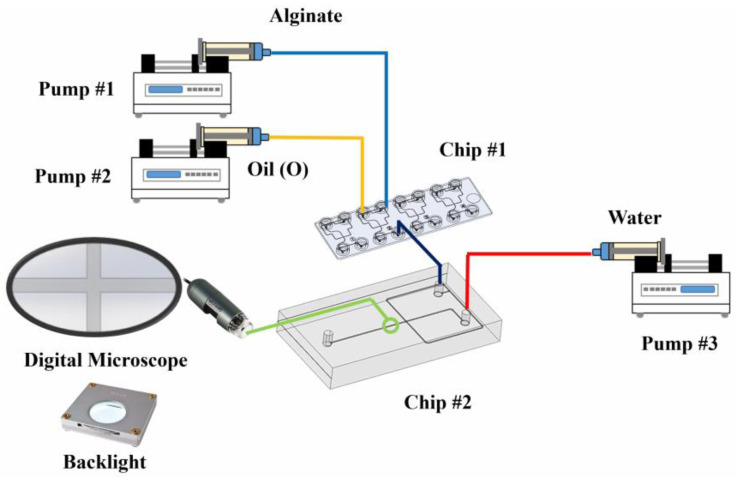
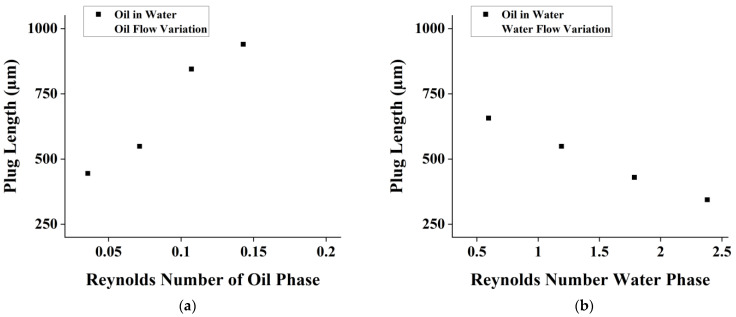
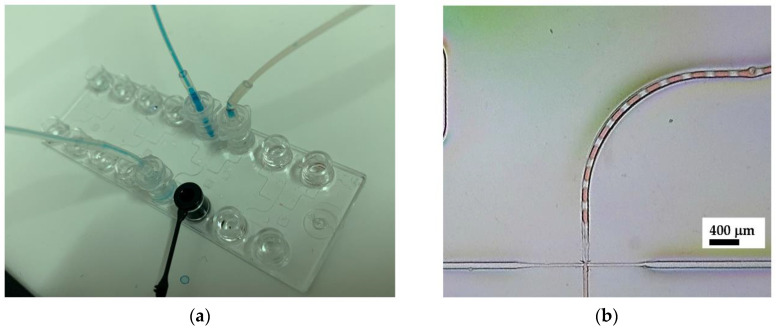
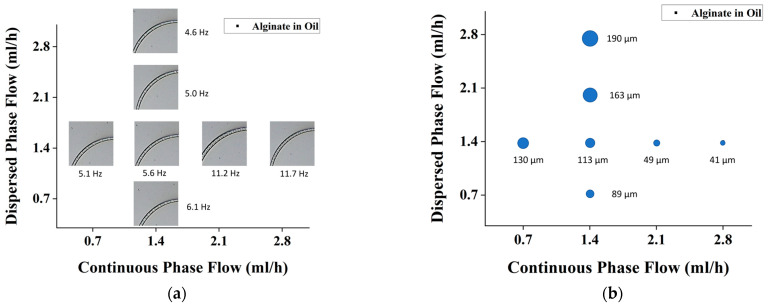
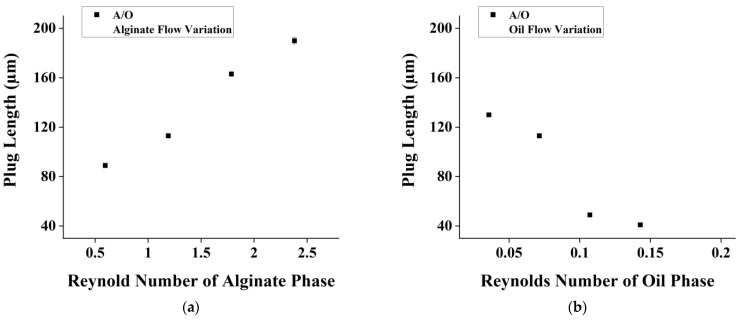
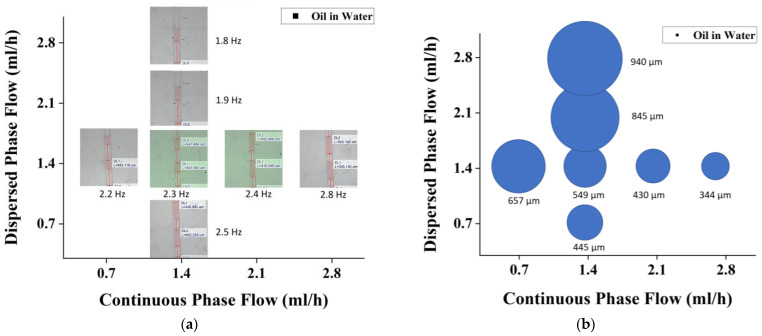
The encapsulation of stem cells into alginate microspheres is an important aspect of tissue engineering or bioprinting which ensures cell growth and development. We previously demonstrated the encapsulation of stem cells using the hanging drop method. However, this conventional process takes a relatively long time and only produces a small-volume droplet. Here, an experimental approach for alginate emulsification in multistage microfluidics is reported. By using the microfluidic method, the emulsification of alginate in oil can be manipulated by tuning the flow rate for both phases. Two-step droplet emulsification is conducted in a series of polycarbonate and polydimethylsiloxane microfluidic chips. Multistage emulsification of alginate for stem cell encapsulation has been successfully reported in this study under certain flow rates. Fundamental non-dimensional numbers such as Reynolds and capillary are used to evaluate the effect of flow rate on the emulsification process. Reynolds numbers of around 0.5-2.5 for alginate/water and 0.05-0.2 for oil phases were generated in the current study. The capillary number had a maximum value of 0.018 to ensure the formation of plug flow. By using the multistage emulsification system, the flow rates of each process can be tuned independently, offering a wider range of droplet sizes that can be produced. A final droplet size of 500-1000 µm can be produced using flow rates of 0.1-0.5 mL/h and 0.7-2.4 mL/h for the first stage and second stage, respectively.
将干细胞封装到藻酸盐微球中是组织工程或生物打印的一个重要方面,可确保细胞生长和发育。我们之前展示了使用悬滴法封装干细胞。然而,这种传统方法耗时较长,且只能产生小体积的液滴。在此,报道了一种在多级微流控中进行藻酸盐乳化的实验方法。通过使用微流控方法,可通过调节两相的流速来控制藻酸盐在油中的乳化。在一系列聚碳酸酯和聚二甲基硅氧烷微流控芯片中进行两步液滴乳化。本研究已成功报道在特定流速下对藻酸盐进行多级乳化以封装干细胞。使用诸如雷诺数和毛细管数等基本无量纲数来评估流速对乳化过程的影响。在本研究中,藻酸盐/水相的雷诺数约为0.5 - 2.5,油相的雷诺数为0.05 - 0.2。毛细管数的最大值为0.018以确保形成塞流。通过使用多级乳化系统,每个过程的流速可独立调节,从而能产生更广泛的液滴尺寸范围。分别使用0.1 - 0.5 mL/h和0.7 - 2.4 mL/h的流速作为第一阶段和第二阶段,可产生500 - 1000 µm的最终液滴尺寸。