Selvamani Shanmugaprakasham, Kapoor Nidhi, Ajmera Arun, El Enshasy Hesham Ali, Dailin Daniel Joe, Sukmawati Dalia, Abomoelak Mona, Nurjayadi Muktiningsih, Abomoelak Bassam
Institute of Bioproduct Development, Universiti Teknologi Malaysia (UTM), Skudai, Johor Bahru 80000, Malaysia.
Nutrition Technologies SDN. BHD., No 1 & No 3, Jalan SiLC 2, Kawasan Perindustrian SiLC, Iskandar Puteri, Johor Bahru 80150, Malaysia.
Microorganisms. 2023 Sep 29;11(10):2453. doi: 10.3390/microorganisms11102453.
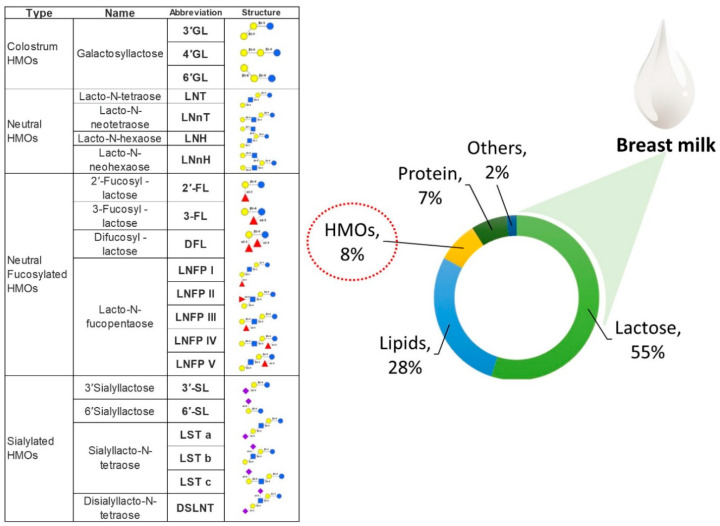
At present, prebiotics, like probiotics, are receiving more attention as a promising tool for health maintenance. Many studies have recognized the role of prebiotics in preventing and treating various illnesses including metabolic disorders, gastrointestinal disorders, and allergies. Naturally, prebiotics are introduced to the human body in the first few hours of life as the mother breastfeeds the newborn. Prebiotic human milk oligosaccharides (HMOs) are the third largest constituent of human breastmilk. Studies have proven that HMOs modulate an infant's microbial composition and assist in the development of the immune system. Due to some health conditions of the mother or beyond the recommended age for breastfeeding, infants are fed with formula. Few types of prebiotics have been incorporated into formula to yield similar beneficial impacts similar to breastfeeding. Synthetic HMOs have successfully mimicked the bifidogenic effects of breastmilk. However, studies on the effectiveness and safety of consumption of these synthetic HMOs are highly needed before massive commercial production. With the introduction of solid foods after breastfeeding or formula feeding, children are exposed to a range of prebiotics that contribute to further shaping and maturing their gut microbiomes and gastrointestinal function. Therefore, this review evaluates the functional role of prebiotic interventions in improving microbial compositions, allergies, and functional gastrointestinal disorders in children.
目前,益生元与益生菌一样,作为一种有前景的健康维持工具正受到越来越多的关注。许多研究已经认识到益生元在预防和治疗各种疾病中的作用,包括代谢紊乱、胃肠道疾病和过敏。自然地,在母亲母乳喂养新生儿的最初几个小时内,益生元就被引入人体。益生元人乳寡糖(HMOs)是母乳的第三大成分。研究证明,HMOs可调节婴儿的微生物组成,并有助于免疫系统的发育。由于母亲的某些健康状况或超出母乳喂养的推荐年龄,婴儿会食用配方奶粉。很少有几种益生元被添加到配方奶粉中以产生与母乳喂养类似的有益影响。合成HMOs已成功模拟了母乳的双歧杆菌生成作用。然而,在大规模商业生产之前,迫切需要对这些合成HMOs食用的有效性和安全性进行研究。在母乳喂养或配方奶粉喂养后引入固体食物时,儿童会接触到一系列益生元,这些益生元有助于进一步塑造和成熟他们的肠道微生物群和胃肠道功能。因此,本综述评估了益生元干预措施在改善儿童微生物组成、过敏和功能性胃肠道疾病方面的功能作用。