
用于犬内脏利什曼病的传播阻断疫苗:新进展与新挑战
Transmission-Blocking Vaccines for Canine Visceral Leishmaniasis: New Progress and Yet New Challenges.
作者信息
Leite Jaqueline Costa, Gonçalves Ana Alice Maia, de Oliveira Diana Souza, Resende Lucilene Aparecida, Boas Diego Fernandes Vilas, Ribeiro Helen Silva, Pereira Diogo Fonseca Soares, da Silva Augusto Ventura, Mariano Reysla Maria da Silveira, Reis Pedro Campos Carvalhaes, Nakasone Eiji Nakasone, França-Silva João Carlos, Galdino Alexsandro Sobreira, Paes Paulo Ricardo de Oliveira, Melo Marília Martins, Dias Edelberto Santos, Chávez-Fumagalli Miguel Angel, da Silveira-Lemos Denise, Dutra Walderez Ornelas, Giunchetti Rodolfo Cordeiro
机构信息
Laboratory of Biology of Cell Interactions, Department of Morphology, Federal University of Minas Gerais (UFMG), Belo Horizonte 31270-901, MG, Brazil.
Microorganism Biotechnology Laboratory, Federal University of São João Del-Rei (UFSJ), Midwest Campus, Divinópolis 35501-296, MG, Brazil.
出版信息
Vaccines (Basel). 2023 Oct 5;11(10):1565. doi: 10.3390/vaccines11101565.
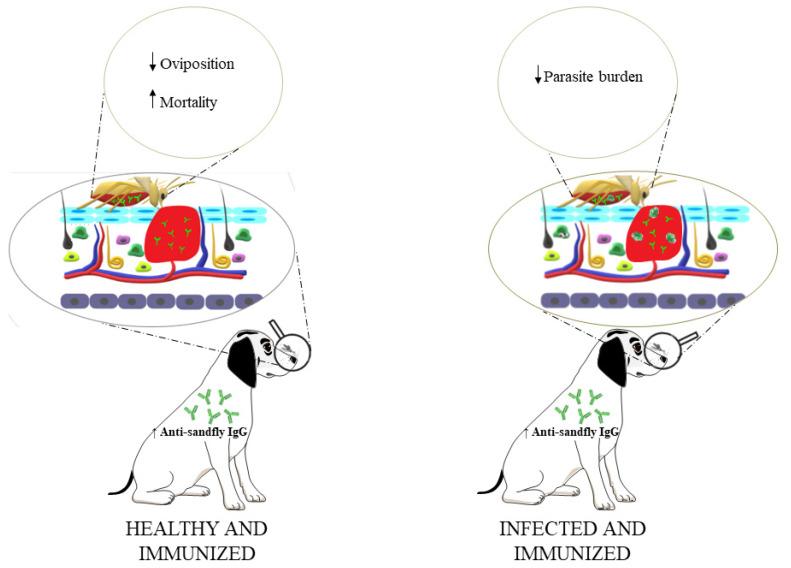
Dogs with visceral leishmaniasis play a key role in the transmission cycle of to humans in the urban environment. There is a consensus regarding the importance of developing a vaccine to control this disease. Despite many efforts to develop a protective vaccine against CVL, the ones currently available, Leish-tec and LetiFend, have limited effectiveness. This is due, in part, to the complexity of the immune response of the naturally infected dogs against the parasite and the complexity of the parasite transmission cycle. Thus, strategies, such as the development of a transmission-blocking vaccines (TBVs) already being applied to other vector-borne diseases like malaria and dengue, would be an attractive alternative to control leishmaniasis. TBVs induce the production of antibodies in the vertebrate host, which can inhibit parasite development in the vector and/or interfere with aspects of vector biology, leading to an interruption of parasite transmission. To date, there are few TBV studies for CVL and other leishmaniasis forms. However, the few studies that exist show promising results, thus justifying the further development of this approach.
患有内脏利什曼病的犬类在城市环境中对该疾病向人类的传播循环中起着关键作用。关于开发一种疫苗来控制这种疾病的重要性已达成共识。尽管为开发一种针对犬内脏利什曼病(CVL)的保护性疫苗付出了诸多努力,但目前可用的疫苗Leish-tec和LetiFend效果有限。部分原因在于自然感染犬类针对寄生虫的免疫反应的复杂性以及寄生虫传播循环的复杂性。因此,诸如开发已应用于疟疾和登革热等其他媒介传播疾病的传播阻断疫苗(TBV)的策略,将是控制利什曼病的一种有吸引力的替代方法。传播阻断疫苗在脊椎动物宿主中诱导抗体产生,这可以抑制寄生虫在媒介中的发育和/或干扰媒介生物学的某些方面,从而导致寄生虫传播中断。迄今为止,针对犬内脏利什曼病和其他利什曼病形式的传播阻断疫苗研究很少。然而,现有的少数研究显示出了有希望的结果,因此证明了进一步开发这种方法的合理性。
 Zotero 插件