CNNP Lab (www.cnnp-lab.com), Interdisciplinary Computing and Complex BioSystems Group, School of Computing, Newcastle University, Newcastle upon Tyne, United Kingdom.
Translational and Clinical Research Institute, Faculty of Medical Sciences, Newcastle University, Newcastle upon Tyne, United Kingdom.
EBioMedicine. 2023 Nov;97:104848. doi: 10.1016/j.ebiom.2023.104848. Epub 2023 Oct 27.
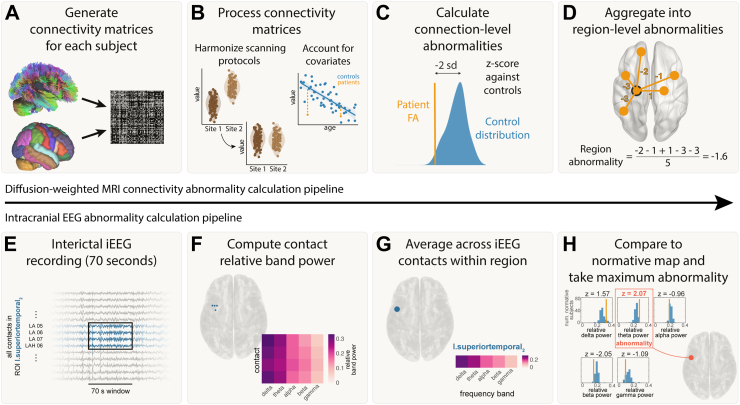
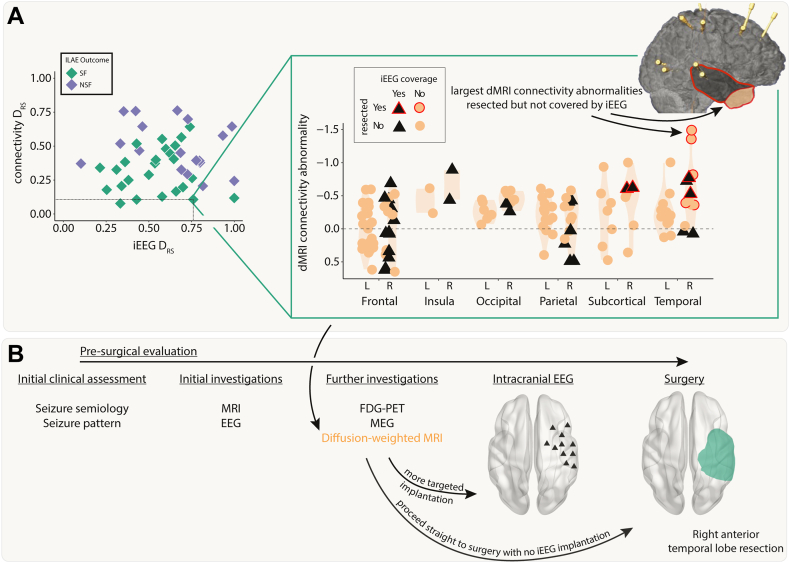
When investigating suitability for epilepsy surgery, people with drug-refractory focal epilepsy may have intracranial EEG (iEEG) electrodes implanted to localise seizure onset. Diffusion-weighted magnetic resonance imaging (dMRI) may be acquired to identify key white matter tracts for surgical avoidance. Here, we investigate whether structural connectivity abnormalities, inferred from dMRI, may be used in conjunction with functional iEEG abnormalities to aid localisation of the epileptogenic zone (EZ), improving surgical outcomes in epilepsy.
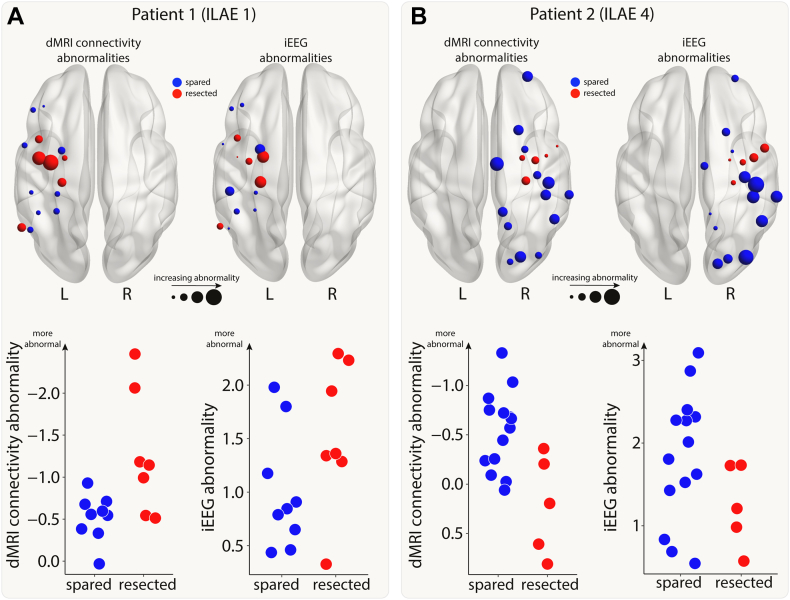
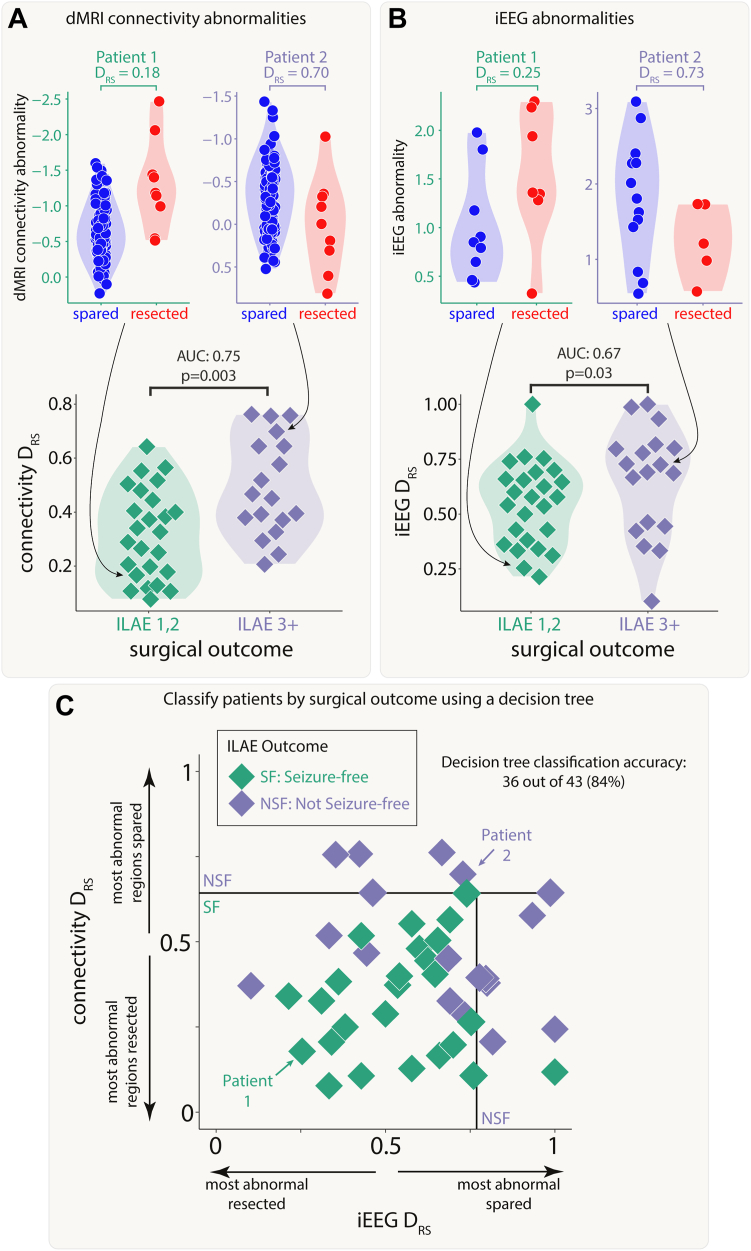
We retrospectively investigated data from 43 patients (42% female) with epilepsy who had surgery following iEEG. Twenty-five patients (58%) were free from disabling seizures (ILAE 1 or 2) at one year. Interictal iEEG functional, and dMRI structural connectivity abnormalities were quantified by comparison to a normative map and healthy controls. We explored whether the resection of maximal abnormalities related to improved surgical outcomes, in both modalities individually and concurrently. Additionally, we suggest how connectivity abnormalities may inform the placement of iEEG electrodes pre-surgically using a patient case study.
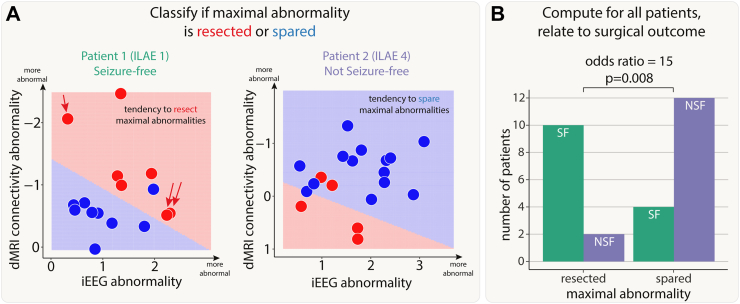
Seizure freedom was 15 times more likely in patients with resection of maximal connectivity and iEEG abnormalities (p = 0.008). Both modalities separately distinguished patient surgical outcome groups and when used simultaneously, a decision tree correctly separated 36 of 43 (84%) patients.
Our results suggest that both connectivity and iEEG abnormalities may localise epileptogenic tissue, and that these two modalities may provide complementary information in pre-surgical evaluations.
This research was funded by UKRI, CDT in Cloud Computing for Big Data, NIH, MRC, Wellcome Trust and Epilepsy Research UK.
在调查癫痫手术的适宜性时,药物难治性局灶性癫痫患者可能需要植入颅内脑电图 (iEEG) 电极以定位发作起始部位。可能会获取弥散加权磁共振成像 (dMRI) 以识别手术回避的关键白质束。在这里,我们研究了结构连通性异常是否可以与功能 iEEG 异常结合使用,以帮助定位致痫区 (EZ),从而改善癫痫手术的结果。
我们回顾性研究了 43 名接受 iEEG 后手术的癫痫患者的数据(42%为女性)。25 名患者(58%)在一年时无致残性发作(ILAE 1 或 2)。通过与正常图谱和健康对照比较,量化了 iEEG 功能和 dMRI 结构连通性异常。我们探讨了在两种模态下,异常切除最大值是否与改善手术结果相关,包括单独和同时使用。此外,我们还通过一个患者病例研究,提出了连通性异常如何在术前指导 iEEG 电极的放置。
与切除最大连通性和 iEEG 异常的患者相比,癫痫发作自由的可能性高 15 倍(p=0.008)。两种模态都可以区分患者的手术结果组,当同时使用时,决策树可以正确区分 43 名患者中的 36 名(84%)。
我们的结果表明,连通性和 iEEG 异常都可以定位致痫组织,这两种模态在术前评估中可能提供互补信息。
这项研究得到了英国研究与创新署、云计算大数据 CDT、美国国立卫生研究院、英国医学研究理事会、惠康信托基金会和英国癫痫研究协会的资助。