Department of Neurology, Charité-Universitätsmedizin Berlin, Berlin, Germany.
Universitätsmedizin Greifswald, Greifswald, Germany.
J Headache Pain. 2023 Oct 30;24(1):144. doi: 10.1186/s10194-023-01682-2.
Monoclonal antibodies (mAbs) targeting the Calcitonin Gene-Related Peptide (CGRP) pathway are safe and effective treatments for migraine prevention. However, the high cost of these novel therapies has led to reimbursement policies requiring patients to try multiple traditional preventives before access. In Germany, a recent change in insurance policy significantly expanded coverage for the CGRP receptor mAb erenumab, enabling migraine patients who failed just one prior prophylactic medication to receive this mAb. Here, we compare the clinical response to treatment with erenumab in migraine patients treated using the old and new coverage policy.
In this retrospective cohort study, we included CGRP-mAb naïve patients with episodic or chronic migraine, who started erenumab at our headache center according to either the old or the new insurance policy and received at least 3 consecutive injections. Headache diaries and electronic documentation were used to evaluate reductions in monthly headache and migraine days (MHD and MMD) and ≥ 50% and ≥ 30% responder rates at month 3 (weeks 9-12) of treatment.
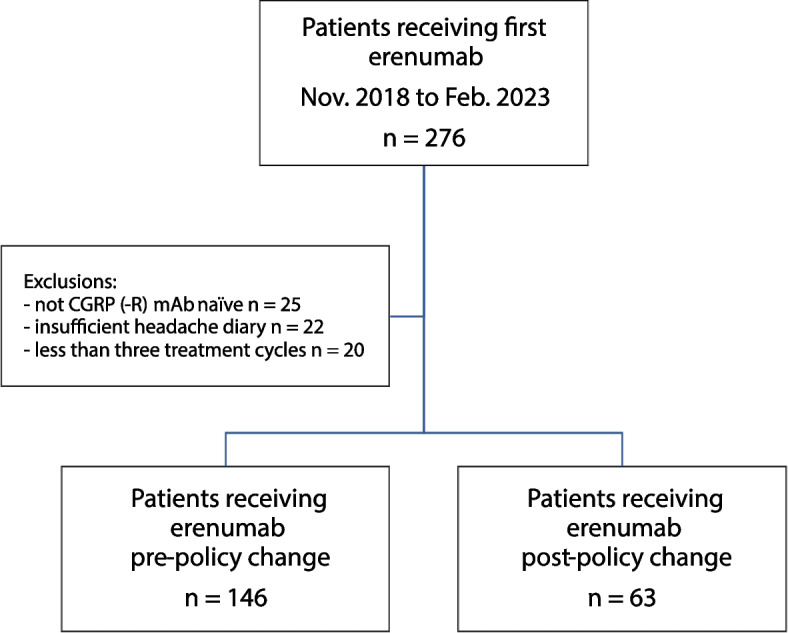
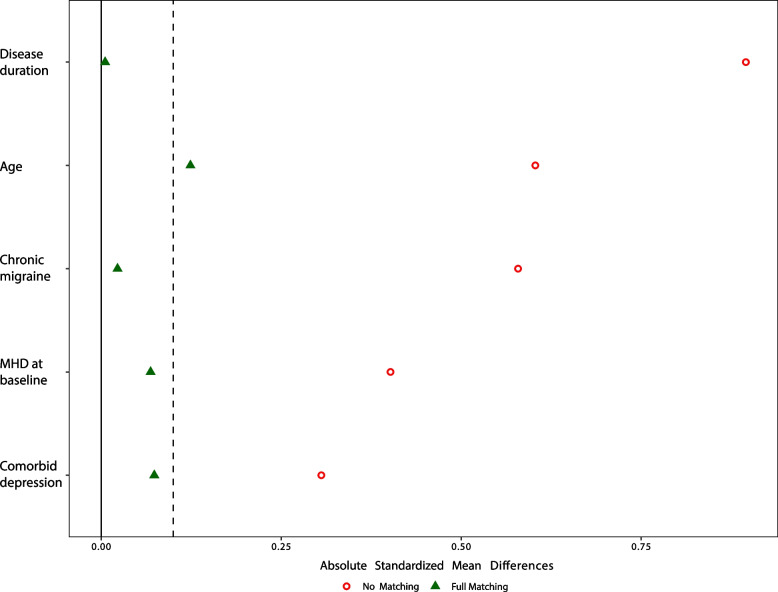
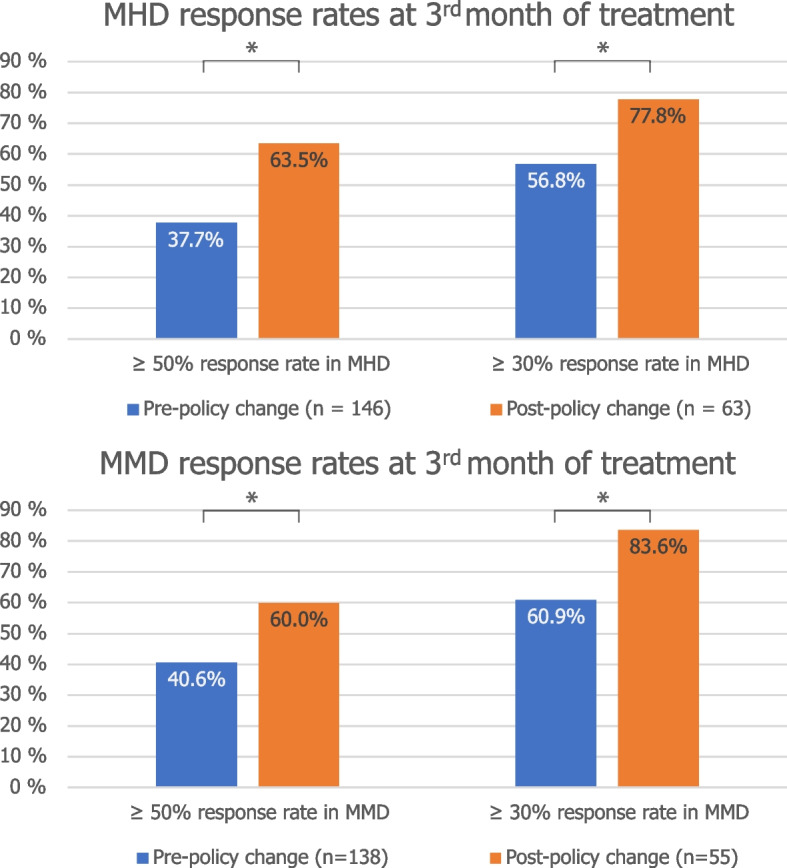
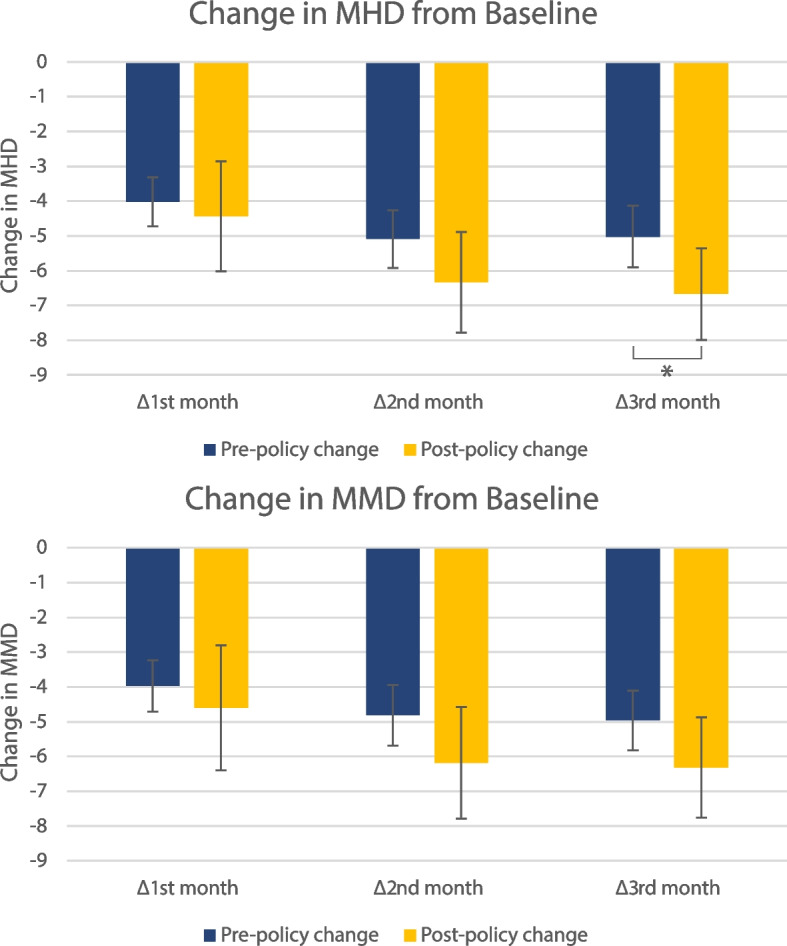
We included 146 patients who received erenumab according to the old policy and 63 patients that were treated using the new policy. At weeks 9-12 of treatment, 37.7% of the old policy group had a 50% or greater reduction in MHD, compared to 63.5% of the new policy group (P < 0.001). Mean reduction in MHD was 5.02 days (SD = 5.46) and 6.67 days (SD = 5.32, P = 0.045) in the old and new policy cohort, respectively. After propensity score matching, the marginal effect of the new policy on treatment outcome was 2.29 days (standard error, SE: 0.715, P = 0.001) more reduction in MHD, and 30.1% (SE: 10.6%, P = 0.005) increase in ≥ 50% response rate for MHD.
Starting erenumab earlier in the course of migraine progression in a real-world setting may lead to a better response than starting after multiple failed prophylactic attempts. Continually gathering real-world evidence may help policymakers in deciding how readily to cover CGRP-targeted therapies in migraine prevention.
靶向降钙素基因相关肽(CGRP)通路的单克隆抗体(mAbs)是预防偏头痛的安全有效治疗方法。然而,这些新型疗法的高成本导致报销政策要求患者在获得治疗之前尝试多种传统预防药物。在德国,最近的保险政策变化显著扩大了 CGRP 受体 mAb 依那西普的覆盖范围,使仅使用一种预防性药物治疗失败的偏头痛患者能够获得这种 mAb。在这里,我们比较了使用新旧覆盖政策治疗偏头痛患者时对依那西普治疗的临床反应。
在这项回顾性队列研究中,我们纳入了在我们头痛中心开始使用依那西普治疗的、无 CGRP-mAb 治疗史的偏头痛患者,这些患者的偏头痛为发作性或慢性,并且根据旧的或新的保险政策进行治疗,且至少接受了 3 次连续注射。使用头痛日记和电子病历来评估治疗第 3 个月(第 9-12 周)时每月头痛和偏头痛天数(MHD 和 MMD)的减少情况,以及≥50%和≥30%应答率。
我们纳入了 146 名根据旧政策接受依那西普治疗的患者和 63 名根据新政策接受治疗的患者。在治疗的第 9-12 周,旧政策组中有 37.7%的患者 MHD 减少≥50%,而新政策组中有 63.5%(P<0.001)。旧政策组 MHD 的平均减少量为 5.02 天(SD=5.46),新政策组为 6.67 天(SD=5.32,P=0.045)。在倾向评分匹配后,新政策对治疗结果的边际效应为 MHD 减少 2.29 天(标准误差,SE:0.715,P=0.001),MHD 的≥50%应答率增加 30.1%(SE:10.6%,P=0.005)。
在现实环境中,在偏头痛进展的早期阶段开始依那西普治疗可能比在多次预防性治疗失败后开始治疗产生更好的反应。不断收集真实世界的证据可能有助于决策者决定如何轻易地在偏头痛预防中覆盖 CGRP 靶向治疗。