Teucher Markus, Qi Mian, Cati Ninive, Hintz Henrik, Godt Adelheid, Bordignon Enrica
Faculty of Chemistry and Biochemistry, Ruhr University Bochum, Universitätsstraße 150, 44801 Bochum, Germany.
Faculty of Chemistry and Center for Molecular Materials (CM2), Bielefeld University, Universitätsstraße 25, 33615 Bielefeld, Germany.
Magn Reson (Gott). 2020 Dec 9;1(2):285-299. doi: 10.5194/mr-1-285-2020. eCollection 2020.
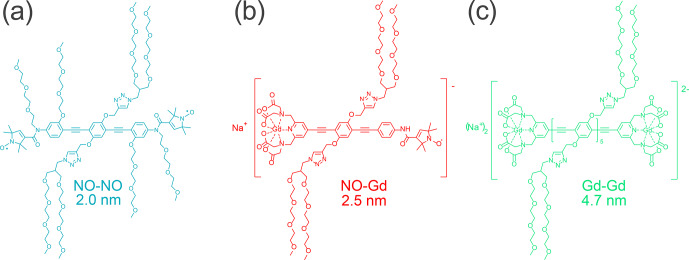
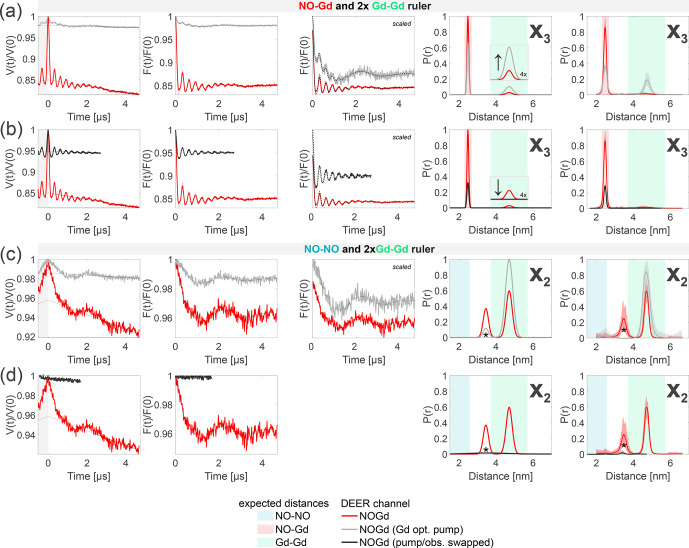
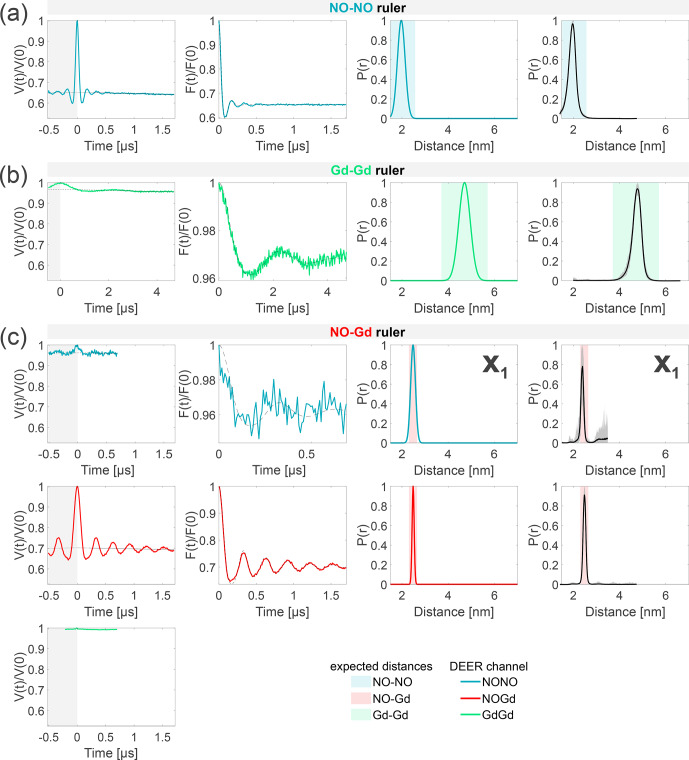
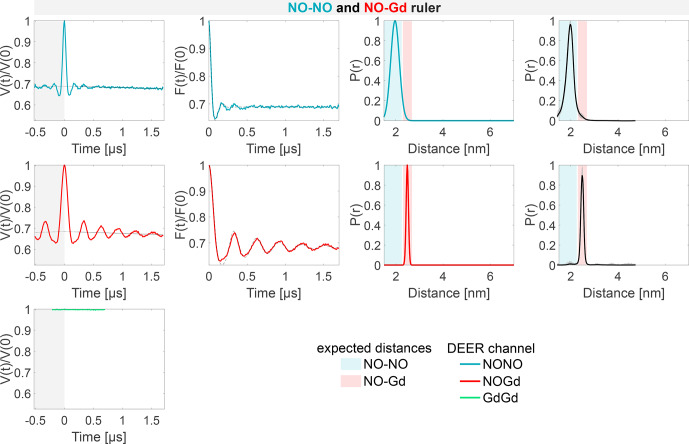
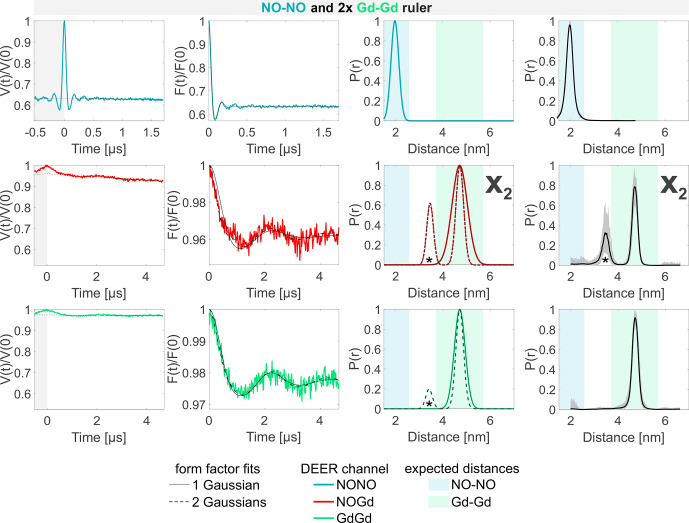
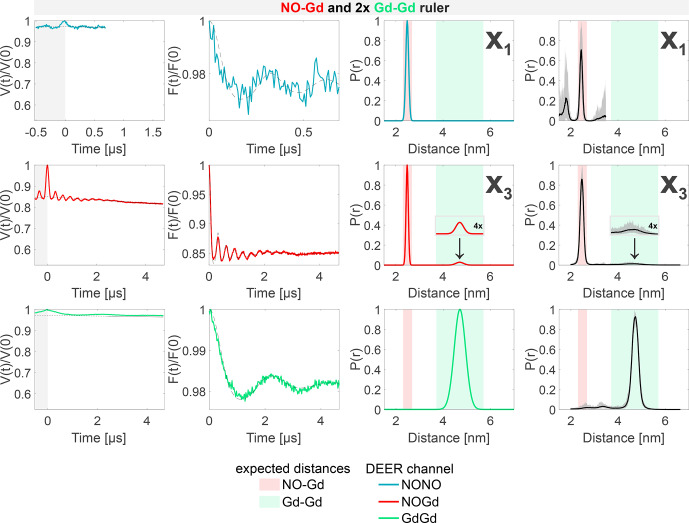
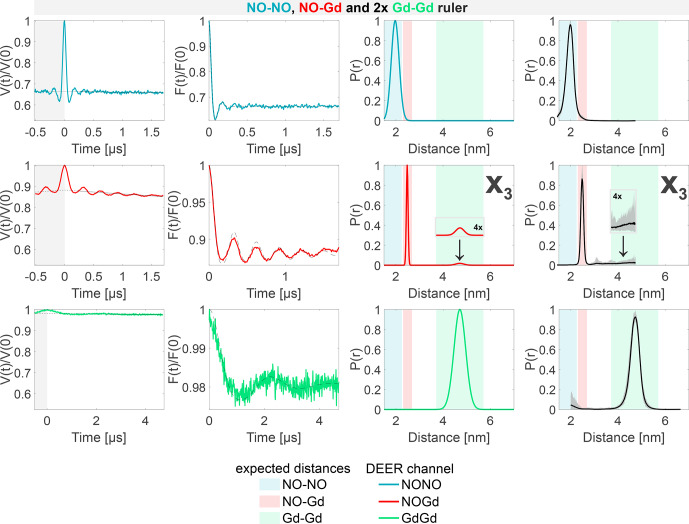
Double electron-electron resonance (DEER) spectroscopy applied to orthogonally spin-labeled biomolecular complexes simplifies the assignment of intra- and intermolecular distances, thereby increasing the information content per sample. In fact, various spin labels can be addressed independently in DEER experiments due to spectroscopically nonoverlapping central transitions, distinct relaxation times, and/or transition moments; hence, they are referred to as spectroscopically orthogonal. Molecular complexes which are, for example, orthogonally spin-labeled with nitroxide (NO) and gadolinium (Gd) labels give access to three distinct DEER channels that are optimized to selectively probe NO-NO, NO-Gd, and Gd-Gd distances. Nevertheless, it has been previously recognized that crosstalk signals between individual DEER channels can occur, for example, when a Gd-Gd distance appears in a DEER channel optimized to detect NO-Gd distances. This is caused by residual spectral overlap between NO and Gd spins which, therefore, cannot be considered as perfectly orthogonal. Here, we present a systematic study on how to identify and suppress crosstalk signals that can appear in DEER experiments using mixtures of NO-NO, NO-Gd, and Gd-Gd molecular rulers characterized by distinct, nonoverlapping distance distributions. This study will help to correctly assign the distance peaks in homo- and heterocomplexes of biomolecules carrying not perfectly orthogonal spin labels.
将双电子 - 电子共振(DEER)光谱应用于正交自旋标记的生物分子复合物,可简化分子内和分子间距离的归属,从而增加每个样品的信息含量。事实上,由于光谱上不重叠的中心跃迁、不同的弛豫时间和/或跃迁矩,在DEER实验中可以独立处理各种自旋标记;因此,它们被称为光谱正交。例如,用氮氧化物(NO)和钆(Gd)标记进行正交自旋标记的分子复合物可提供三个不同的DEER通道,这些通道经过优化,可选择性地探测NO - NO、NO - Gd和Gd - Gd距离。然而,此前已经认识到,各个DEER通道之间可能会出现串扰信号,例如,当Gd - Gd距离出现在优化用于检测NO - Gd距离的DEER通道中时。这是由NO和Gd自旋之间的残余光谱重叠引起的,因此,不能将它们视为完全正交。在这里,我们对如何识别和抑制在DEER实验中可能出现的串扰信号进行了系统研究,这些串扰信号使用具有不同、不重叠距离分布的NO - NO、NO - Gd和Gd - Gd分子尺混合物。这项研究将有助于正确归属携带并非完全正交自旋标记的生物分子同型和异型复合物中的距离峰。