Jung Han Wool
Department of Psychiatry, Hallym University Medical Center, Chuncheon-si, Republic of Korea.
Front Psychol. 2023 Oct 20;14:1230577. doi: 10.3389/fpsyg.2023.1230577. eCollection 2023.
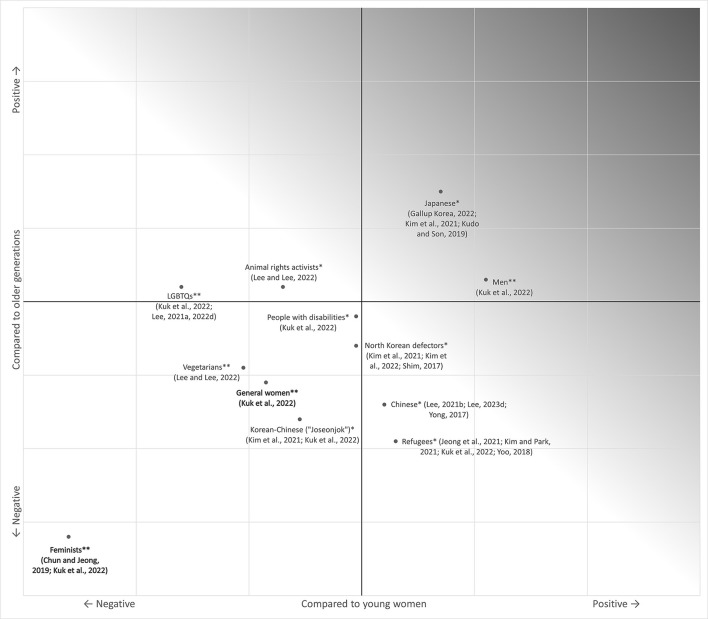
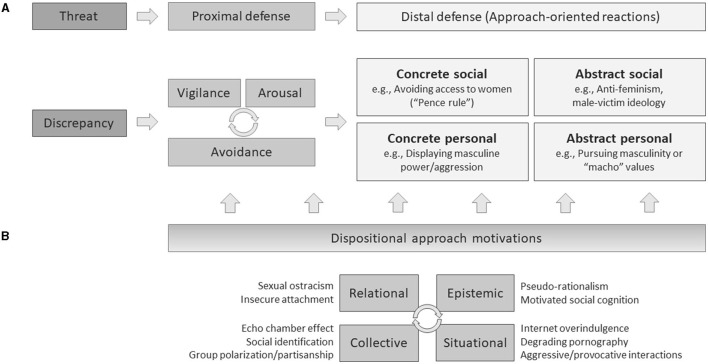
In South Korea, anti-feminism is now rapidly spreading online among young men, who have started to identify themselves as a social minority or "victims" of female power. Despite its ramifications, theoretically, anti-feminism is indistinct from the racism and sexism of White men that emerged more than half a century ago. In view of this, it shares the same root as typical modern racism or sexism, although it appears to be a novel phenomenon. Such a hypothesis was buttressed by quantifying the attitudes of anti-feminists toward various outgroups based on the transference of prejudice theory. Moreover, the subtle sexist undertones hidden in their arguments have been discussed using various psychological theories and empirical data/statistics. Additionally, various potential factors that may shape or accelerate their attitudes or behaviors have been discussed on the basis of the threat-defense theory. Through comprehensive literature review based on this theory, this study proposes the features related to Korean anti-feminism, encompassing behavioral/situational (overindulging violent or degrading Internet contents, verbal aggression), relational/epistemic (ostracism, attachment insecurity, pseudo-rationalism), and group-level (provocative interactions, polarization) attributes, some of which may also influence groups other than young men and ingrain or exacerbate the extreme ideologies of other groups, including young women. Scrutinizing Korean online anti-feminism and male-victim ideology may improve our understanding of the psychological origins of various social extremities or radical ideologies beyond cultural barriers.
在韩国,反女权主义如今正在年轻男性中迅速在网上蔓延,他们开始将自己视为社会少数群体或女性权力的“受害者”。尽管其影响深远,但从理论上讲,反女权主义与半个多世纪前出现的白人男性的种族主义和性别歧视并无二致。有鉴于此,尽管它看似是一种新现象,但它与典型的现代种族主义或性别歧视有着相同的根源。基于偏见转移理论对反女权主义者对各种外群体的态度进行量化,支持了这一假设。此外,还运用各种心理学理论和实证数据/统计资料,探讨了他们言论中隐藏的微妙性别歧视意味。此外,基于威胁防御理论,还讨论了可能塑造或加速他们态度或行为的各种潜在因素。通过基于该理论的全面文献综述,本研究提出了与韩国反女权主义相关的特征,包括行为/情境(过度沉迷于暴力或有辱人格的网络内容、言语攻击)、关系/认知(排斥、依恋不安全感、伪理性主义)和群体层面(挑衅性互动、两极分化)属性,其中一些属性可能也会影响除年轻男性之外的群体,并使其他群体(包括年轻女性)的极端意识形态根深蒂固或加剧。审视韩国网络反女权主义和男性受害者意识形态,可能会增进我们对跨越文化障碍的各种社会极端主义或激进意识形态心理根源的理解。