Gebru Nioud Mulugeta, Goncalves Priscila Dib, Cruz Rick A, Thompson Wesley K, Allegair Nicholas, Potter Alexandra, Garavan Hugh, Dumas Julie, Leeman Robert F, Johnson Micah
Center for Alcohol and Addiction Studies, Department of Behavioral and Social Sciences, Brown University School of Public Health, Providence, RI, United States.
Department of Health Education and Behavior, University of Florida, Gainesville, FL, United States.
Front Behav Neurosci. 2023 Oct 24;17:1213894. doi: 10.3389/fnbeh.2023.1213894. eCollection 2023.
Impulsivity is a known risk factor for the development of substance use disorders and other psychiatric conditions that is influenced by both genetics and environment. Although research has linked parental mental health to children's impulsivity, potential mediators of this relationship remain understudied. The current investigation leverages the large national Adolescent Brain Cognitive Development (ABCD) Study to assess the mediating role of family conflict - an important social context for youth development - in the relationship between parental mental health and youth impulsivity.
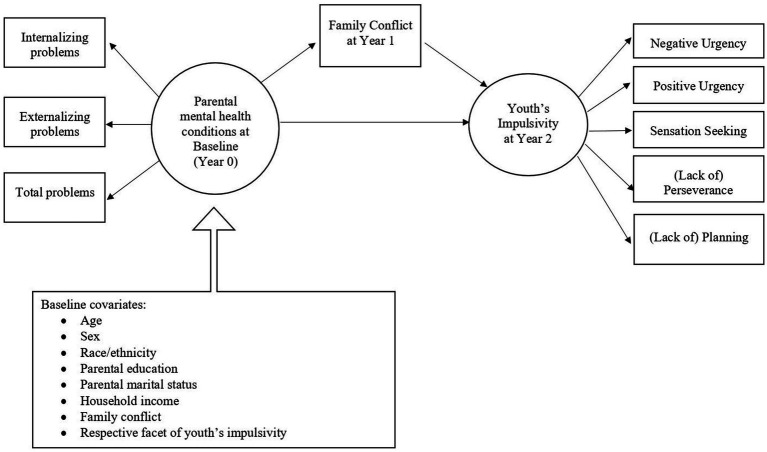
Data were from the first three annual waves of the ABCD study (Baseline = 11,876 children, = 9.9 years; 48% female; 52% White). Parental mental health conditions were self-reported internalizing, externalizing, and total problems. Youth completed the family conflict scale, and Urgency, Planning (lack of), Perseverance (lack of), Sensation Seeking, and Positive Urgency (UPPS-P) scale to measure impulsivity. To determine if within-family change in conflict from baseline to year 1 explained changes in the strength of relations between baseline parental mental health and year 2 youth impulsivity, longitudinal causal mediation analyses were conducted, controlling for demographic factors (i.e., age, sex, race, household income, parental education, marital status), as well as baseline levels of family conflict and outcomes. Separate mediation models were run for each mental health condition and each UPPS-P subscale.
Above and beyond bivariate relations, longitudinal mediation models, which included covariates, showed family conflict significantly (s < 0.001) mediated relations between all three parental mental health conditions and all but one (i.e., sensation seeking) UPPS-P subscales. The proportion mediated through family conflict for internalizing problems and total problems on facets of impulsivity (except sensation seeking) ranged from 9% (for lack of perseverance) to 17% (for lack of planning). Proportion mediated via family conflict for externalizing problems on youth's impulsivity (except sensation seeking) was slightly higher, ranging between 13% (lack of perseverance) to 21% (lack of planning).
Family conflict may be an important intergenerational factor linking parental mental health and youth's impulsivity. Addressing parental mental health and family conflict may help curb increased impulsivity in youth, and in turn reduce adolescent substance use disorders.
冲动是物质使用障碍和其他精神疾病发展的已知风险因素,它受到遗传和环境的双重影响。尽管研究已将父母的心理健康与孩子的冲动联系起来,但这种关系的潜在中介因素仍未得到充分研究。当前的调查利用大型全国性青少年大脑认知发展(ABCD)研究,来评估家庭冲突(青少年发展的一个重要社会背景)在父母心理健康与青少年冲动之间关系中的中介作用。
数据来自ABCD研究的前三年度波次(基线=11876名儿童,平均年龄=9.9岁;48%为女性;52%为白人)。父母的心理健康状况通过自我报告的内化问题、外化问题和总问题来衡量。青少年完成家庭冲突量表以及冲动性量表(UPPS-P),该量表包括紧迫感、计划性(缺乏)、坚持性(缺乏)、寻求刺激和积极紧迫感等维度,以测量冲动性。为了确定从基线到第1年家庭冲突的家庭内部变化是否解释了基线父母心理健康与第2年青少年冲动性之间关系强度的变化,我们进行了纵向因果中介分析,控制了人口统计学因素(即年龄、性别、种族、家庭收入、父母教育程度、婚姻状况),以及家庭冲突和结果的基线水平。针对每种心理健康状况和每个UPPS-P子量表分别运行独立的中介模型。
除双变量关系外,包含协变量的纵向中介模型显示,家庭冲突在所有三种父母心理健康状况与除一个(即寻求刺激)之外的所有UPPS-P子量表之间的关系中起到了显著的中介作用(p<0.001)。通过家庭冲突对冲动性各方面(除寻求刺激外)的内化问题和总问题进行中介的比例范围为9%(缺乏坚持性)至17%(缺乏计划性)。通过家庭冲突对青少年冲动性(除寻求刺激外)的外化问题进行中介的比例略高,在13%(缺乏坚持性)至21%(缺乏计划性)之间。
家庭冲突可能是连接父母心理健康与青少年冲动性的一个重要代际因素。解决父母的心理健康问题和家庭冲突可能有助于抑制青少年冲动性的增加,进而减少青少年物质使用障碍。