
传统和补充医学在管理慢性疲劳方面是否发挥作用?一项随机对照试验的系统评价
Is there a role for traditional and complementary medicines in managing chronic fatigue? a systematic review of randomized controlled trials.
作者信息
Li Yuxiao, Yang Jingya, Chau Chi Ian, Shi Junnan, Chen Xianwen, Hu Hao, Ung Carolina Oi Lam
机构信息
State Key Laboratory of Quality Research in Chinese Medicine, Institute of Chinese Medical Sciences, University of Macau, Macao SAR, China.
Department of Public Health and Medicinal Administration, Faculty of Health Sciences, University of Macau, Macao SAR, China.
出版信息
Front Pharmacol. 2023 Oct 24;14:1266803. doi: 10.3389/fphar.2023.1266803. eCollection 2023.
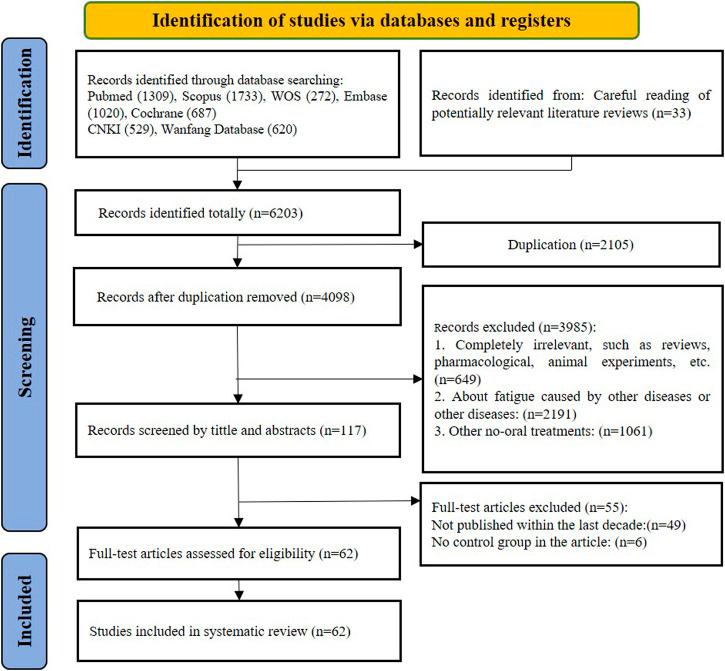
Chronic fatigue syndrome (CFS) is an increasingly common condition that is challenging to treat due to unclear etiology and a lack of consensus on clinical diagnosis and treatment guidance. Many affected people resorted to using traditional and complementary medicines (T&CMs). However, the evidence for T&CMs for CFS has been inconclusive and continues to evolve. The study aims to identify, summarize and assess the most recent evidence on the efficacy and safety of T&CMs for CFS. Randomized controlled trials (RCTs) investigating T&CMs for CFS published in English of Chinese between 1 January 2013 and 31 December 2022 were searched from 7 databases. RCTs comparing T&CMs with no treatment, placebo, or pharmacological medicine were included, irrespective of language or blinding. The Consolidated Standards of Reporting Trials Statement extensions for Chinese herbal medicine Formulas (CONSORT-CHM) and the Cochrane Collaboration's Risk of Bias tool were used to evaluate the quality and risk of bias of included studies. A total of 62 RCTs investigating 43 types of T&CMs and involving 5,231 participants with CFS were included in this review. The primary outcome measures mainly included the scoring of fatigue symptoms using the validated tool Fatigue Scale-14 (FS-14) or the TCM syndrome score. The main interventions showing overall efficacy were Chaihu Guizhi Decoction and Buzhong Yiqi combined with Xiao Chaihu Decoction, and 148 ingredients were identified, including Astragali Radix, Glycyrrhizae Radix et Rhizoma, Atractylodis Macrocephalae Rhizoma, and Bupleuri Radix. The most significant effect was the improvement of fatigue, followed by TCM-diagnosed symptoms and other psychological conditions. No serious adverse effect had been reported. However, the quality of the RCTs included RCTs were found to be suboptimal, and the risk of bias remained uncertain. Some evidence from RCTs supported the efficacy and safety of T&CM in CFS. However, given the methodological and quality heterogenicity of the included studies, the recommendations of T&CMs in treating CFS remain inconclusive. To develop better quality evidence about T&CMs for CFS, future studies should employ more objective diagnosis standards and outcome measurements, larger sample size, and better bias control, and ensure the compliance with the corresponding reporting guidelines. https://www.crd.york.ac.uk/prospero/display_record.php?ID=CRD42022362268, identifier CRD42022362268.
慢性疲劳综合征(CFS)是一种日益常见的疾病,由于病因不明以及在临床诊断和治疗指导方面缺乏共识,其治疗具有挑战性。许多患者求助于使用传统和补充医学(T&CMs)。然而,T&CMs治疗CFS的证据尚无定论,且仍在不断发展。本研究旨在识别、总结和评估T&CMs治疗CFS的疗效和安全性的最新证据。从7个数据库中检索了2013年1月1日至2022年12月31日期间以英文或中文发表的关于T&CMs治疗CFS的随机对照试验(RCTs)。纳入了比较T&CMs与不治疗、安慰剂或药物治疗的RCTs,无论语言或是否设盲。使用《中药复方随机对照试验报告规范》(CONSORT-CHM)和Cochrane协作网的偏倚风险工具来评估纳入研究的质量和偏倚风险。本综述共纳入62项RCTs,涉及43种T&CMs,共5231例CFS患者。主要结局指标主要包括使用经过验证的工具疲劳量表-14(FS-14)对疲劳症状进行评分或中医证候评分。显示总体疗效的主要干预措施为柴胡桂枝汤和补中益气汤合小柴胡汤,并确定了148种成分,包括黄芪、甘草、白术和柴胡。最显著的效果是疲劳改善,其次是中医诊断的症状和其他心理状况。未报告严重不良反应。然而,发现纳入的RCTs质量欠佳,偏倚风险仍不确定。一些RCTs的证据支持T&CMs治疗CFS的疗效和安全性。然而,鉴于纳入研究的方法学和质量异质性,T&CMs治疗CFS的建议仍无定论。为了获得关于T&CMs治疗CFS的更高质量证据,未来的研究应采用更客观的诊断标准和结局测量方法、更大的样本量、更好地控制偏倚,并确保符合相应的报告指南。https://www.crd.york.ac.uk/prospero/display_record.php?ID=CRD42022362268,标识符CRD42022362268。


 Zotero 插件