Liang Qianqian, Sun Difang, Xue Shuyue, Li Xinying, Liu Xin, Du Qing, Zhang Zhichun, Ma Xiubin, Li Jun
Eye Institute of Shandong First Medical University, Qingdao Eye Hospital of Shandong First Medical University, Qingdao, Shandong, People's Republic of China.
State Key Laboratory Cultivation Base, Shandong Provincial Key Laboratory of Ophthalmology, Qingdao, Shandong, People's Republic of China.
Clin Ophthalmol. 2023 Nov 6;17:3389-3396. doi: 10.2147/OPTH.S436825. eCollection 2023.
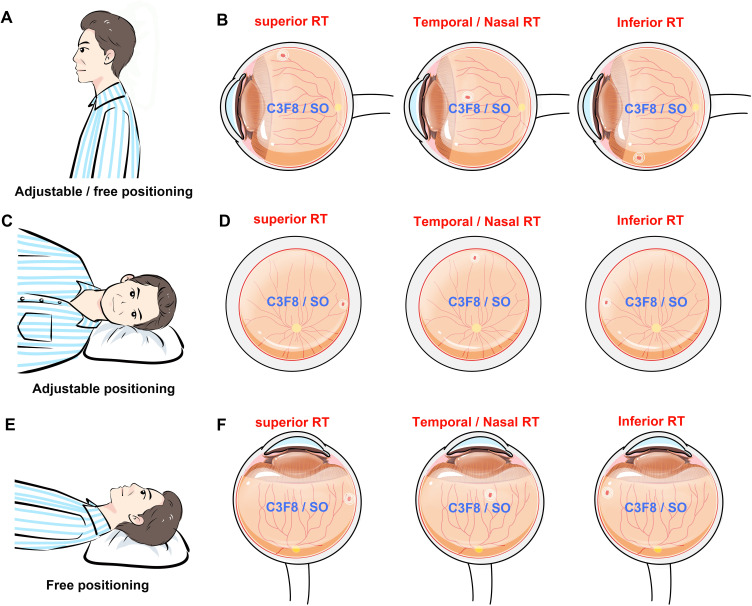
To compare the effectiveness and safety of adjustable and free postoperative positioning after pars plana vitrectomy (PPV) for rhegmatogenous retinal detachment (RRD).
Prospective, randomized controlled study.
A total of 94 eyes with RRD were enrolled from April 2020 to April 2023 and monitored postoperatively for at least 3 months. All patients underwent PPV combined with silicone oil injection or gas tamponade and were randomly divided postoperatively into two groups: an adjustable positioning group and a free positioning group. The success of the outcome was based on the retinal reattachment rate, best corrected visual acuity (BCVA), postoperative complications, and ocular biometric parameters such as anterior chamber depth (ACD) and lens thickness (LT).
The initial retinal reattachment rate was 97.9% in the adjustable positioning group and 95.7% in the free positioning group, manifesting no statistical difference between the two groups. Similarly, no statistical difference was observed between the two groups in the final BCVA, which was significantly improved compared to the preoperative BCVA. The comparison of the 1-month postoperative ACD and LT with the preoperative values showed no statistically significant differences in the two groups. The rates of complications were not statistically different in the two groups.
After treating RRD using PPV, neither the adjustable nor the free postoperative positioning affected the retinal reattachment rate or the incidence of complications. Therefore, our study showed that it is safe and effective to adopt free positioning postoperatively, which may provide more options for patients with RRD undergoing PPV.
比较孔源性视网膜脱离(RRD)行玻璃体切割术(PPV)后可调节与自由术后体位的有效性和安全性。
前瞻性随机对照研究。
2020年4月至2023年4月共纳入94例RRD患者眼,术后至少随访3个月。所有患者均接受PPV联合硅油注入或气体填充,并在术后随机分为两组:可调节体位组和自由体位组。结局的成功基于视网膜复位率、最佳矫正视力(BCVA)、术后并发症以及眼前房深度(ACD)和晶状体厚度(LT)等眼部生物测量参数。
可调节体位组初始视网膜复位率为97.9%,自由体位组为95.7%,两组间无统计学差异。同样,两组最终BCVA相比术前均显著提高,两组间无统计学差异。术后1个月ACD和LT与术前值比较,两组均无统计学显著差异。两组并发症发生率无统计学差异。
RRD采用PPV治疗后,可调节或自由术后体位均不影响视网膜复位率或并发症发生率。因此,我们的研究表明术后采用自由体位是安全有效的,这可能为接受PPV的RRD患者提供更多选择。