Joyce Justin, Chalavadi Rupasri, Chan Joey, Tanna Sheel, Xenes Daniel, Kuo Nathanael, Rose Victoria, Matelsky Jordan, Kitchell Lindsey, Bishop Caitlyn, Rivlin Patricia K, Villafañe-Delgado Marisel, Wester Brock
Research & Exploratory Development, Johns Hopkins University Applied Physics Laboratory.
Johns Hopkins University Krieger School of Arts and Sciences.
bioRxiv. 2023 Oct 23:2023.10.20.563359. doi: 10.1101/2023.10.20.563359.
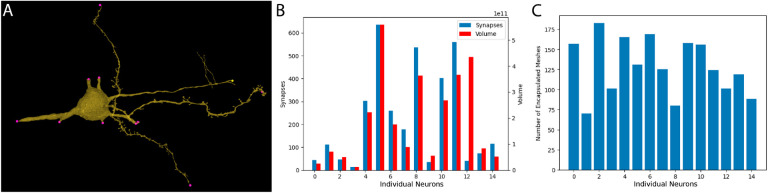
The immense scale and complexity of neuronal electron microscopy (EM) datasets pose significant challenges in data processing, validation, and interpretation, necessitating the development of efficient, automated, and scalable error-detection methodologies. This paper proposes a novel approach that employs mesh processing techniques to identify potential error locations near neuronal tips. Error detection at tips is a particularly important challenge since these errors usually indicate that many synapses are falsely split from their parent neuron, injuring the integrity of the connectomic reconstruction. Additionally, we draw implications and results from an implementation of this error detection in a semi-automated proofreading pipeline. Manual proofreading is a laborious, costly, and currently necessary method for identifying the errors in the machine learning based segmentation of neural tissue. This approach streamlines the process of proofreading by systematically highlighting areas likely to contain inaccuracies and guiding proofreaders towards potential continuations, accelerating the rate at which errors are corrected.
神经元电子显微镜(EM)数据集的巨大规模和复杂性在数据处理、验证和解释方面带来了重大挑战,因此需要开发高效、自动化且可扩展的错误检测方法。本文提出了一种新颖的方法,该方法采用网格处理技术来识别神经元末梢附近的潜在错误位置。末梢处的错误检测是一项尤为重要的挑战,因为这些错误通常表明许多突触与其母神经元被错误地分割开,损害了连接组重建的完整性。此外,我们还阐述了在半自动校对流程中实施此错误检测的意义和结果。人工校对是一种费力、成本高且目前识别基于机器学习的神经组织分割中的错误所必需的方法。这种方法通过系统地突出显示可能存在不准确之处的区域并引导校对人员找到潜在的延续部分,简化了校对过程,加快了错误纠正的速度。