Feng Wenshuai, Guo Liuli, Liu Yiman, Ren Ming
College of Traditional Chinese Medicine, Tianjin University of Traditional Chinese Medicine, Tianjin, China.
Baokang Hospital Affiliated to Tianjin University of Traditional Chinese Medicine, Tianjin, China.
Front Cardiovasc Med. 2023 Oct 30;10:1234271. doi: 10.3389/fcvm.2023.1234271. eCollection 2023.
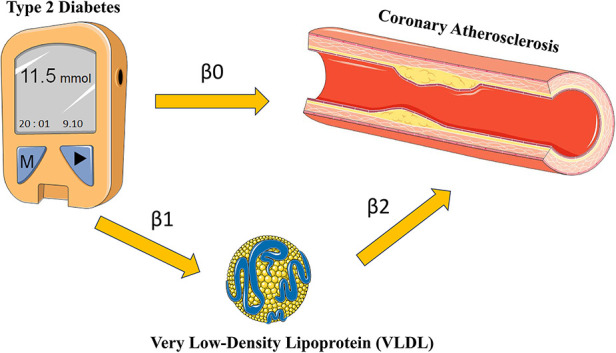
The causal link between Type 2 diabetes (T2D) and coronary atherosclerosis has been established through wet lab experiments; however, its analysis with Genome-wide association studies (GWAS) data remains unexplored. This study aims to validate this relationship using Mendelian randomization analysis and explore the potential mediation of VLDL in this mechanism.
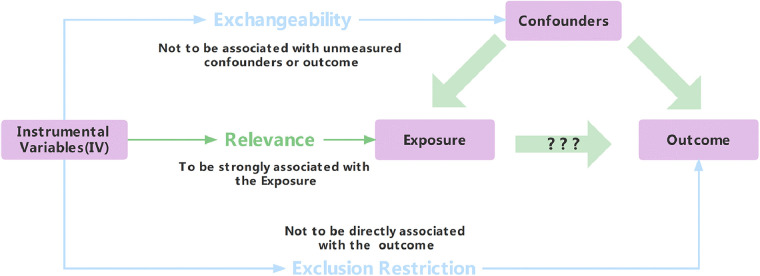
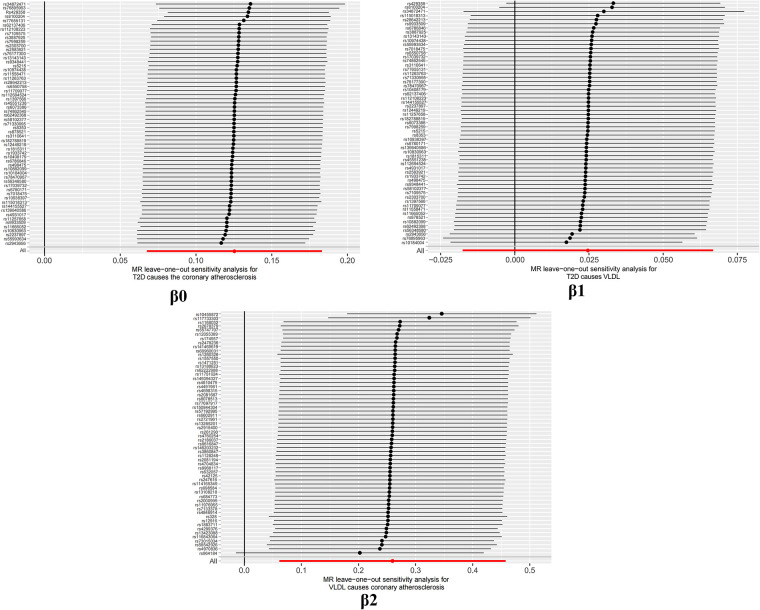
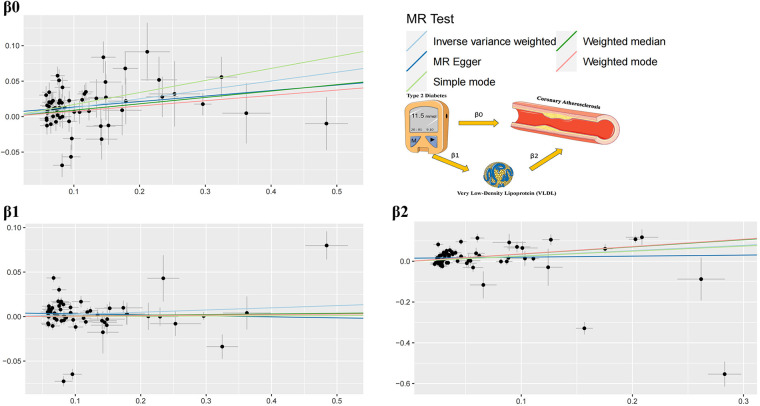
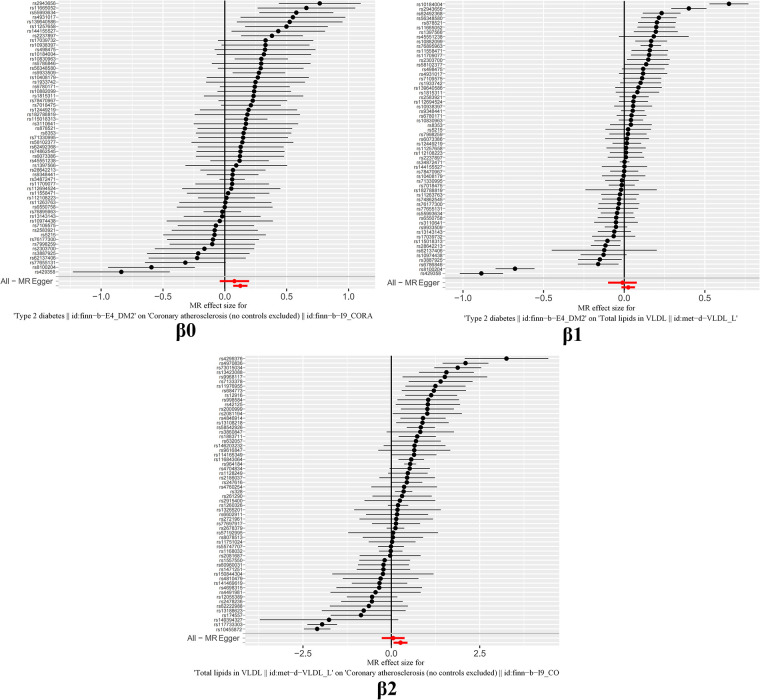
Employing Mendelian randomization analysis, we investigated the causal connection between T2D and coronary atherosclerosis. We utilized GWAS summary statistics from European ancestry cohorts, comprising 23,363 coronary atherosclerosis patients and 195,429 controls, along with 32,469 T2D patients and 183,185 controls. VLDL levels, linked to SNPs, were considered as a potential mediating causal factor that might contribute to coronary atherosclerosis in the presence of T2D. We employed the inverse variance weighted (IVW), Egger regression (MR-Egger), weighted median, and weighted model methods for causal effect estimation. A leave-one-out sensitivity analysis was conducted to ensure robustness.
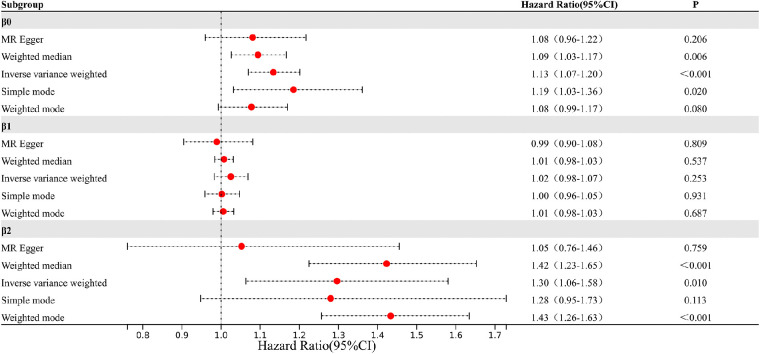
Our Mendelian randomization analysis demonstrated a genetic association between T2D and an increased coronary atherosclerosis risk, with the IVW estimate at 1.13 [95% confidence interval (CI): 1.07-1.20]. Additionally, we observed a suggestive causal link between T2D and VLDL levels, as evidenced by the IVW estimate of 1.02 (95% CI: 0.98-1.07). Further supporting lipid involvement in coronary atherosclerosis pathogenesis, the IVW-Egger estimate was 1.30 (95% CI: 1.06-1.58).
In conclusion, this study highlights the autonomous contributions of T2D and VLDL levels to coronary atherosclerosis development. T2D is linked to a 13.35% elevated risk of coronary atherosclerosis, and within T2D patients, VLDL concentration rises by 2.49%. Notably, each standard deviation increase in VLDL raises the likelihood of heart disease by 29.6%. This underscores the significant role of lipid regulation, particularly VLDL, as a mediating pathway in coronary atherosclerosis progression.
2型糖尿病(T2D)与冠状动脉粥样硬化之间的因果联系已通过湿实验室实验得以确立;然而,利用全基因组关联研究(GWAS)数据对其进行分析仍未得到探索。本研究旨在通过孟德尔随机化分析验证这种关系,并探究极低密度脂蛋白(VLDL)在此机制中的潜在中介作用。
我们采用孟德尔随机化分析,研究T2D与冠状动脉粥样硬化之间的因果联系。我们利用了来自欧洲血统队列的GWAS汇总统计数据,其中包括23363例冠状动脉粥样硬化患者和195429例对照,以及32469例T2D患者和183185例对照。与单核苷酸多态性(SNP)相关的VLDL水平被视为一个潜在的中介因果因素,在T2D存在的情况下可能导致冠状动脉粥样硬化。我们采用逆方差加权(IVW)、Egger回归(MR-Egger)、加权中位数和加权模型方法进行因果效应估计。进行了留一法敏感性分析以确保稳健性。
我们的孟德尔随机化分析表明,T2D与冠状动脉粥样硬化风险增加之间存在遗传关联,IVW估计值为1.13 [95%置信区间(CI):1.07 - 1.20]。此外,我们观察到T2D与VLDL水平之间存在提示性的因果联系,IVW估计值为1.02(95% CI:0.98 - 1.07)可证明这一点。进一步支持脂质参与冠状动脉粥样硬化发病机制的是,IVW-Egger估计值为1.30(95% CI:1.06 - 1.58)。
总之,本研究强调了T2D和VLDL水平对冠状动脉粥样硬化发展的独立贡献。T2D与冠状动脉粥样硬化风险升高13.35%相关,在T2D患者中,VLDL浓度升高2.49%。值得注意的是,VLDL每增加一个标准差,心脏病发生的可能性就增加29.6%。这突出了脂质调节,特别是VLDL,作为冠状动脉粥样硬化进展中的一条中介途径的重要作用。