Gosnell Jordan M, Finn Michael T M, Marckini Darcy N, Molla Azizur R, Sowinski Heather A
Betz Congenital Heart Center, Helen DeVos Children's Hospital of Corewell Health, Grand Rapids, Michigan, USA.
Department of Public Health, Grand Valley State University College of Health Professions, Allendale, Michigan, USA.
CJC Pediatr Congenit Heart Dis. 2022 Dec 12;2(1):3-11. doi: 10.1016/j.cjcpc.2022.12.001. eCollection 2023 Feb.
The lifelong care of patients with congenital heart disease (CHD) typically begins at a young age, giving paediatric cardiologists a unique perspective on the mental health of their patients. Our aim was to describe and predict reported psychological problems among adolescents with CHD.
A retrospective review was performed on patients aged 12-17 years who presented to the congenital cardiology clinic during a 1-year timeframe. The presence of psychological problems was collected along with CHD class, clinical history, developmental delay, and patient demographics. We described the prevalence of psychological problems and then, using machine learning algorithms, trained and tested optimal predictive models.
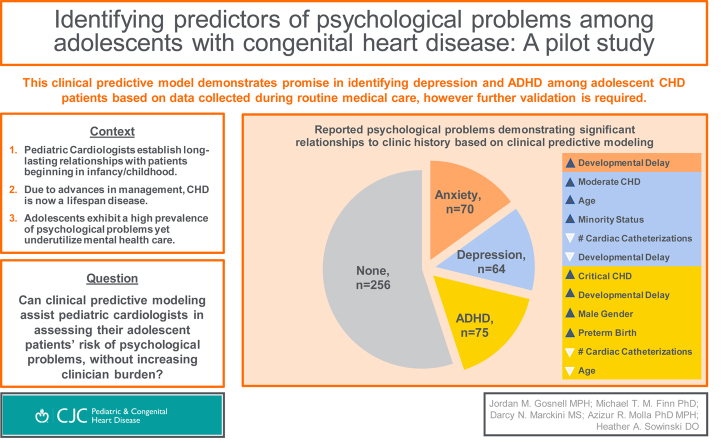
Of the 397 patients who met inclusion criteria, the lifetime prevalence of any reported psychological problem was 35.5%. The most prevalent reported problems were attention-deficit/hyperactivity disorder (18.9%), anxiety (17.6%), and depression (16.1%). Contrary to our expectations, we could not predict the presence or absence of any psychological problem using routine clinical data. Instead, we found multivariate models predicting depression and attention-deficit/hyperactivity disorder with promising accuracy. Prediction of anxiety was less successful.
Approximately 1 of 3 adolescents with CHD presented with the lifetime prevalence of 1 or more psychological problems. Congenital cardiac programmes are in a position of influence to respond to these problems and impact their patients' mental health as part of a comprehensive care plan. The discovered models using routine clinical data predicted specific psychological problems with varying accuracy. With further validation, these models could become the tools of routine recommendations for referral to psychological care.
先天性心脏病(CHD)患者的终身护理通常始于幼年,这使儿科心脏病专家对其患者的心理健康有独特的见解。我们的目的是描述和预测患有CHD的青少年中报告的心理问题。
对在1年时间内到先天性心脏病诊所就诊的12至17岁患者进行回顾性研究。收集心理问题的存在情况以及CHD分类、临床病史、发育迟缓情况和患者人口统计学资料。我们描述了心理问题的患病率,然后使用机器学习算法训练并测试最佳预测模型。
在符合纳入标准的397例患者中,任何报告的心理问题的终生患病率为35.5%。报告最多的问题是注意力缺陷/多动障碍(18.9%)、焦虑(17.6%)和抑郁(16.1%)。与我们的预期相反,我们无法使用常规临床数据预测是否存在任何心理问题。相反,我们发现多变量模型预测抑郁和注意力缺陷/多动障碍的准确性很有前景。对焦虑的预测不太成功。
大约三分之一患有CHD的青少年存在一种或多种心理问题的终生患病率。先天性心脏病治疗项目有能力应对这些问题,并作为综合护理计划的一部分影响患者的心理健康。利用常规临床数据发现的模型对特定心理问题的预测准确性各不相同。经过进一步验证,这些模型可能会成为转介心理护理常规建议的工具。