Duke Cancer Institute, Duke University Medical Center, Durham, North Carolina.
Internal Medicine Research Unit, Pfizer Inc, Cambridge, Massachusetts.
Clin Cancer Res. 2024 Feb 1;30(3):489-497. doi: 10.1158/1078-0432.CCR-23-1631.
Cachexia is common in patients with advanced cancer and is associated with elevated serum growth differentiation factor 15 (GDF-15) concentrations. This first-in-patient (phase Ib), 24-week study assessed use of ponsegromab, a mAb against GDF-15, in adults with advanced cancer, cachexia, and elevated GDF-15 serum concentration.
Participants (n = 10) received open-label ponsegromab subcutaneous 200 mg every 3 weeks for 12 weeks in addition to standard-of-care anticancer treatment. Ponsegromab safety, tolerability, and pharmacokinetics were assessed in addition to serum GDF-15 concentrations and exploratory measures of efficacy.
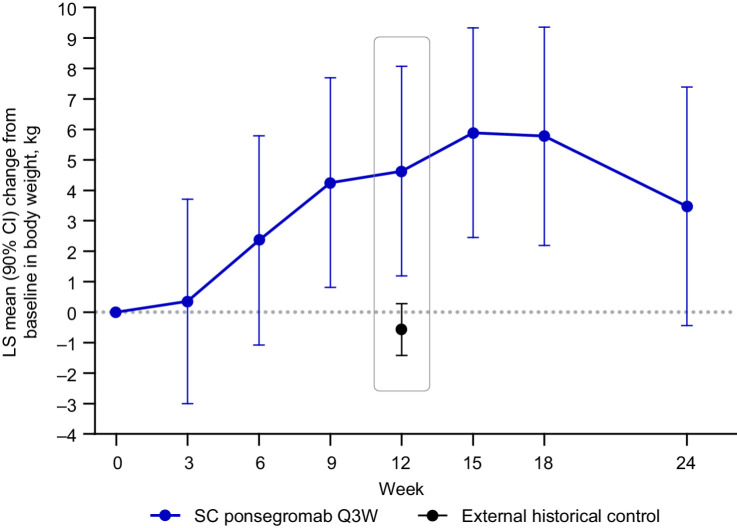
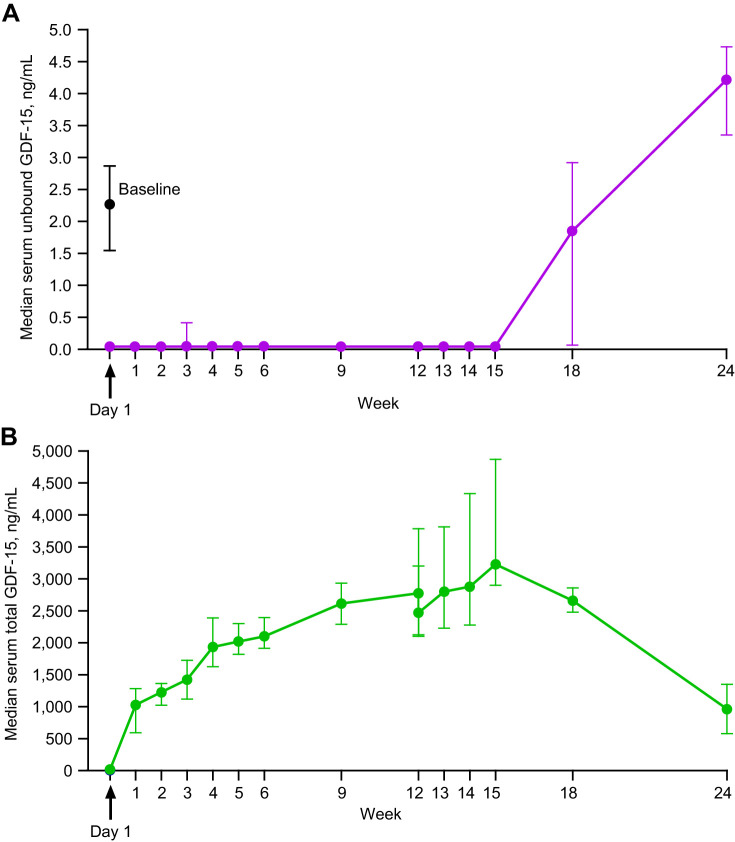
No treatment-related treatment-emergent adverse events, injection site reactions, or adverse trends in clinical laboratory tests, vital signs, or electrocardiogram parameters attributable to ponsegromab were identified. Median serum unbound GDF-15 concentration at baseline was 2.269 ng/mL. Following initiation of study treatment, median unbound GDF-15 concentrations were below the lower limit of quantification (0.0424 ng/mL) from day 1 (3 hours postdose) through week 15. Increases in body weight were observed at all time points during the treatment and follow-up periods. A least-squares mean (SE) increase of 4.63 (1.98) kg was observed at week 12, an increase of approximately 6.6% relative to baseline. Ponsegromab-mediated improvements in actigraphy-based assessments of physical activity and in quality of life, including appetite as assessed by Functional Assessment of Anorexia-Cachexia Therapy total and subscale scores, were also observed.
Ponsegromab was well tolerated, suppressed serum GDF-15 concentrations, and demonstrated preliminary evidence of efficacy. These findings support the continued development of ponsegromab for the treatment of cachexia.
恶病质在晚期癌症患者中很常见,与血清生长分化因子 15(GDF-15)浓度升高有关。这项首次在患者中进行的(Ib 期)、24 周研究评估了针对 GDF-15 的单克隆抗体 ponsegromab 在晚期癌症、恶病质和 GDF-15 血清浓度升高的成年患者中的应用。
参与者(n=10)在接受标准抗癌治疗的基础上,每 3 周接受皮下 ponsegromab 200mg,共 12 周。评估 ponsegromab 的安全性、耐受性和药代动力学,以及血清 GDF-15 浓度和疗效的探索性指标。
未发现与 ponsegromab 相关的治疗后出现的治疗相关不良事件、注射部位反应或临床实验室检查、生命体征或心电图参数的不良趋势。基线时血清游离 GDF-15 浓度的中位数为 2.269ng/ml。在开始研究治疗后,从第 1 天(给药后 3 小时)到第 15 周,中位游离 GDF-15 浓度均低于定量下限(0.0424ng/ml)。在治疗和随访期间的所有时间点都观察到体重增加。在第 12 周时观察到最小二乘均值(SE)增加了 4.63(1.98)kg,与基线相比增加了约 6.6%。还观察到 ponsegromab 介导的基于活动记录仪的身体活动评估和生活质量的改善,包括通过功能评估厌食恶病质治疗总评分和子量表评估的食欲。
ponsegromab 耐受良好,抑制了血清 GDF-15 浓度,并初步证明了疗效。这些发现支持 ponsegromab 继续开发用于治疗恶病质。