School of Psychology, Korea University, Seoul, Republic of Korea.
Graduate School of Culture Technology, Korea Advanced Institute of Science and Technology, Daejeon, Republic of Korea.
JAMA Netw Open. 2023 Nov 1;6(11):e2344120. doi: 10.1001/jamanetworkopen.2023.44120.
Mobile mental health applications (apps) for moderate to severe depression are proliferating, likely owing to their capacity to overcome the limitations of conventional psychotherapy, but research on the potential moderators of treatment efficacy is lacking.
To examine the treatment efficacy associated with mobile app interventions for moderate to severe depression and identify the potential moderators associated with better treatment outcomes.
PubMed, Embase, and PsycINFO were searched from their inception to January 22, 2023.
Only randomized clinical trials evaluating mobile app treatments in adults with moderate to severe depression that published their results in English were included in the analysis.
Three independent researchers extracted and assessed relevant studies, their risk of bias, the characteristics of the population and study design, and the components of the intervention program following the Preferred Reporting Items for Systematic Reviews and Meta-analyses reporting guidelines. A fixed-effects model was used for data analysis, and exploratory post hoc meta-regression and subgroup analyses were also conducted. Data were analyzed from February 16 to March 25, 2023.
The main outcome was changes in depression symptom severity from before to after treatment, measured by standardized depression assessment instruments. Secondary outcomes included study-, intervention-, and patient-level factors associated with app efficacy.
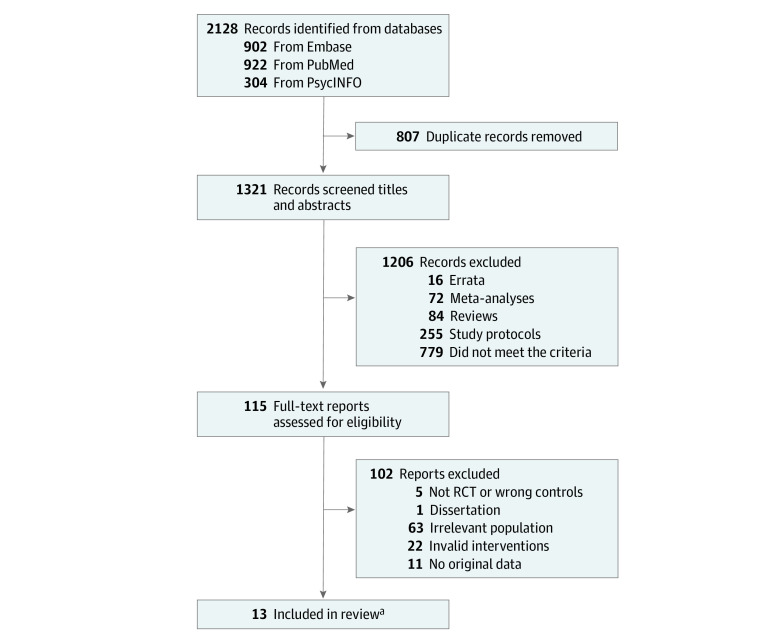
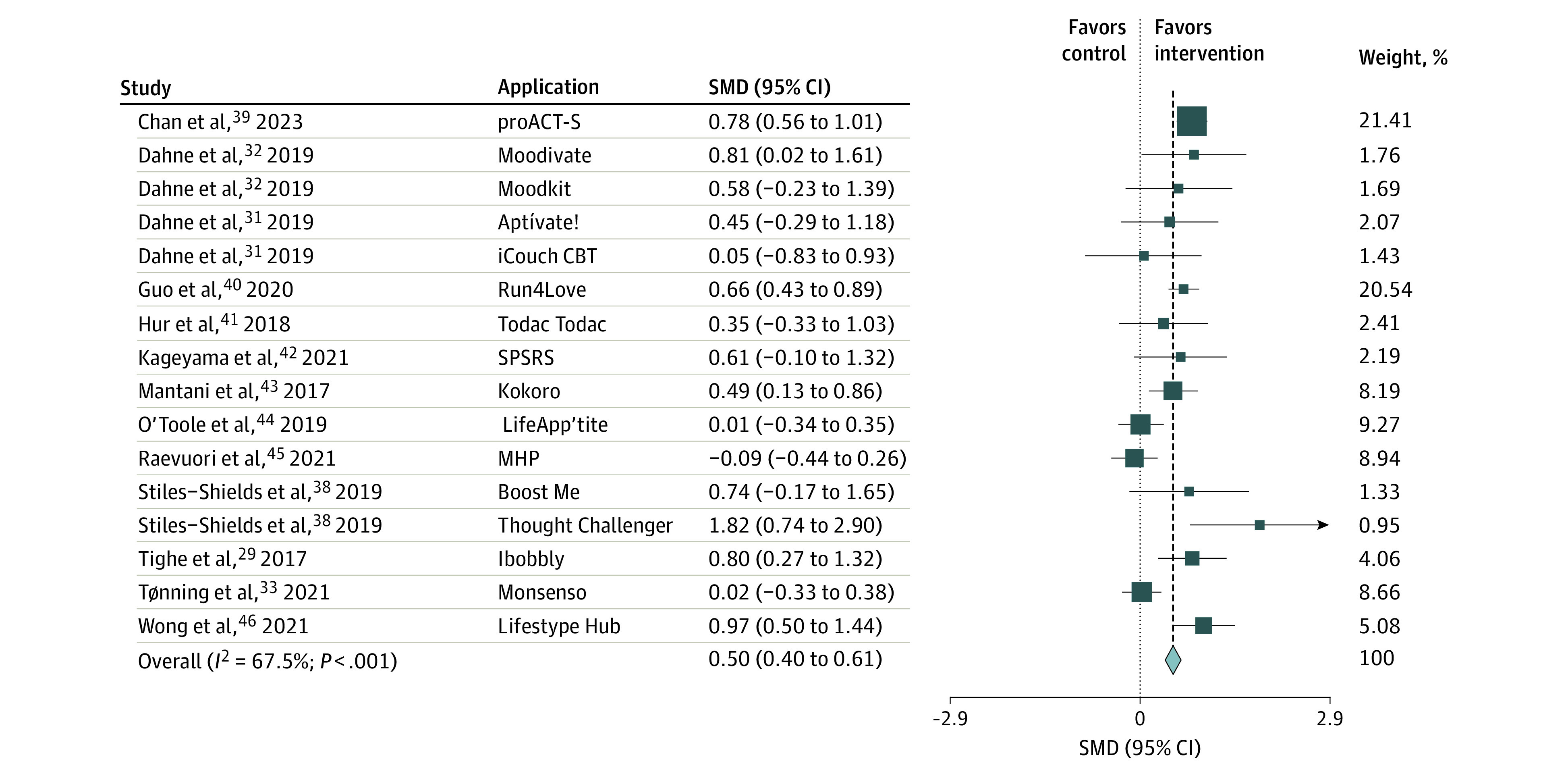
Of 2128 studies identified, 13 studies evaluating 16 intervention apps with 1470 participants with moderate to severe depression were included in the analysis. The overall pooled effect size of mobile app interventions vs both active and inactive control groups was 0.50 (95% CI, 0.40 to 0.61). Interventions with in-app notifications were associated with significantly lower treatment outcomes (standardized mean difference [SMD], 0.45; 95% CI, 0.29-0.60) than interventions without (SMD, 0.71; 95% CI, 0.54-0.87; P = .02). In addition, app interventions delivered for less than 8 weeks were associated with a significantly greater effect size (SMD, 0.77; 95% CI, 0.59-0.96) than interventions delivered for 8 weeks or longer (SMD, 0.43; 95% CI, 0.30-0.57; P = .004).
In this systematic review and meta-analysis, the feasibility and efficacy of mobile app interventions were supported in treating moderate and severe depression, and practical implications were also provided for developing effective app-based interventions in clinical practice.
用于治疗中度至重度抑郁症的移动心理健康应用程序(app)正在大量涌现,这可能是由于它们克服了传统心理治疗的局限性,但缺乏对治疗效果潜在调节因素的研究。
研究移动应用程序干预治疗中度至重度抑郁症的疗效,并确定与更好的治疗效果相关的潜在调节因素。
从成立到 2023 年 1 月 22 日,在 PubMed、Embase 和 PsycINFO 上进行了检索。
仅纳入了评估成人中度至重度抑郁症移动应用程序治疗的随机临床试验,且研究结果以英文发表。
根据系统评价和荟萃分析报告指南的要求,由 3 位独立研究人员提取并评估了相关研究、其偏倚风险、人群和研究设计特征以及干预方案的组成部分。使用固定效应模型进行数据分析,并进行了探索性事后荟萃回归和亚组分析。数据分析于 2023 年 2 月 16 日至 3 月 25 日进行。
主要结局是通过标准化抑郁评估工具测量的治疗前后抑郁症状严重程度的变化。次要结局包括与应用程序疗效相关的研究、干预和患者水平的因素。
在 2128 项研究中,有 13 项研究评估了 16 种干预应用程序,共纳入了 1470 名中度至重度抑郁症患者。与主动和非活动对照组相比,移动应用程序干预的总体汇总效应大小为 0.50(95%置信区间,0.40 至 0.61)。与没有通知的应用程序干预(标准化均数差[SMD],0.45;95%置信区间,0.29-0.60)相比,带有应用程序内通知的干预与显著较低的治疗效果相关(SMD,0.71;95%置信区间,0.54-0.87;P = .02)。此外,干预持续时间少于 8 周的应用程序干预与更大的效应量(SMD,0.77;95%置信区间,0.59-0.96)相关,而干预持续 8 周或更长时间的应用程序干预与较小的效应量(SMD,0.43;95%置信区间,0.30-0.57;P = .004)相关。
在本系统评价和荟萃分析中,移动应用程序干预治疗中度和重度抑郁症的可行性和疗效得到了支持,并为临床实践中开发有效的基于应用程序的干预措施提供了实际意义。