Houston VA HSR&D Center for Innovations in Quality, Effectiveness and Safety, Michael E. DeBakey VA Medical Center, Houston, TX, USA.
Margaret M. and Albert B Alkek Department of Medicine, Baylor College of Medicine, Houston, TX, USA.
Curr Psychiatry Rep. 2022 Oct;24(10):529-539. doi: 10.1007/s11920-022-01359-8. Epub 2022 Sep 2.
The goal of this paper is to provide a comparative review of using phone (audio-only) or video for mental health treatments. Our review includes evidence of phone and video's effectiveness in terms of reduced symptomology, retention, satisfaction, therapeutic alliance, and other outcomes of interest. This review also discusses how patients and providers' experiences and attitudes differ between these two modalities. Finally, we present information on different usage rates of phone and video across patient populations and mental health provider types, and different implementation strategies.
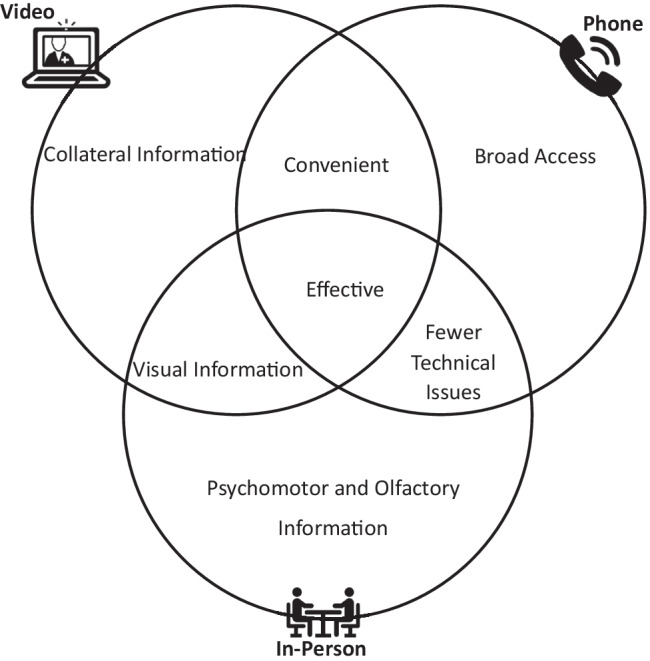
Treatments through phone and video are both able to reduce symptoms related to mental health conditions and have both been found to be non-inferior to in-person care. Both phone and video are more convenient to patients. Video offers important visual information that can be important to diagnosing mental health conditions. Phone, however, is more broadly accessible and may come with fewer technological issues. In the context of mental health care, where non-verbal cues are tied to symptomology and diagnosing, and a strong relationship between patient and provider can enhance treatment, we encourage the use of video, especially for psychotherapeutic services. However, as phone is more accessible, we ultimately recommend an accommodating approach, one that flexibly makes use of both phone and video. Future studies on telehealth should focus on direct, head-to-head comparisons between phone and video and conduct more rigorous testing on whether clinical differences exist.
目的综述:本文旨在对使用电话(仅音频)或视频进行心理健康治疗进行比较性综述。我们的综述包括了电话和视频在减少症状、保留率、满意度、治疗联盟以及其他相关结果方面有效性的证据。本综述还讨论了患者和提供者在这两种模式下的体验和态度有何不同。最后,我们介绍了不同患者群体和心理健康提供者类型对电话和视频的使用率,以及不同实施策略的信息。
最新发现:通过电话和视频进行的治疗都能够减轻与心理健康状况相关的症状,并且都被发现与面对面治疗一样有效。电话和视频对患者来说都更加方便。视频提供了重要的视觉信息,这对诊断心理健康状况很重要。然而,电话更广泛普及,并且可能存在较少的技术问题。在心理健康护理中,非言语线索与症状和诊断有关,患者与提供者之间的牢固关系可以增强治疗效果,因此我们鼓励使用视频,特别是对于心理治疗服务。但是,由于电话更容易获得,因此我们最终建议采用灵活的方法,同时使用电话和视频。关于远程医疗的未来研究应侧重于电话和视频之间的直接、面对面比较,并更严格地测试是否存在临床差异。