Friedman Katie Paul, Foster Miran J, Pham Ly Ly, Feshuk Madison, Watford Sean M, Wambaugh John F, Judson Richard S, Setzer R Woodrow, Thomas Russell S
Center for Computational Toxicology and Exposure, Office of Research and Development, U.S. Environmental Protection Agency, Research Triangle Park, North Carolina, 27711, USA.
Oak Ridge Associated Universities, Oak Ridge, TN.
Comput Toxicol. 2023 Nov;28:1-17. doi: 10.1016/j.comtox.2023.100287.
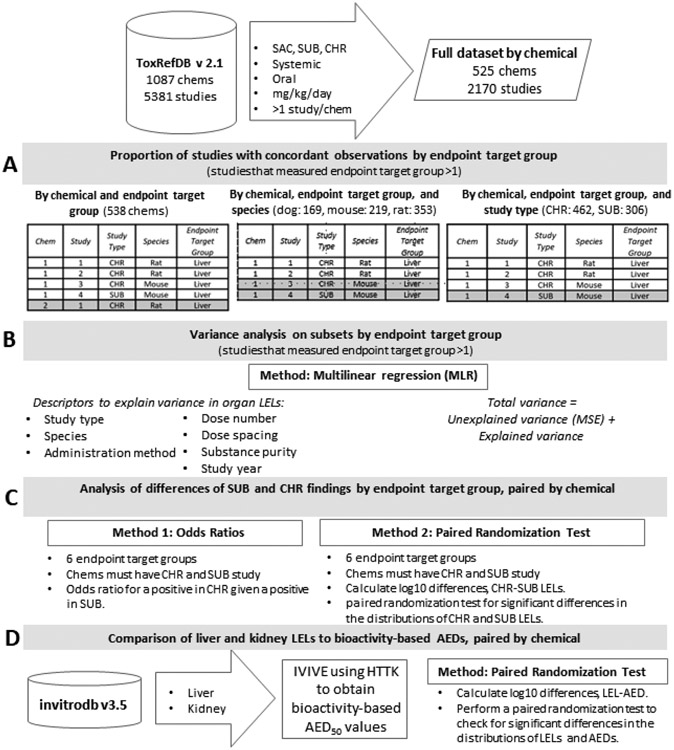
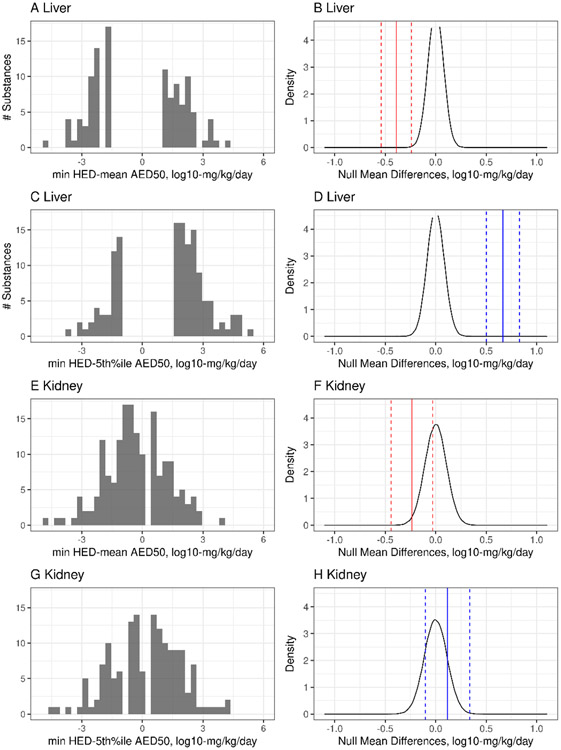
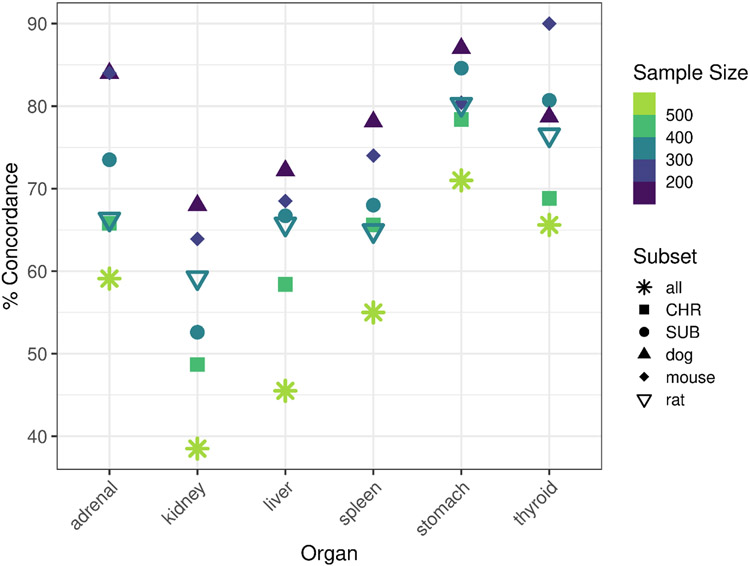
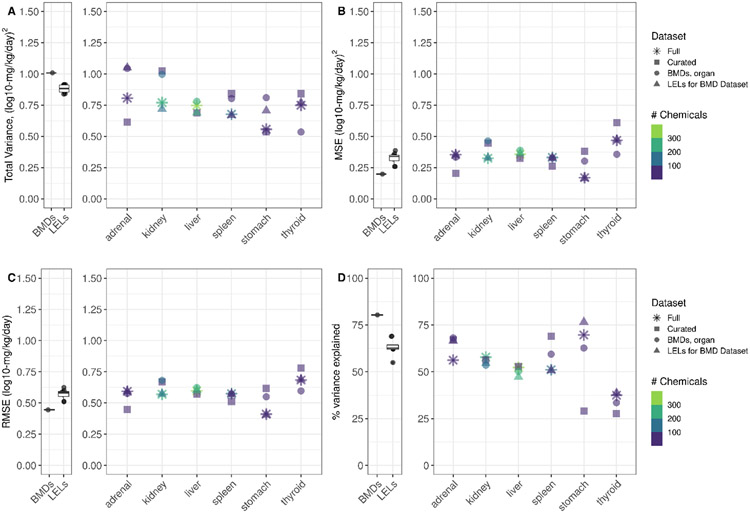
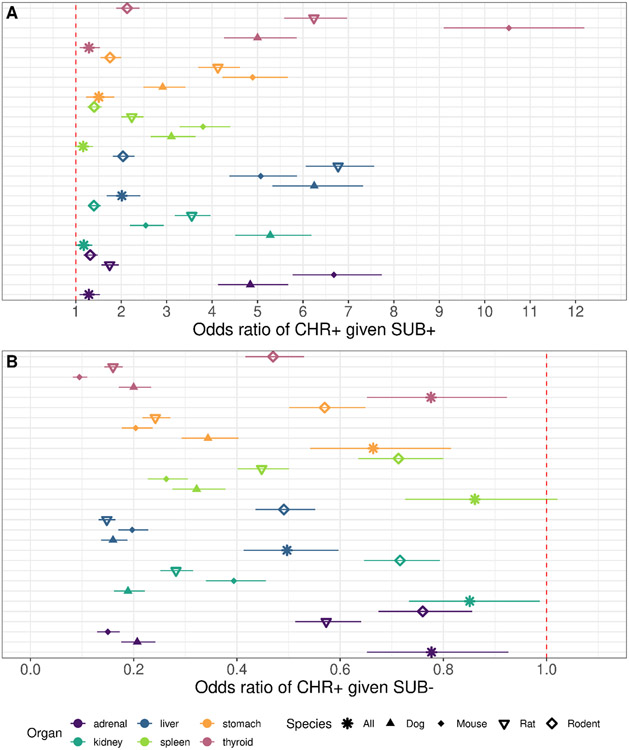
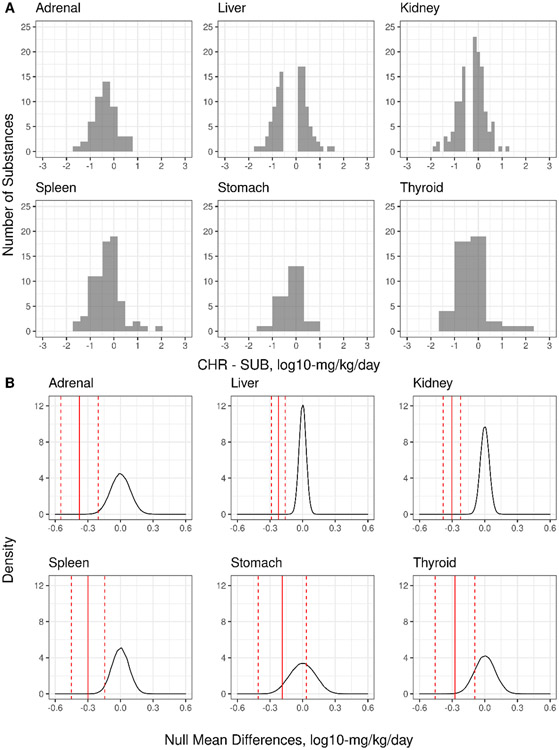
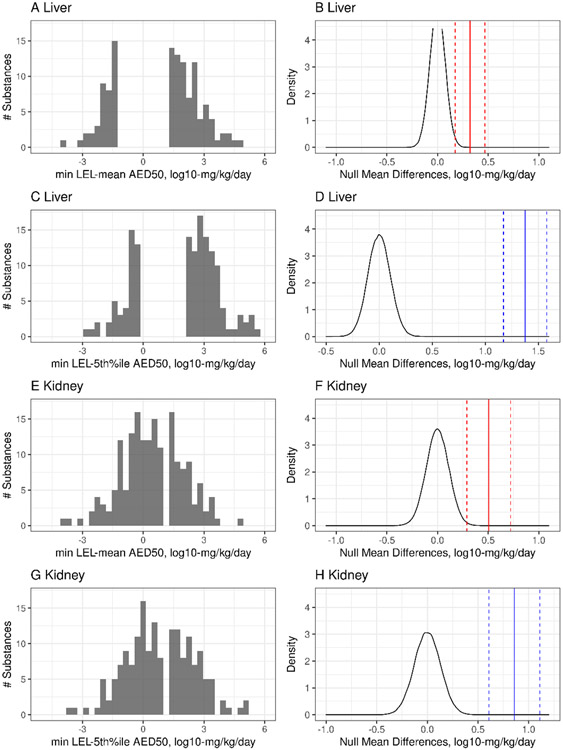
This work estimates benchmarks for new approach method (NAM) performance in predicting organ-level effects in repeat dose studies of adult animals based on variability in replicate animal studies. Treatment-related effect values from the Toxicity Reference database (v2.1) for weight, gross, or histopathological changes in the adrenal gland, liver, kidney, spleen, stomach, and thyroid were used. Rates of chemical concordance among organ-level findings in replicate studies, defined by repeated chemical only, chemical and species, or chemical and study type, were calculated. Concordance was 39 - 88%, depending on organ, and was highest within species. Variance in treatment-related effect values, including lowest effect level (LEL) values and benchmark dose (BMD) values when available, was calculated by organ. Multilinear regression modeling, using study descriptors of organ-level effect values as covariates, was used to estimate total variance, mean square error (MSE), and root residual mean square error (RMSE). MSE values, interpreted as estimates of unexplained variance, suggest study descriptors accounted for 52-69% of total variance in organ-level LELs. RMSE ranged from 0.41 - 0.68 log-mg/kg/day. Differences between organ-level effects from chronic (CHR) and subchronic (SUB) dosing regimens were also quantified. Odds ratios indicated CHR organ effects were unlikely if the SUB study was negative. Mean differences of CHR - SUB organ-level LELs ranged from -0.38 to -0.19 log mg/kg/day; the magnitudes of these mean differences were less than RMSE for replicate studies. Finally, to extrapolation (IVIVE) was employed to compare bioactive concentrations from NAMs for kidney and liver to LELs. The observed mean difference between LELs and mean IVIVE dose predictions approached 0.5 log-mg/kg/day, but differences by chemical ranged widely. Overall, variability in repeat dose organ-level effects suggests expectations for quantitative accuracy of NAM prediction of LELs should be at least ± 1 log-mg/kg/day, with qualitative accuracy not exceeding 70%.
本研究基于成年动物重复剂量研究中复制动物研究的变异性,估计了新方法(NAM)在预测器官水平效应方面的基准。使用了毒性参考数据库(v2.1)中关于肾上腺、肝脏、肾脏、脾脏、胃和甲状腺的体重、大体或组织病理学变化的与治疗相关的效应值。计算了重复研究中器官水平发现之间的化学一致性率,其定义为仅重复化学物质、化学物质和物种或化学物质和研究类型。一致性为39%-88%,取决于器官,且在物种内最高。按器官计算了与治疗相关的效应值的方差,包括最低效应水平(LEL)值和可用时的基准剂量(BMD)值。使用器官水平效应值的研究描述符作为协变量的多线性回归模型,用于估计总方差、均方误差(MSE)和根残差均方误差(RMSE)。MSE值被解释为未解释方差的估计值,表明研究描述符占器官水平LEL总方差的52%-69%。RMSE范围为0.41-0.68 log-mg/kg/天。还对慢性(CHR)和亚慢性(SUB)给药方案的器官水平效应之间的差异进行了量化。优势比表明,如果亚慢性研究为阴性,则慢性器官效应不太可能出现。慢性-亚慢性器官水平LEL的平均差异范围为-0.38至-0.19 log mg/kg/天;这些平均差异的幅度小于复制研究的RMSE。最后,采用体外外推法(IVIVE)将肾脏和肝脏的NAM生物活性浓度与LEL进行比较。LEL与IVIVE平均剂量预测之间观察到的平均差异接近0.5 log-mg/kg/天,但不同化学物质的差异范围很大。总体而言,重复剂量器官水平效应的变异性表明,对NAM预测LEL的定量准确性的期望应至少为±1 log-mg/kg/天,定性准确性不超过70%。