Krioplanet Ltd, Treviglio, Bergamo, Italy.
Department of Experimental Medicine, Università degli Studi di Genova, Genoa, Italy.
PLoS One. 2023 Nov 22;18(11):e0288700. doi: 10.1371/journal.pone.0288700. eCollection 2023.
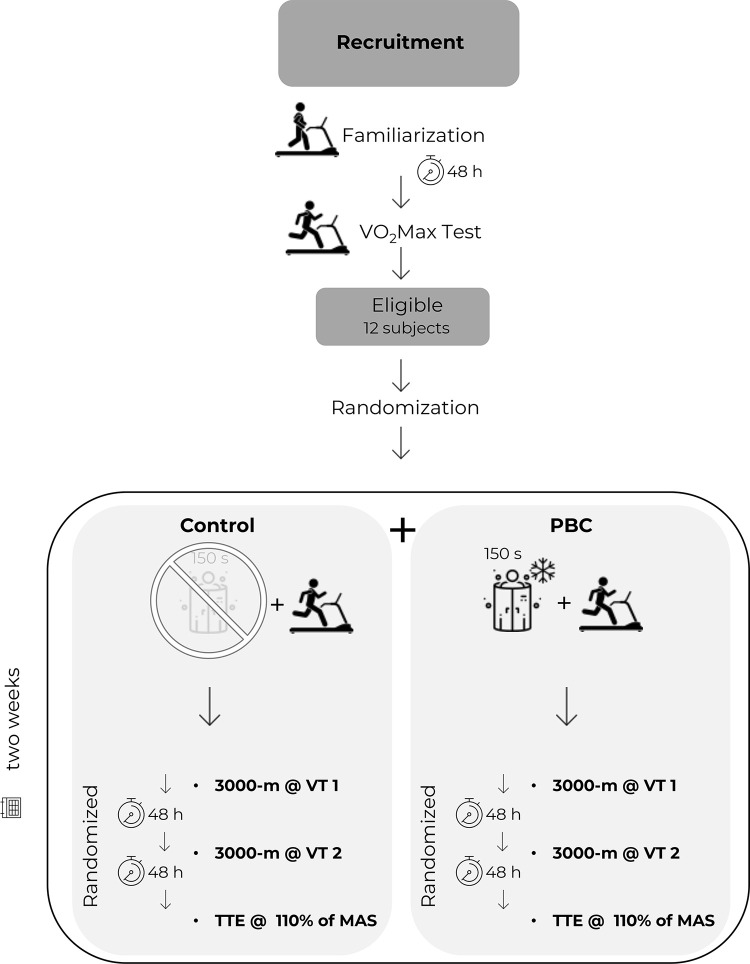
The purpose of this study was to investigate the effects of partial-body cryostimulation on middle-distance runners before two 3000-m tests at the speed of the first and second ventilatory threshold, and before a time to exhaustion test at 110% of the maximal aerobic speed. Twelve amateur runners (age: 46 ± 9 years; VO2max: 51.7 ± 4.9 ml·kg-1·min-1) completed six running testing sessions in a randomized counterbalanced cross-over fashion: three of them were preceded by a partial-body cryostimulation and the other three by a control condition. The testing sessions consisted of: 1) a 3000-m continuous running test at the speed of the first ventilatory threshold; 2) a 3000-m continuous running test at the speed of the second ventilatory threshold; 3) a time to exhaustion test at 110% of the maximal aerobic speed. Heart rate, ratings of perceived exertion and visual analogue scale relative to muscle pain were recorded throughout the tests. Total quality recovery was evaluated 24-48 h after the end of each test. Distance to exhaustion was higher after partial-body cryostimulation than control condition (p = 0.018; partial-body cryostimulation: 988 ± 332 m, control: 893 ± 311 m). There were differences in the ratings of perceived exertion during each split of the 3000-m continuous running test at the speed of the second ventilatory threshold (p = 0.001). Partial-body cryostimulation can be positively considered to enhance middle-distance running performance and reduce perception of effort in amateur runners.
本研究旨在探讨部分身体冷冻刺激对中长跑运动员在两次 3000 米测试(速度分别为第一和第二通气阈值)以及 110%最大有氧速度的力竭测试前的影响。12 名业余跑步者(年龄:46 ± 9 岁;最大摄氧量:51.7 ± 4.9 ml·kg-1·min-1)以随机交叉平衡的方式完成了六次跑步测试:其中三次测试前进行部分身体冷冻刺激,另外三次测试前进行对照条件。测试内容包括:1)以第一通气阈值速度进行 3000 米连续跑步测试;2)以第二通气阈值速度进行 3000 米连续跑步测试;3)以 110%最大有氧速度进行力竭测试。在整个测试过程中,记录心率、感知运动强度和肌肉疼痛的视觉模拟量表。在每次测试结束后 24-48 小时,评估总质量恢复情况。与对照条件相比,部分身体冷冻刺激后力竭距离更高(p = 0.018;部分身体冷冻刺激:988 ± 332 m,对照:893 ± 311 m)。在以第二通气阈值速度进行的 3000 米连续跑步测试的每个分段中,感知运动强度存在差异(p = 0.001)。部分身体冷冻刺激可以被认为积极地增强了中长跑运动员的运动表现,同时降低了业余跑步者的运动感知强度。