Instituto de Investigaciones en Matemáticas Aplicadas y en Sistemas, Universidad Nacional Autónoma de México, Ciudad de México, Mexico.
Instituto de Matemáticas, Universidad Nacional Autónoma de México, Juriquilla Querétaro, Mexico.
PLoS Comput Biol. 2023 Nov 22;19(11):e1011673. doi: 10.1371/journal.pcbi.1011673. eCollection 2023 Nov.
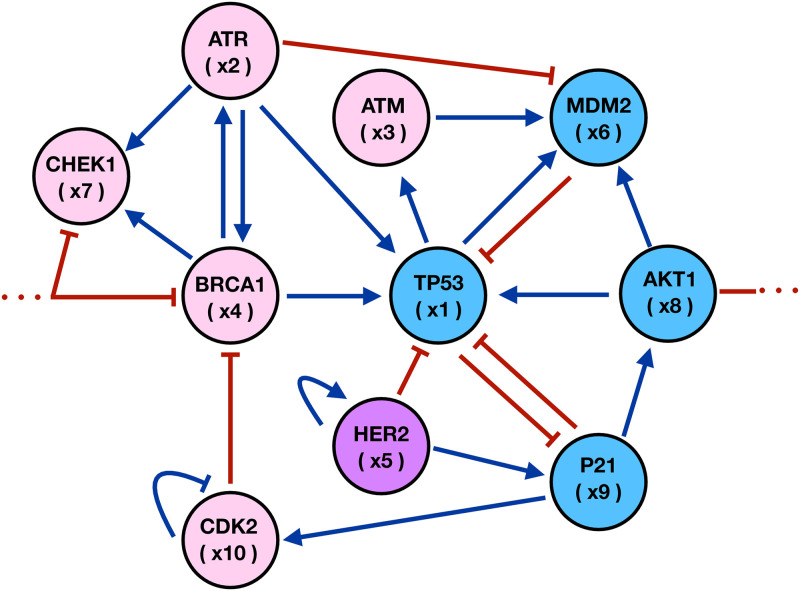
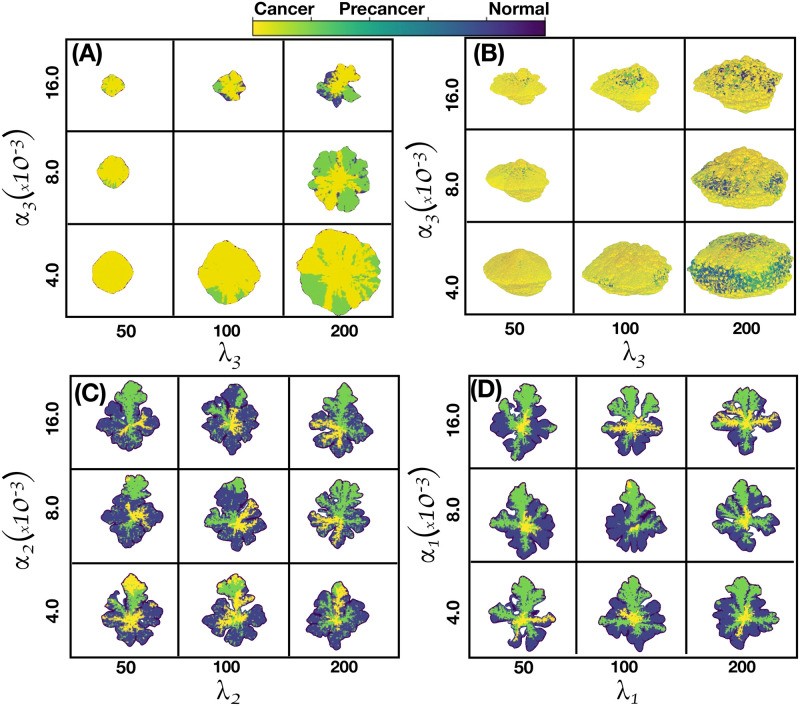
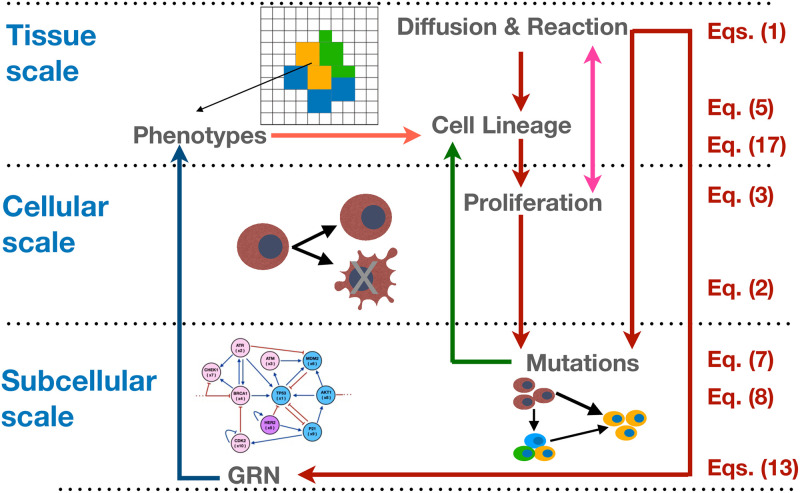
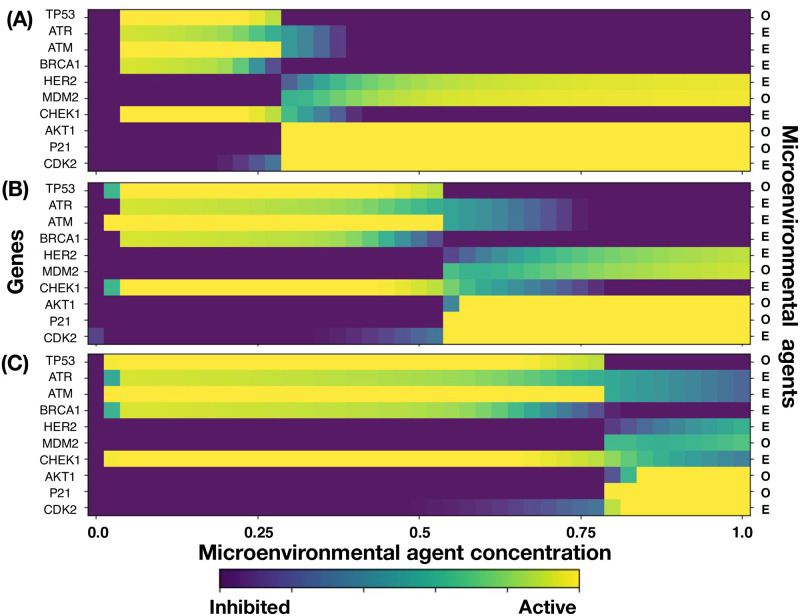
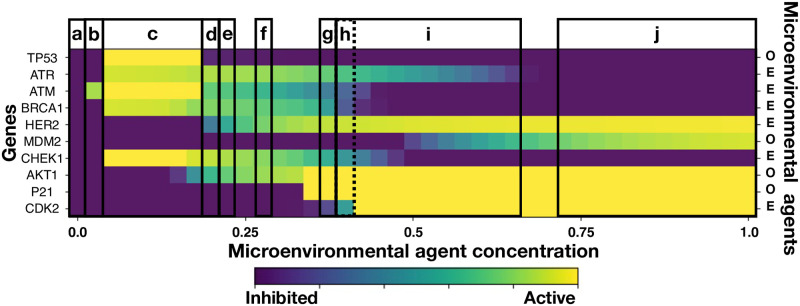
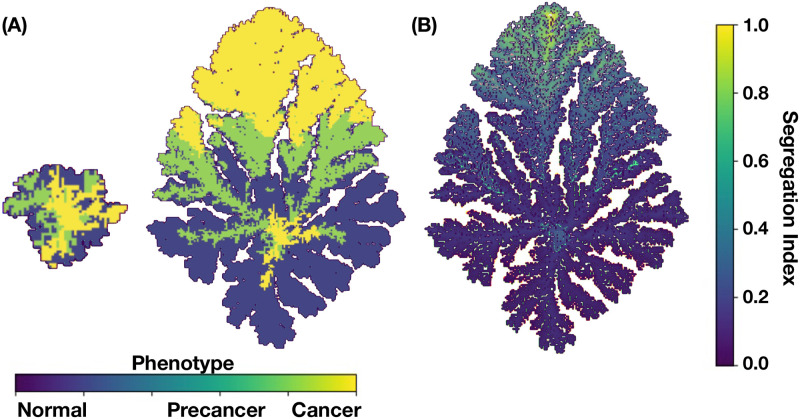
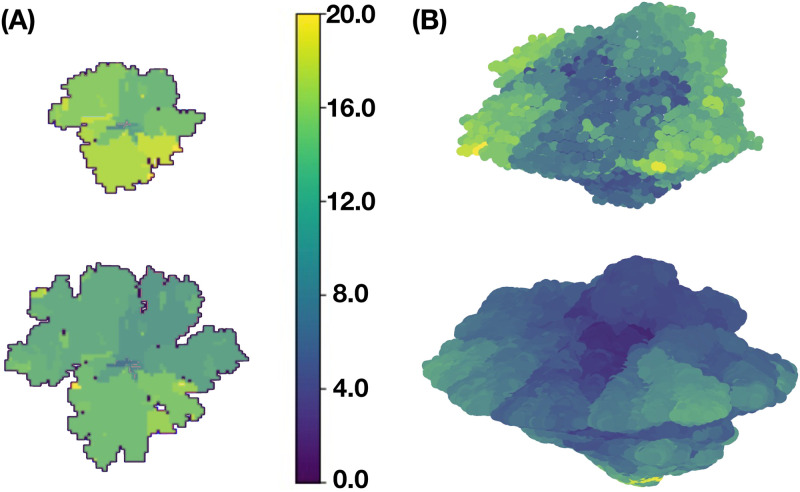
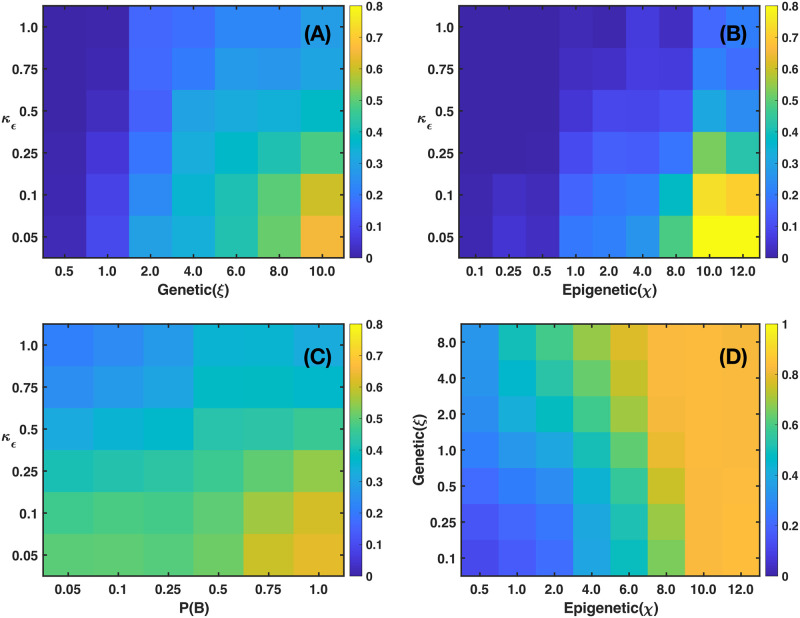
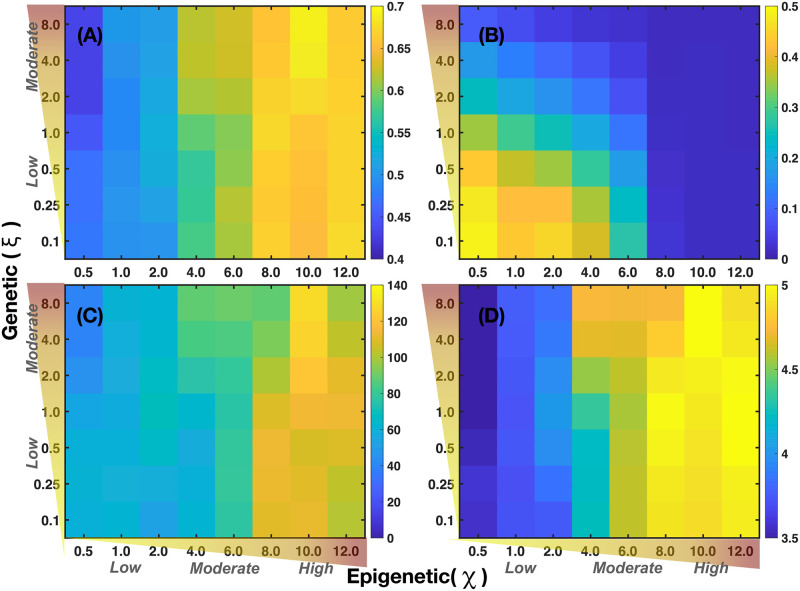
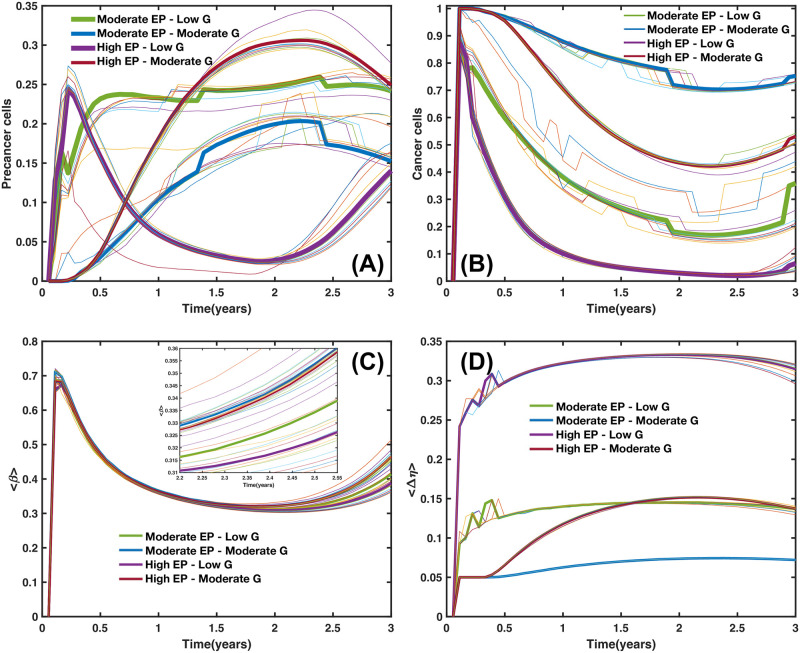
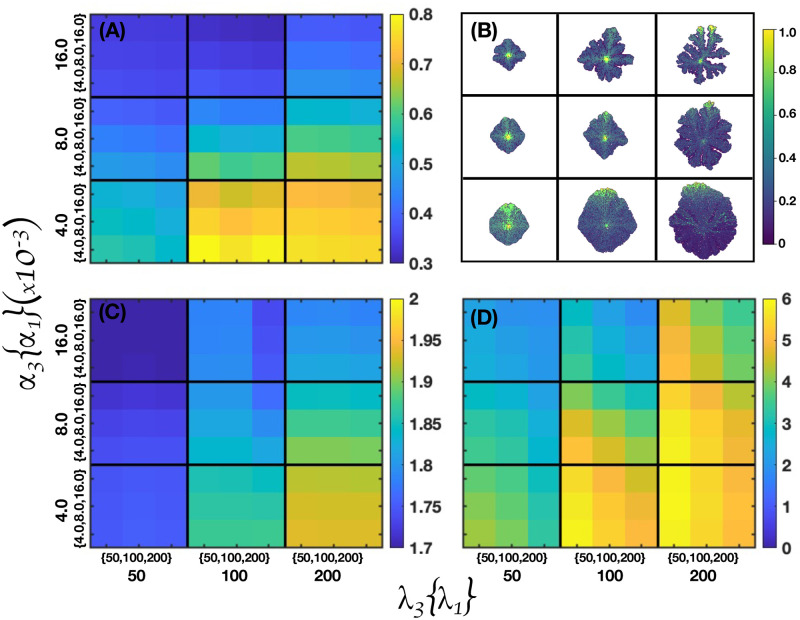
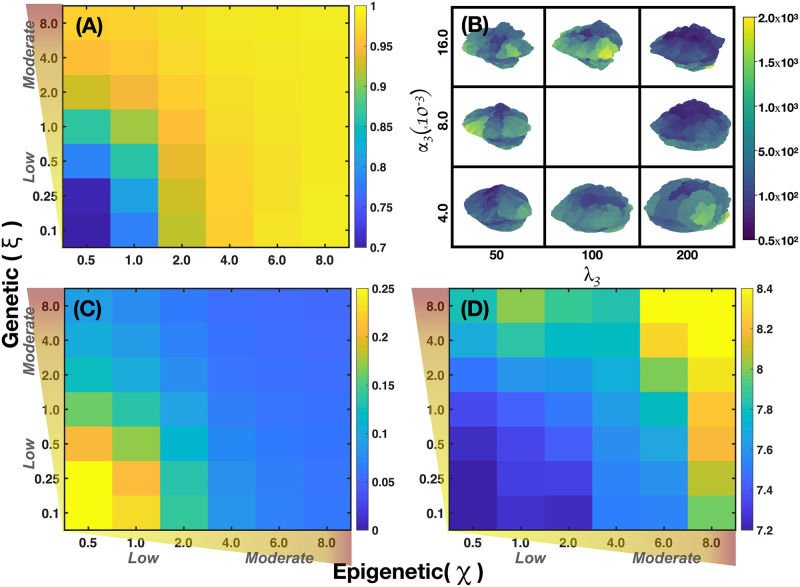
We analyzed a quantitative multiscale model that describes the epigenetic dynamics during the growth and evolution of an avascular tumor. A gene regulatory network (GRN) formed by a set of ten genes that are believed to play an important role in breast cancer development was kinetically coupled to the microenvironmental agents: glucose, estrogens, and oxygen. The dynamics of spontaneous mutations was described by a Yule-Furry master equation whose solution represents the probability that a given cell in the tissue undergoes a certain number of mutations at a given time. We assumed that the mutation rate is modified by a spatial gradient of nutrients. The tumor mass was simulated by means of cellular automata supplemented with a set of reaction diffusion equations that described the transport of microenvironmental agents. By analyzing the epigenetic state space described by the GRN dynamics, we found three attractors that were identified with cellular epigenetic states: normal, precancer and cancer. For two-dimensional (2D) and three-dimensional (3D) tumors we calculated the spatial distribution of the following quantities: (i) number of mutations, (ii) mutation of each gene and, (iii) phenotypes. Using estrogen as the principal microenvironmental agent that regulates cell proliferation process, we obtained tumor shapes for different values of estrogen consumption and supply rates. It was found that he majority of mutations occurred in cells that were located close to the 2D tumor perimeter or close to the 3D tumor surface. Also, it was found that the occurrence of different phenotypes in the tumor are controlled by estrogen concentration levels since they can change the individual cell threshold and gene expression levels. All results were consistently observed for 2D and 3D tumors.
我们分析了一个定量多尺度模型,该模型描述了无血管肿瘤生长和进化过程中的表观遗传动态。由一组十个基因组成的基因调控网络(GRN)被认为在乳腺癌的发展中起着重要作用,与葡萄糖、雌激素和氧气等微环境因子动力学耦合。自发突变的动力学由一个 Yule-Furry 主方程描述,其解表示组织中给定细胞在给定时间经历一定数量突变的概率。我们假设突变率由营养物质的空间梯度修改。肿瘤质量通过补充一组描述微环境因子运输的反应扩散方程的元胞自动机来模拟。通过分析 GRN 动力学描述的表观遗传状态空间,我们发现了三个吸引子,它们与细胞表观遗传状态相对应:正常、癌前和癌症。对于二维(2D)和三维(3D)肿瘤,我们计算了以下数量的空间分布:(i)突变数,(ii)每个基因的突变和(iii)表型。使用雌激素作为调节细胞增殖过程的主要微环境因子,我们获得了不同雌激素消耗和供应率下的肿瘤形状。结果发现,大多数突变发生在靠近 2D 肿瘤边缘或靠近 3D 肿瘤表面的细胞中。此外,还发现肿瘤中不同表型的发生受到雌激素浓度水平的控制,因为它们可以改变单个细胞的阈值和基因表达水平。所有结果在 2D 和 3D 肿瘤中均得到一致观察。