Duke Institute for Genome Sciences and Policy, Duke University Medical Center, Durham, NC 27708, USA.
Breast Cancer Res. 2011 Jun 7;13(3):R62. doi: 10.1186/bcr2899.
Breast cancer heterogeneity occurs as a consequence of the dysregulation of numerous oncogenic pathways as well as many non-genetic factors, including tumor microenvironmental stresses such as hypoxia, lactic acidosis, and glucose deprivation. Although the importance of these non-genetic factors is well recognized, it is not clear how to integrate these factors within the genetic framework of cancer as the next logical step in understanding tumor heterogeneity.
We report here the development of a series of gene expression signatures to measure the influences of microenvironmental stresses. The pathway activities of hypoxia, lactic acidosis, acidosis and glucose deprivation were investigated in a collection of 1,143 breast tumors, which have been separated into 17 breast tumor subgroups defined by their distinct patterns of oncogenic pathways. A validation dataset comprised of 547 breast tumors was also used to confirm the major findings, and representative breast cancer cell lines were utilized to validate in silico results and mechanistic studies.
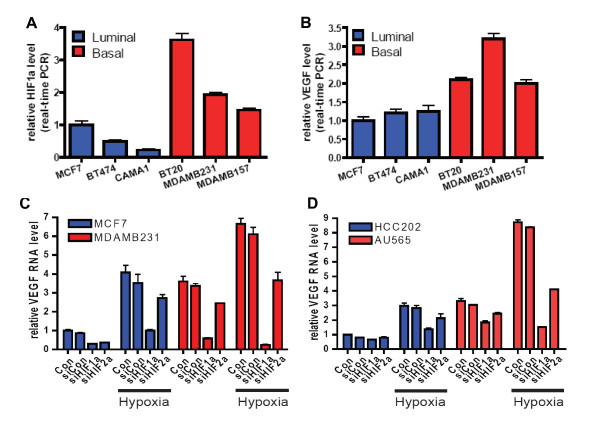
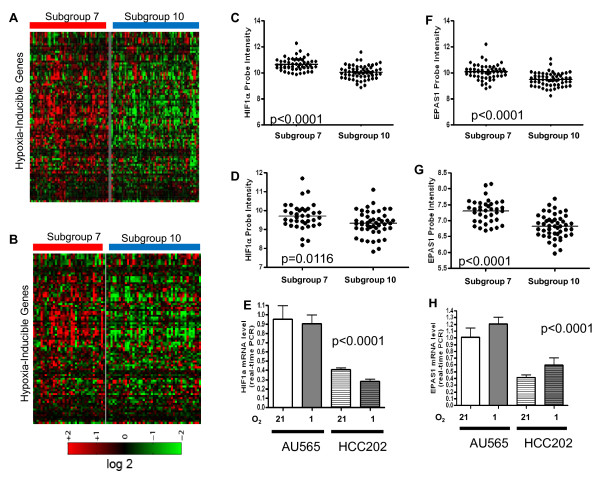
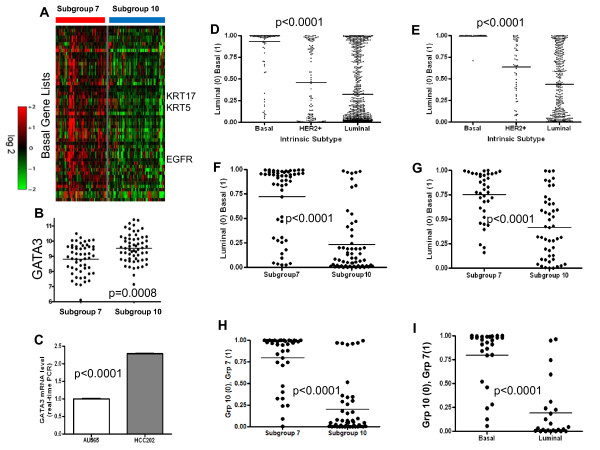
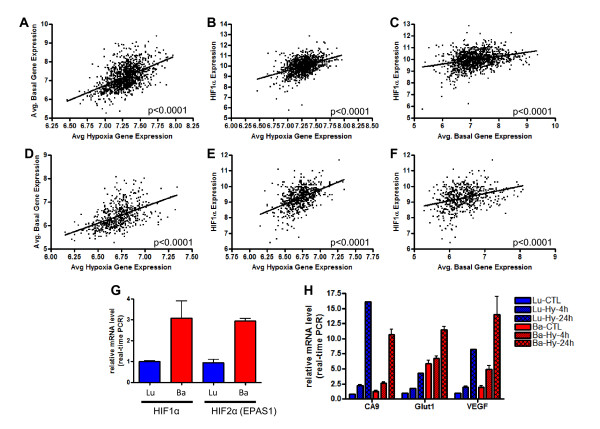
Through the integrative pathway analysis of microenvironmental stresses and oncogenic events in breast tumors, we identified many known and novel correlations between these two sources of tumor heterogeneity. Focusing on differences between two human epidermal growth factor receptor 2 (HER2)-related subgroups, previously identified based on patterns of oncogenic pathway activity, we determined that these subgroups differ with regards to tumor microenvironmental signatures, including hypoxia. We further demonstrate that each of these subgroups have features consistent with basal and luminal breast tumors including patterns of oncogenic signaling pathways, expression of subtype specific genes, and cellular mechanisms that regulate the hypoxia response. Importantly, we also demonstrate that the correlated pattern of hypoxia-related gene expression and basal-associated gene expression are consistent across HER2-related tumors whether we analyze the tumors as a function of our pathway-based classification scheme, using the intrinsic gene list (ERBB2+), or based on HER2 IHC status. Our results demonstrate a cell lineage-specific phenomenon in which basal-like tumors, HER2-related tumors with high hypoxia, as well as normal basal epithelial cells express increased mRNA levels of HIF-1α compared to luminal types and silencing of HIF-1α results in decreased expression of hypoxia-induced genes.
This study demonstrates differences in microenvironmental conditions in HER2-related subgroups defined by distinct oncogenic pathway activities, and provides a mechanistic explanation for differences in the observed hypoxia response between these subgroups. Collectively, these data demonstrate the potential of a pathway-based classification strategy as a framework to integrate genetic and non-genetic factors to investigate the basis of tumor heterogeneity.
乳腺癌异质性是由于众多致癌途径的失调以及许多非遗传因素引起的,包括肿瘤微环境应激如缺氧、乳酸酸中毒和葡萄糖剥夺。尽管这些非遗传因素的重要性已得到广泛认可,但如何将这些因素纳入癌症的遗传框架内,以了解肿瘤异质性的下一个逻辑步骤尚不清楚。
我们在此报告了一系列基因表达特征的开发,以测量微环境应激的影响。在一组 1143 个乳腺癌肿瘤中研究了缺氧、乳酸酸中毒、酸中毒和葡萄糖剥夺的途径活性,这些肿瘤已根据其不同的致癌途径模式分为 17 个乳腺癌肿瘤亚组。还使用了包含 547 个乳腺癌肿瘤的验证数据集来证实主要发现,并利用代表性乳腺癌细胞系进行了计算机模拟结果和机制研究的验证。
通过对乳腺癌肿瘤中微环境应激和致癌事件的综合途径分析,我们发现了这两种肿瘤异质性来源之间的许多已知和新的相关性。我们专注于两个基于人类表皮生长因子受体 2(HER2)的亚组之间的差异,这些亚组是根据致癌途径活性模式先前确定的,我们确定这些亚组在肿瘤微环境特征方面存在差异,包括缺氧。我们进一步证明,这些亚组中的每一个都具有与基底和管腔乳腺癌一致的特征,包括致癌信号通路的模式、亚型特异性基因的表达以及调节缺氧反应的细胞机制。重要的是,我们还证明,无论我们是根据我们的基于途径的分类方案、使用内在基因列表(ERBB2+)还是基于 HER2 IHC 状态分析肿瘤,与缺氧相关的基因表达和基底相关基因表达的相关模式在 HER2 相关肿瘤中都是一致的。我们的结果表明,在基底样肿瘤、HER2 相关的高缺氧肿瘤以及正常的基底上皮细胞中,与管腔类型相比,HIF-1α 的 mRNA 水平表达增加,并且沉默 HIF-1α 导致缺氧诱导基因的表达减少,这是一种细胞谱系特异性现象。
本研究表明,HER2 相关亚组之间的微环境条件存在差异,这些差异是由不同的致癌途径活性定义的,并为这些亚组之间观察到的缺氧反应差异提供了一种机制解释。总的来说,这些数据表明,基于途径的分类策略具有作为整合遗传和非遗传因素以研究肿瘤异质性基础的潜力。