Matud María Pilar, Zueco Jesús, Del Pino-Espejo Maria José, Fortes Demelsa, Beleña María Ángeles, Santos Cristina, Díaz Amelia
Department of Clinical Psychology, Psychobiology and Methodology, University of La Laguna, 38200 La Laguna, Spain.
Department of Microbiology, University of Valencia, 46100 Valencia, Spain.
Eur J Investig Health Psychol Educ. 2023 Nov 9;13(11):2583-2598. doi: 10.3390/ejihpe13110180.
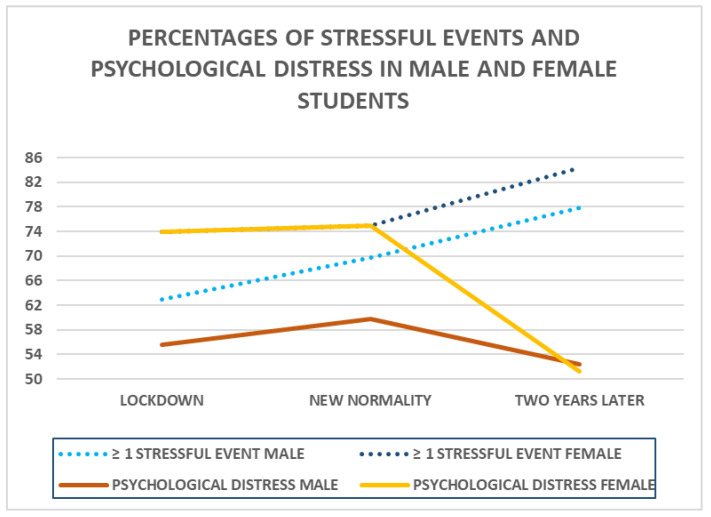
The present study assesses the evolution of stressful events and psychological distress in male and female students over three different time periods of the COVID-19 pandemic in Spain: the initial "lockdown", with no face-to-face teaching; the "new normality" period, when classes were resumed; and two years after the first wave of the pandemic. The participants were 1200 Spanish university students who were assessed for psychological distress, COVID-19-associated stressful events, social support, and self-esteem. Female students reported more stressful events and higher levels of psychological distress than male students during the "lockdown" and "new normality" time periods of the first wave of the pandemic. However, these differences disappeared in the third period tested, two years after the first wave of the pandemic, with female and male students showing no differences in psychological distress or in the number of stressful events. The main risk predictors of psychological distress during the first wave of the pandemic were lower self-esteem and having suffered a high number of stressful events. The last variable, number of stressful events associated with COVID-19, lost most its effect two years later, when only self-esteem presented a strong and highly significant predictive role.
最初的“封锁”期,无面对面教学;“新常态”期,恢复上课;以及疫情第一波爆发两年后。参与者为1200名西班牙大学生,他们接受了心理困扰、新冠相关压力事件、社会支持和自尊的评估。在疫情第一波的“封锁”和“新常态”时期,女生报告的压力事件更多,心理困扰水平也高于男生。然而,在测试的第三个时期,即疫情第一波爆发两年后,这些差异消失了,男女学生在心理困扰或压力事件数量上没有差异。疫情第一波期间心理困扰的主要风险预测因素是自尊较低和经历了大量压力事件。最后一个变量,即与新冠相关的压力事件数量,在两年后失去了大部分影响,此时只有自尊呈现出强烈且高度显著的预测作用。