Eildermann Katja, Goldmann Sabrina, Krause Ulrich, Backhoff David, Schöndube Friedrich A, Paul Thomas, Quentin Thomas, Müller Matthias J
Department of Pediatric Cardiology and Intensive Care Medicine, Georg-August-University Goettingen, 37077 Goettingen, Germany.
Department of Thoracic and Cardiovascular Surgery, Georg-August-University Goettingen, 37077 Goettingen, Germany.
J Cardiovasc Dev Dis. 2023 Nov 17;10(11):466. doi: 10.3390/jcdd10110466.
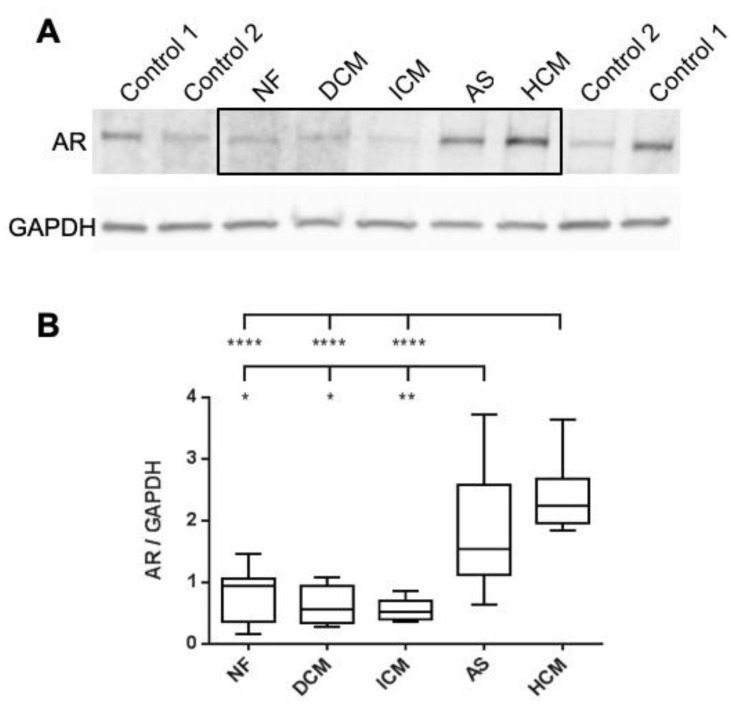
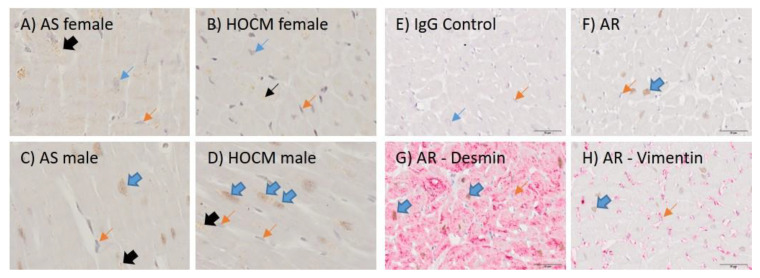
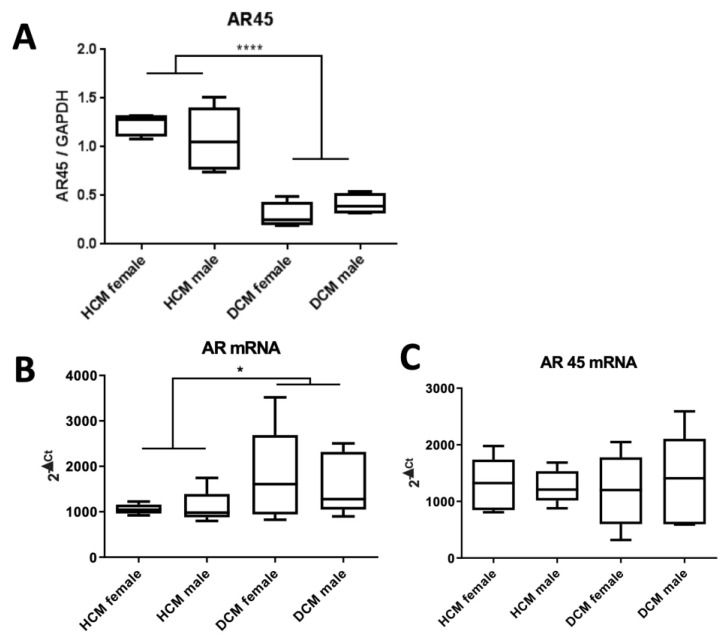
: Sex-specific differences in heart disease outcomes are influenced by the levels of the steroid hormones, estrogen and testosterone. While the roles of estrogen receptors in cardiac disease are well-studied in animals and humans, respective research on androgen receptors (AR) is limited. Here we investigate AR protein and mRNA expression in human myocardium of various cardiac diseases. : AR expression was analyzed by western blotting in myocardium from human non-failing hearts (NF, n = 6) and patients with aortic stenosis (AS, n = 6), hypertrophic cardiomyopathy (HCM, n = 7), dilated cardiomyopathy (DCM, n = 7), and ischemic cardiomyopathy (ICM, n = 7). Using an AR45-specific antibody, a subsequent western blot assessed samples from male and female patients with HCM (n = 10) and DCM (n = 10). The same sample set was probed for full-length and mRNA expression. Immunohistochemistry (IHC) localized AR in myocardium from HCM and AS hearts. : Full-length AR was notably enriched in AS and HCM hearts compared to ICM, DCM, and NF. Similarly, AR45 was more abundant in HCM than in DCM. In contrast to the pattern observed for AR protein, full-length mRNA levels were lower in HCM compared to DCM, with no discernible difference for the isoform. Although gender differences in AR expression were not detected in western blots or qRT-PCR, IHC showed stronger nuclear AR signals in males than in females. : Our findings indicate disease-specific regulation of mRNA and/or AR protein in cardiac hypertrophy, underscoring a potential role in this cardiac pathology.
心脏病结局中的性别差异受甾体激素雌激素和睾酮水平的影响。虽然雌激素受体在心脏病中的作用在动物和人类中已得到充分研究,但关于雄激素受体(AR)的相关研究却很有限。在此,我们研究各种心脏病患者心肌中AR蛋白和mRNA的表达情况。
通过蛋白质印迹法分析了来自人类非衰竭心脏(NF,n = 6)以及患有主动脉瓣狭窄(AS,n = 6)、肥厚型心肌病(HCM,n = 7)、扩张型心肌病(DCM,n = 7)和缺血性心肌病(ICM,n = 7)患者的心肌中的AR表达。使用一种AR45特异性抗体,随后的蛋白质印迹法评估了来自HCM和DCM的男性和女性患者(n = 10)的样本。对同一组样本检测全长 和 mRNA表达情况。免疫组织化学(IHC)确定了HCM和AS心脏心肌中的AR定位。
与ICM、DCM和NF相比,全长AR在AS和HCM心脏中显著富集。同样,AR45在HCM中比在DCM中更丰富。与AR蛋白观察到的模式相反,与DCM相比,HCM中全长 mRNA水平较低, 异构体没有明显差异。虽然在蛋白质印迹法或定量逆转录聚合酶链反应(qRT-PCR)中未检测到AR表达的性别差异,但免疫组织化学显示男性的核AR信号比女性更强。
我们的研究结果表明,在心肌肥厚中mRNA和/或AR蛋白存在疾病特异性调控,这突出了其在这种心脏病理中的潜在作用。