Chungnam National University Hospital Biomedical Research Institute, Daejeon, South Korea.
National Food Safety Information Service, Seoul, South Korea.
Eur J Nutr. 2024 Feb;63(1):279-289. doi: 10.1007/s00394-023-03258-x. Epub 2023 Nov 24.
Unfavorable changes in eating patterns over time may contribute to upward trends in chronic diseases, such as obesity. We examined 20-year trends in the percentage of energy from main meals and snacks and the food sources of each eating occasion among Korean adults.
This study used nationally representative data from the 1st, 4th, and 7th Korea National Health and Nutrition Examination Surveys (1998, 2007-2009, and 2016-2018) among adults aged 20-69 years (n = 29,389). Each eating occasion (breakfast, lunch, dinner, and snacks) was defined by respondents during a 24-h dietary recall interview. To identify the food sources of each eating occasion, we used the NOVA system. The percentage of energy at each eating occasion and that from each NOVA group across survey cycles were estimated, and tests for linear trends were conducted using orthogonal polynomial contrasts in linear regression models. All analyses accounted for the complex survey design.
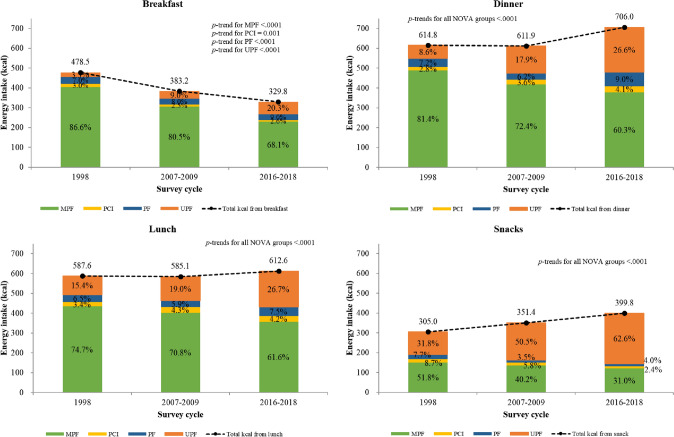
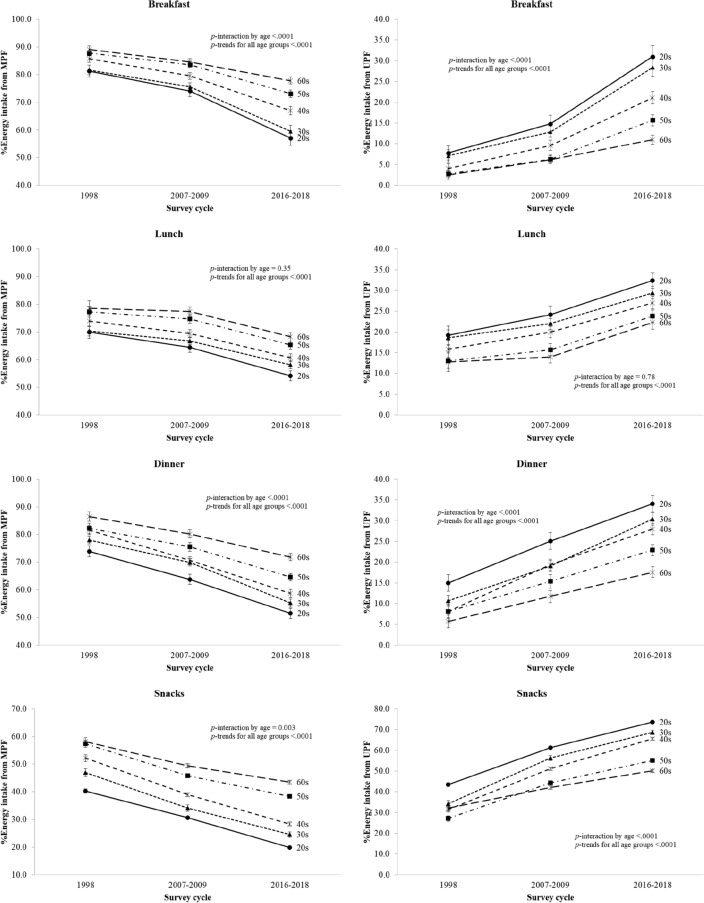
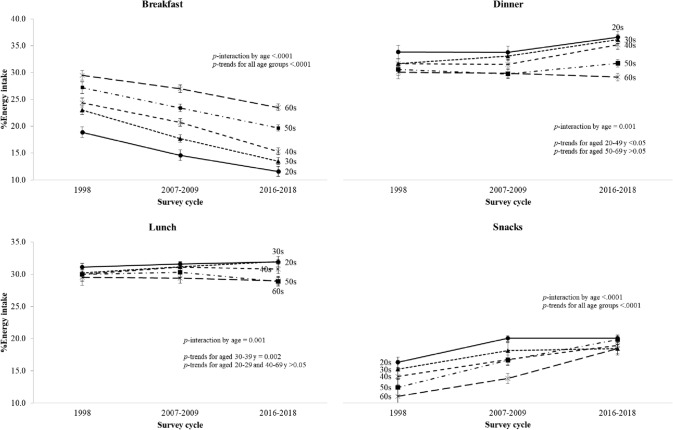
After adjusting for age and sex, the percentage of energy from breakfast decreased from 25.0% in 1998 to 16.7% in 2018 (difference, - 8.2%; standard error [SE], 0.3), whereas that from dinner and snacks increased from 31.1 to 33.8% (difference, + 2.7%; SE, 0.4) and from 14.0 to 19.0% (difference, + 5.0%; SE, 0.5), respectively (all P < 0.001). At all eating occasions, the percentage of energy from minimally processed foods declined (difference, - 18.6% for breakfast; - 13.1% for lunch; - 21.1% for dinner; - 20.7% for snacks), while that from ultra-processed foods increased (difference, + 17.0% for breakfast; + 11.3% for lunch; + 18.0% for dinner; + 30.7% for snacks). When stratified by age, the given trends were shown to a greater extent in younger adults (< 50 years old) than in older adults (≥ 50 years old).
The eating patterns of Korean adults changed from 1998 to 2018, with the greatest decrease in energy intake from breakfast and the greatest increase from snacking. At all eating occasions, the contribution of minimally processed foods declined, while that of ultra-processed foods increased, especially among younger adults.
随着时间的推移,饮食习惯的不利变化可能导致肥胖等慢性病呈上升趋势。我们研究了韩国成年人在 20 年内主要餐次和零食的能量百分比以及各餐次的食物来源的变化趋势。
本研究使用了韩国全国健康与营养调查(1998 年、2007-2009 年和 2016-2018 年)中 20-69 岁成年人(n=29389)的全国代表性数据。受访者在 24 小时膳食回忆访谈中定义了每一次进食(早餐、午餐、晚餐和零食)。为了确定各次进食的食物来源,我们使用了 NOVA 系统。在各次调查周期中,我们估计了各次进食的能量百分比和各 NOVA 组的能量百分比,并使用线性回归模型中的正交多项式对比进行了线性趋势检验。所有分析均考虑了复杂的调查设计。
在调整了年龄和性别后,早餐的能量百分比从 1998 年的 25.0%下降到 2018 年的 16.7%(差异,-8.2%;标准误差[SE],0.3),而晚餐和零食的能量百分比分别从 31.1%增加到 33.8%(差异,+2.7%;SE,0.4)和从 14.0%增加到 19.0%(差异,+5.0%;SE,0.5)(均 P<0.001)。在所有的进食场合,低加工食品的能量百分比均下降(早餐差异,-18.6%;午餐差异,-13.1%;晚餐差异,-21.1%;零食差异,-20.7%),而超加工食品的能量百分比增加(早餐差异,+17.0%;午餐差异,+11.3%;晚餐差异,+18.0%;零食差异,+30.7%)。按年龄分层后,在较年轻的成年人(<50 岁)中,这些趋势比在较年长的成年人(≥50 岁)中更为明显。
1998 年至 2018 年,韩国成年人的饮食习惯发生了变化,早餐的能量摄入量降幅最大,零食的能量摄入量增幅最大。在所有的进食场合,低加工食品的贡献下降,而超加工食品的贡献增加,尤其是在较年轻的成年人中。