School of Pharmacy, S.D. Asfendiyarov Kazakh National Medical University, Tole-bi 94, Almaty 050012, Kazakhstan.
Higher School of Medicine, Al-Farabi Kazakh National University, Almaty 050040, Kazakhstan.
Molecules. 2023 Nov 12;28(22):7556. doi: 10.3390/molecules28227556.
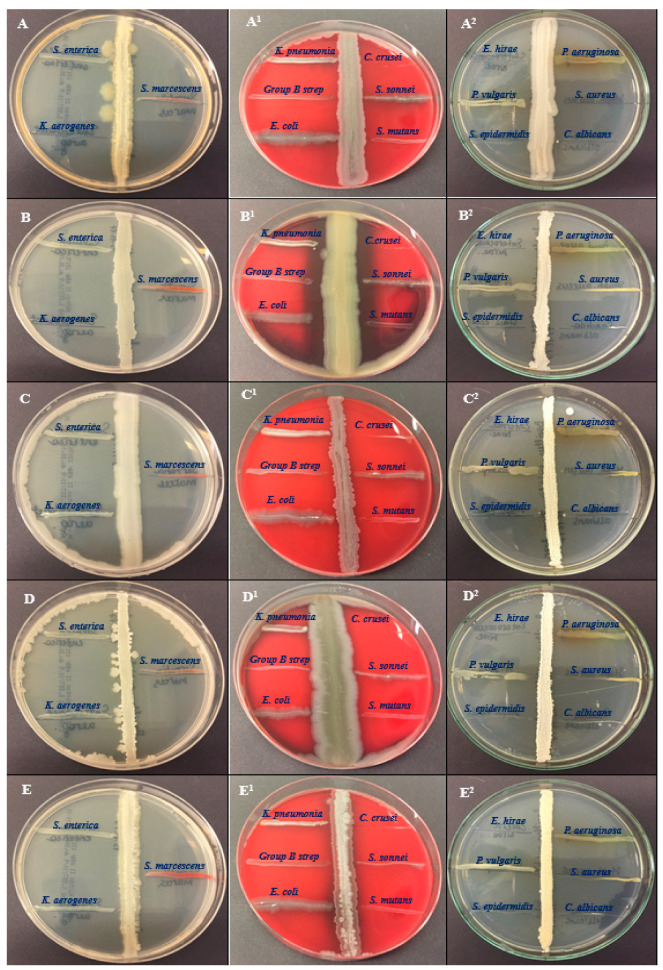
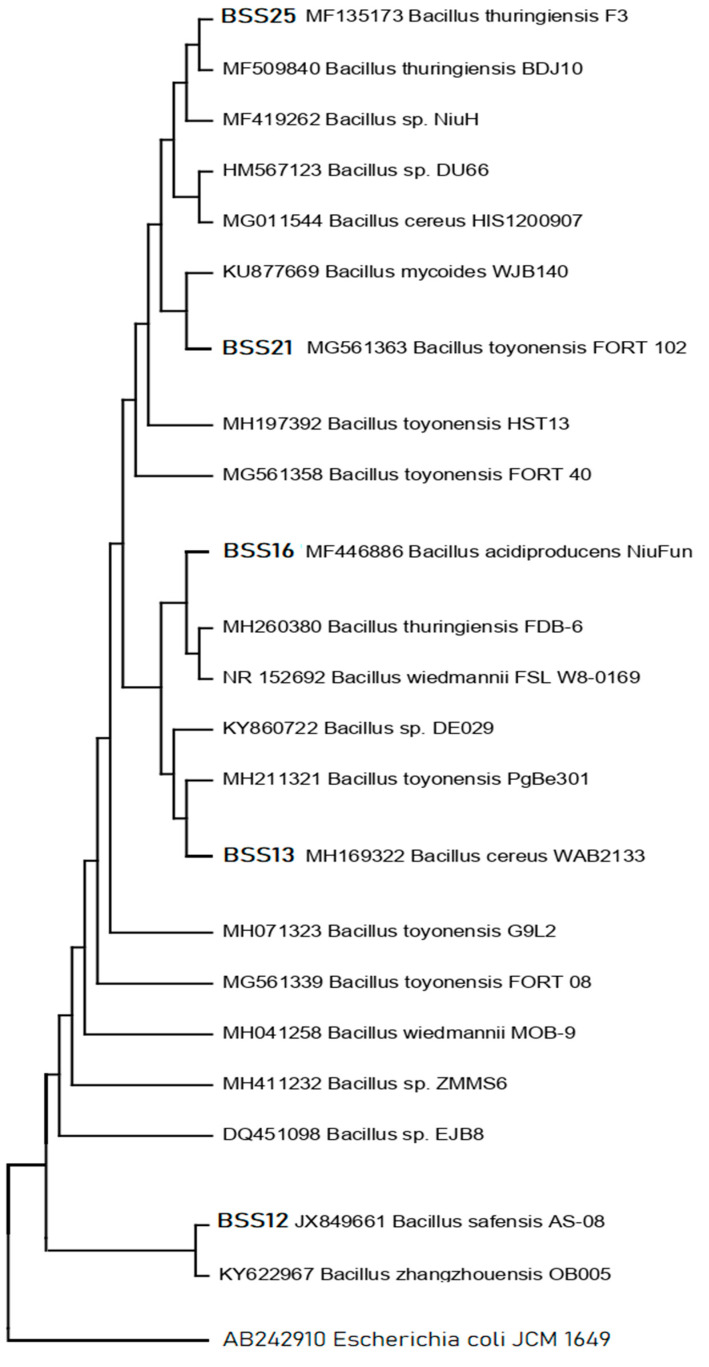
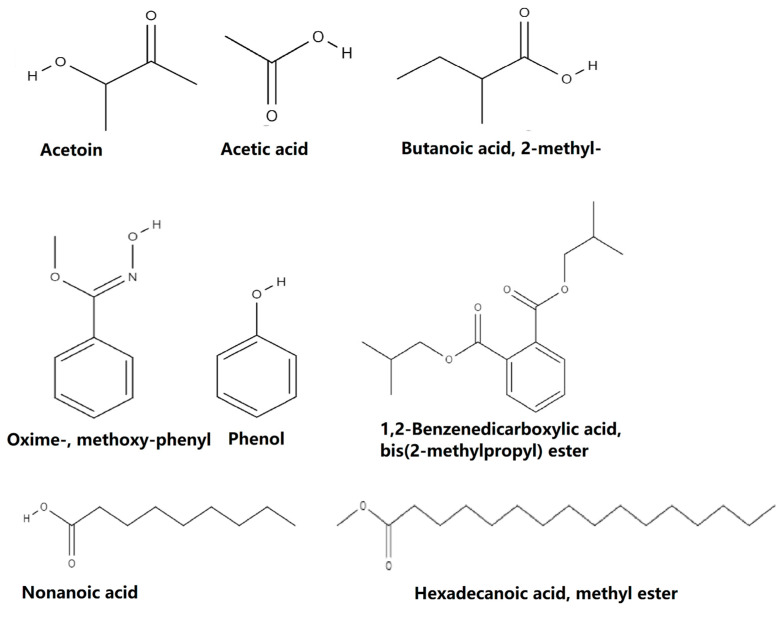
species produce different classes of antimicrobial and antioxidant substances: peptides or proteins with different structural compositions and molecular masses and a broad range of volatile organic compounds (VOCs), some of which may serve as biomarkers for microorganism identification. The aim of this study is the identification of biologically active compounds synthesized by five species using gas chromatography coupled to mass spectrometry (GC-MS). The current study profoundly enhances the knowledge of antibacterial and antioxidant metabolites ensuring the unambiguous identification of VOCs produced by some species, which were isolated from vegetable samples of potato, carrot, and tomato. Phylogenetic and biochemical studies were used to identify the bacterial isolates after culturing. Phylogenetic analysis proved that five bacterial isolates BSS12, BSS13, BSS16, BSS21, and BSS25 showed 99% nucleotide sequence similarities with AS-08, WAB2133, NiuFun, FORT 102, and F3, respectively. The crude extract was prepared from bacterial isolates to assess the antibiotic resistance potency and the antimicrobial potential against various targeted multidrug-resistant strains, including yeast strains such as , , and bacterial strains of , , , , , , group B, , , , , , and . GC-MS analysis of bacterial strains found that VOCs from species come in a variety of chemical forms, such as ketones, alcohols, terpenoids, alkenes, etc. Overall, 69 volatile organic compounds were identified from five species, and all five were found to share different chemical classes of volatile organic components, which have a variety of pharmacological applications. However, eight antibacterial compounds with different concentrations were commonly found in all five species: acetoin, acetic acid, butanoic acid, 2-methyl-, oxime-, methoxy-phenyl, phenol, 1,2-benzenedicarboxylic acid, bis(2-methylpropyl) ester, nonanoic acid, and hexadecanoic acid, methyl. The present study has demonstrated that bacterial isolates BSS25, BSS21, and BSS16 display potent inhibitory effects against , while BSS25, BSS21, and BSS13 exhibit the ability to restrain the growth and activity of . Notably, BSS25 and BSS21 are the only isolates that demonstrate substantial inhibitory activity against . This disparity in inhibitory effects could be attributed to the higher concentrations of acetoin in BSS25 and BSS21, whereas BSS16 and BSS13 have relatively elevated levels of butanoic acid, 2-methyl-. Certainly, the presence of acetoin and butanoic acid, 2-methyl-, contributes to the enhanced antibacterial potential of these bacterial strains, in conjunction with other organic volatile compounds and peptides, among other factors. The biology and physiology of can be better understood using these results, which can also be used to create novel biotechnological procedures and applications. Moreover, because of its exceptional ability to synthesize and produce a variety of different antibacterial compounds, species can serve as natural and universal carriers for antibiotic compounds in the form of probiotic cultures and strains to fight different pathogens, including mycobacteria.
五种 产生不同类别的抗菌和抗氧化物质:具有不同结构组成和分子量的肽或蛋白质以及广泛的挥发性有机化合物 (VOCs),其中一些可能作为微生物鉴定的生物标志物。本研究的目的是使用气相色谱-质谱联用 (GC-MS) 鉴定五种 合成的生物活性化合物。当前的研究深入增强了对抗菌和抗氧化代谢物的认识,确保了一些从土豆、胡萝卜和番茄蔬菜样本中分离出的 产生的 VOC 的明确鉴定。通过培养进行细菌分离物的系统发育和生化研究后进行鉴定。系统发育分析证明,五种细菌分离物 BSS12、BSS13、BSS16、BSS21 和 BSS25 与 AS-08、WAB2133、NiuFun、FORT 102 和 F3 的核苷酸序列相似性均为 99%。从细菌分离物中制备粗提取物以评估抗生素耐药性和针对各种靶向多药耐药菌株的抗菌潜力,包括酵母菌株如 、 和细菌菌株如 、 、 、 、 、B 组、 、 、 、 、 。GC-MS 分析发现,来自 物种的 VOC 以多种化学形式存在,如酮、醇、萜烯、烯烃等。总体而言,从五种 物种中鉴定出 69 种挥发性有机化合物,所有五种都被发现具有不同的挥发性有机成分化学类,具有多种药理学应用。然而,在所有五种物种中都发现了八种具有不同浓度的抗菌化合物:丁酮、乙酸、丁酸、2-甲基-、肟、甲氧基-苯基、苯酚、1,2-苯二甲酸、双(2-甲基丙基)酯、壬酸和十六烷酸、甲基。本研究表明,细菌分离物 BSS25、BSS21 和 BSS16 对 表现出强烈的抑制作用,而 BSS25、BSS21 和 BSS13 表现出抑制 生长和活性的能力。值得注意的是,BSS25 和 BSS21 是唯一对 表现出显著抑制活性的分离物。这种抑制作用的差异可能归因于 BSS25 和 BSS21 中丁酮的浓度较高,而 BSS16 和 BSS13 中 2-甲基-丁酸的浓度较高。当然,丁酮和 2-甲基-丁酸的存在有助于提高这些细菌菌株的抗菌潜力,同时还与其他有机挥发性化合物和肽等因素有关。这些结果可以更好地理解 的生物学和生理学,也可以用于开发新的生物技术程序和应用。此外,由于其能够合成和产生多种不同抗菌化合物的特殊能力, 可以作为抗生素化合物的天然和通用载体,以益生菌培养物和菌株的形式抵抗包括分枝杆菌在内的不同病原体。