Department of Neurology, Affiliated ZhongDa Hospital, School of Medicine, Southeast University, Nanjing, Jiangsu, 210009, China.
Institute of Neuropsychiatry, Affiliated ZhongDa Hospital, Southeast University, Nanjing, Jiangsu, 210009, China.
Transl Psychiatry. 2023 Nov 27;13(1):365. doi: 10.1038/s41398-023-02655-4.
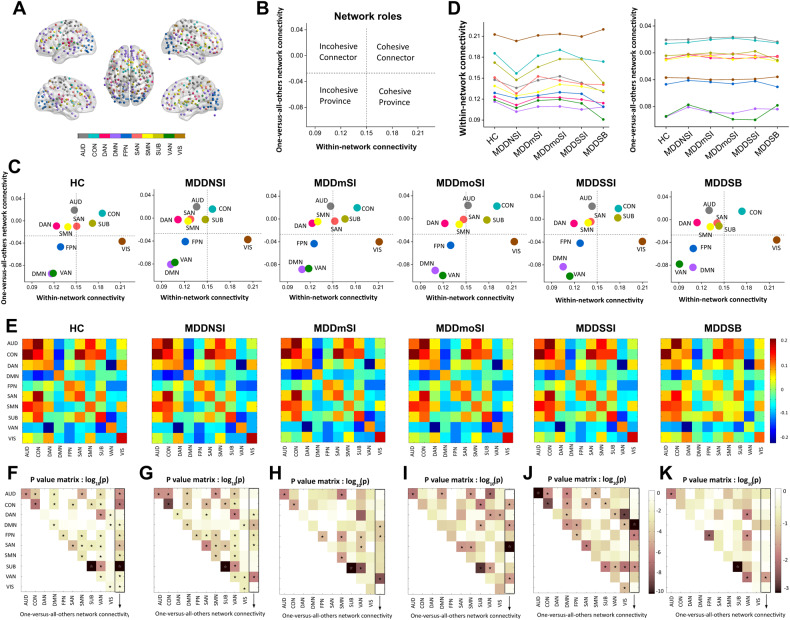
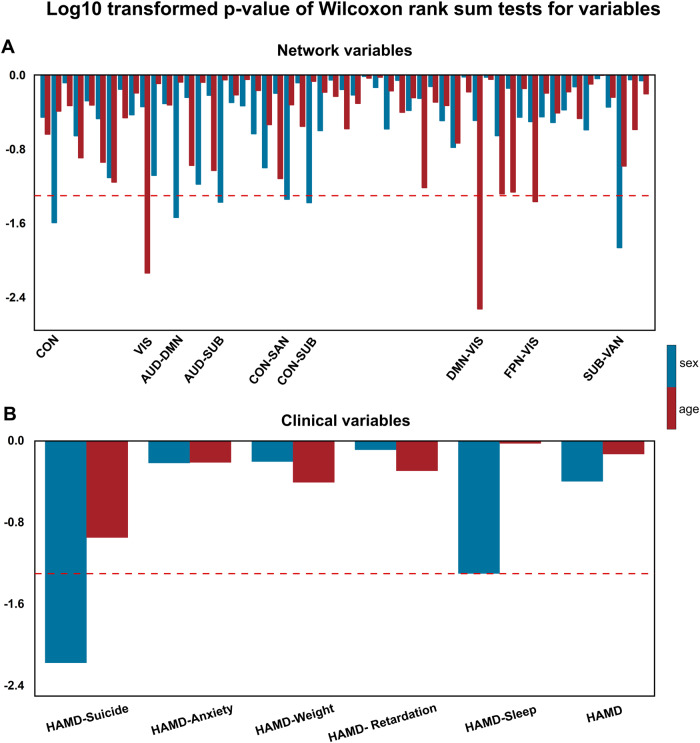
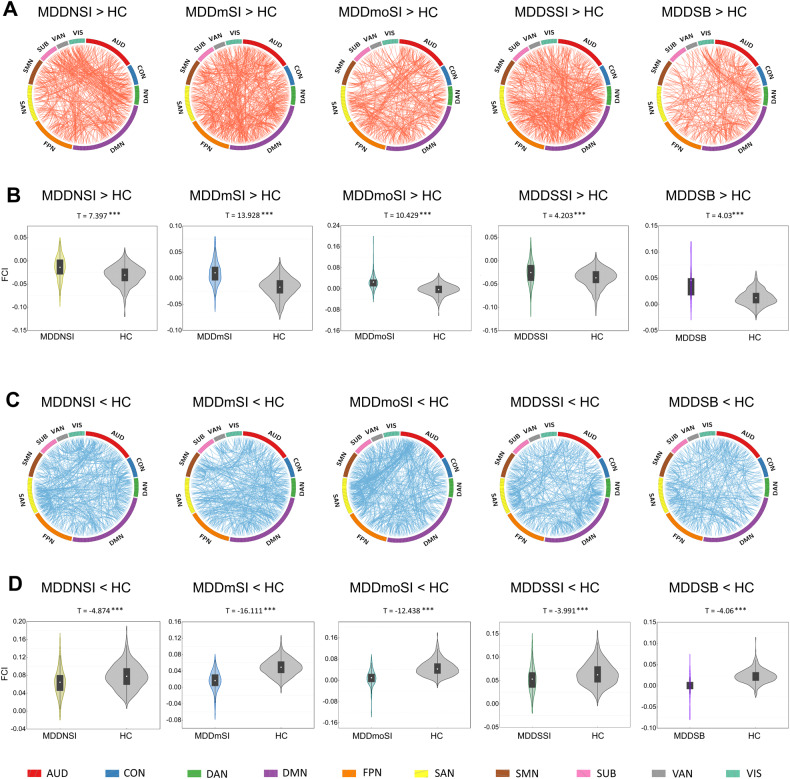
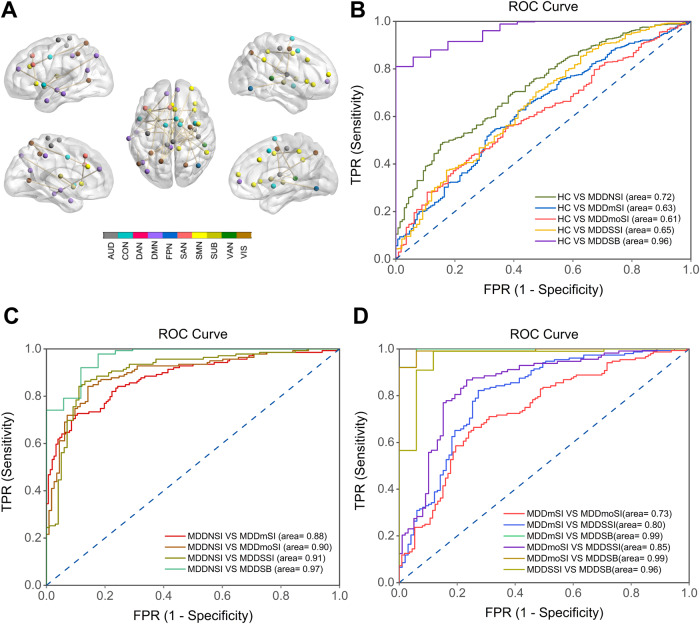
Suicidal behavior is a major concern for patients who suffer from major depressive disorder (MDD). However, dynamic alterations and dysfunction of resting-state networks (RSNs) in MDD patients with suicidality have remained unclear. Thus, we investigated whether subjects with different severity of suicidal ideation and suicidal behavior may have different disturbances in brain RSNs and whether these changes could be used as the diagnostic biomarkers to discriminate MDD with or without suicidal ideation and suicidal behavior. Then a multicenter, cross-sectional study of 528 MDD patients with or without suicidality and 998 healthy controls was performed. We defined the probability of dying by the suicide of the suicidality components as a 'suicidality gradient'. We constructed ten RSNs, including default mode (DMN), subcortical (SUB), ventral attention (VAN), and visual network (VIS). The network connections of RSNs were analyzed among MDD patients with different suicidality gradients and healthy controls using ANCOVA, chi-squared tests, and network-based statistical analysis. And support vector machine (SVM) model was designed to distinguish patients with mild-to-severe suicidal ideation, and suicidal behavior. We found the following abnormalities with increasing suicidality gradient in MDD patients: within-network connectivity values initially increased and then decreased, and one-versus-other network values decreased first and then increased. Besides, within- and between-network connectivity values of the various suicidality gradients are mainly negatively correlated with HAMD anxiety and positively correlated with weight. We found that VIS and DMN-VIS values were affected by age (p < 0.05), cingulo-opercular network, and SUB-VAN values were statistically influenced by sex (p < 0.05). Furthermore, the SVM model could distinguish MDD patients with different suicidality gradients (AUC range, 0.73-0.99). In conclusion, we have identified that disrupted brain connections were present in MDD patients with different suicidality gradient. These findings provided useful information about the pathophysiological mechanisms of MDD patients with suicidality.
自杀行为是患有重度抑郁症(MDD)患者的主要关注点。然而,具有自杀意念和自杀行为的 MDD 患者静息态网络(RSN)的动态改变和功能障碍仍不清楚。因此,我们研究了具有不同自杀意念和自杀行为严重程度的患者是否可能在大脑 RSN 中存在不同的干扰,以及这些变化是否可以用作区分有或无自杀意念和自杀行为的 MDD 的诊断生物标志物。然后进行了一项多中心、横断面研究,共纳入 528 例有或无自杀意念和自杀行为的 MDD 患者和 998 例健康对照者。我们将自杀性成分的自杀概率定义为“自杀梯度”。我们构建了十个 RSN,包括默认模式(DMN)、皮质下(SUB)、腹侧注意(VAN)和视觉网络(VIS)。使用 ANCOVA、卡方检验和基于网络的统计分析,分析了不同自杀梯度的 MDD 患者与健康对照组之间 RSN 的网络连接。并设计了支持向量机(SVM)模型来区分有轻到重度自杀意念和自杀行为的患者。我们发现,随着自杀梯度的增加,MDD 患者存在以下异常:网络内连接值先增加后减少,一对一网络值先减少后增加。此外,各种自杀梯度的网络内和网络间连接值主要与 HAMD 焦虑呈负相关,与体重呈正相关。我们发现 VIS 和 DMN-VIS 值受年龄影响(p<0.05),扣带回-顶叶网络和 SUB-VAN 值受性别影响(p<0.05)。此外,SVM 模型可以区分具有不同自杀梯度的 MDD 患者(AUC 范围,0.73-0.99)。总之,我们发现不同自杀梯度的 MDD 患者存在大脑连接中断。这些发现为具有自杀意念的 MDD 患者的病理生理机制提供了有用的信息。