• 文献检索
  • 文档翻译
  • 深度研究
  • 学术资讯
  • Suppr Zotero 插件Zotero 插件
  • 邀请有礼
  • 套餐&价格
  • 历史记录
应用&插件
Suppr Zotero 插件Zotero 插件浏览器插件Mac 客户端Windows 客户端微信小程序
定价
高级版会员购买积分包购买API积分包
服务
文献检索文档翻译深度研究API 文档MCP 服务
关于我们
关于 Suppr公司介绍联系我们用户协议隐私条款
关注我们

Suppr 超能文献

核心技术专利:CN118964589B侵权必究
粤ICP备2023148730 号-1Suppr @ 2026

文献检索

告别复杂PubMed语法,用中文像聊天一样搜索,搜遍4000万医学文献。AI智能推荐,让科研检索更轻松。

立即免费搜索

文件翻译

保留排版,准确专业,支持PDF/Word/PPT等文件格式,支持 12+语言互译。

免费翻译文档

深度研究

AI帮你快速写综述,25分钟生成高质量综述,智能提取关键信息,辅助科研写作。

立即免费体验

患有破坏性行为问题的青少年的治疗反应性:基于虚拟现实的附加干预措施的共同创建。

Treatment Responsivity in Adolescents With Disruptive Behavior Problems: Co-Creation of a Virtual Reality-Based Add-On Intervention.

作者信息

Klein Schaarsberg Renée E, Ribberink Amber Z, Osinga Babette, van Dam Levi, Lindauer Ramón J L, Popma Arne

机构信息

Child and Adolescent Psychiatry & Psychosocial Care, Amsterdam UMC location Vrije Universiteit Amsterdam, Amsterdam, Netherlands.

Garage2020, Dutch innovation network for societal youth challenges, Amsterdam, Netherlands.

出版信息

JMIR Form Res. 2023 Nov 28;7:e46592. doi: 10.2196/46592.

DOI:10.2196/46592
PMID:38015607
原文链接:https://pmc.ncbi.nlm.nih.gov/articles/PMC10716744/
Abstract

BACKGROUND

We developed Street Temptations (ST) as an add-on intervention to increase the treatment responsivity of adolescents with disruptive behavior problems. ST's primary aim is to improve adolescents' mentalizing abilities in order to help them engage in and benefit from psychotherapy. Additionally, virtual reality (VR) is used to work in a more visual, less verbal, fashion.

OBJECTIVE

By recapping the lessons learned while developing ST so far, we aim to design the following study on ST. Furthermore, we aim to enhance the development and study of new health care interventions in clinical practice, together with adolescents as their end users.

METHODS

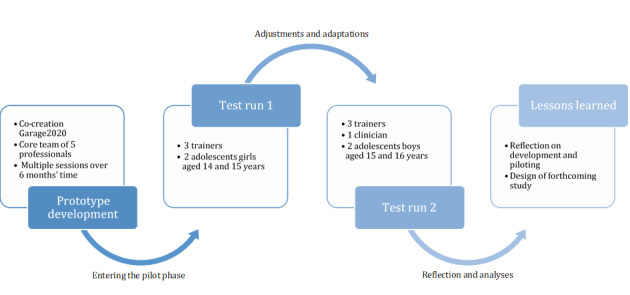
We followed an iterative co-creation process to develop a prototype of ST, in collaboration with adolescents and professionals from a secured residential facility in Amsterdam, the Netherlands. The prototype was tested during a pilot phase, involving 2 test runs, in which 4 adolescents and 4 professionals participated. Qualitative data were collected through interviews with the adolescents and by conducting a group interview with the professionals, in order to gain first insights into ST's usability, feasibility, and its added value to clinical practice. In between the first and second test runs, the prototype was enhanced. On the basis of the complete pilot phase, we reflected on the future development and implementation of ST to design a subsequent study.

RESULTS

Over the course of 6 months, ST's first prototype was developed during multiple creative sessions. Included was the development of a short 360° VR video, to serve as a base for the mentalization exercises. The final version of ST consisted of 7 individual therapy sessions, incorporating both the VR video and a VR StreetView app. On the basis of the qualitative data collected during the pilot phase, we found preliminary signs of ST's potential to support adolescents' perspective-taking abilities specifically. Additionally, using VR to focus on real-life situations that adolescents encounter in their daily lives possibly helps to facilitate communication. However, several challenges and requests concerning the VR hardware and software and the implementation of ST emerged, pointing toward further development of ST as an add-on intervention. These challenges currently limit large-scale implementation, resulting in specific requirements regarding a subsequent study.

CONCLUSIONS

In order to gather more extensive information to shape further development and study treatment effects, a small-scale and individually oriented research design seems currently more suitable than a more standard between-subjects design. Using the reflection on the lessons learned described in this report, a research protocol for a forthcoming study on ST has been developed. By presenting our co-creation journey thus far, we hope to be of inspiration for a more co-creative mindset and in that way contribute to the mutual reinforcement of science and clinical practice.
https://cdn.ncbi.nlm.nih.gov/pmc/blobs/9ac5/10716744/44416b44516c/formative_v7i1e46592_fig1.jpg
摘要

背景

我们开发了“街头诱惑”(ST)作为一种附加干预措施,以提高有破坏性行为问题的青少年对治疗的反应性。ST的主要目标是提高青少年的心理化能力,以帮助他们参与心理治疗并从中受益。此外,虚拟现实(VR)被用于以一种更具视觉性、更少言语性的方式开展工作。

目的

通过回顾迄今为止在开发ST过程中吸取的经验教训,我们旨在设计关于ST的后续研究。此外,我们旨在加强临床实践中针对青少年这一最终用户的新型医疗保健干预措施的开发和研究。

方法

我们与荷兰阿姆斯特丹一家安全住宿机构的青少年和专业人员合作,遵循迭代共创过程来开发ST的原型。该原型在试点阶段进行了测试,包括2次试运行,有4名青少年和4名专业人员参与。通过与青少年进行访谈以及对专业人员进行小组访谈来收集定性数据,以便初步了解ST的可用性、可行性及其对临床实践的附加价值。在第一次和第二次试运行之间,对原型进行了改进。基于整个试点阶段,我们对ST的未来发展和实施进行了反思,以设计后续研究。

结果

在6个月的时间里,ST的第一个原型在多次创意会议期间得以开发。其中包括制作一个简短的360°VR视频,作为心理化练习的基础。ST的最终版本包括7次个体治疗课程,融合了VR视频和VR街景应用程序。根据试点阶段收集的定性数据,我们发现了ST尤其有潜力支持青少年观点采择能力的初步迹象。此外,使用VR聚焦青少年在日常生活中遇到的现实生活情境可能有助于促进交流。然而,出现了一些关于VR硬件和软件以及ST实施方面的挑战和要求,这表明需要进一步将ST开发为一种附加干预措施。这些挑战目前限制了大规模实施,从而对后续研究提出了特定要求。

结论

为了收集更广泛的信息以塑造进一步的发展并研究治疗效果,目前一个小规模且针对个体的研究设计似乎比更标准的组间设计更合适。利用对本报告中吸取的经验教训的反思,我们制定了一份关于ST未来研究的研究方案。通过展示我们迄今为止的共创历程,我们希望能激发更具共创性的思维方式,从而为科学与临床实践的相互促进做出贡献。

相似文献

1
Treatment Responsivity in Adolescents With Disruptive Behavior Problems: Co-Creation of a Virtual Reality-Based Add-On Intervention.患有破坏性行为问题的青少年的治疗反应性:基于虚拟现实的附加干预措施的共同创建。
JMIR Form Res. 2023 Nov 28;7:e46592. doi: 10.2196/46592.
2
The Effects of a Virtual Reality-Based Training Program for Adolescents With Disruptive Behavior Problems on Cognitive Distortions and Treatment Motivation: Protocol for a Multiple Baseline Single-Case Experimental Design.一项基于虚拟现实的针对有破坏性行为问题青少年的训练计划对认知扭曲和治疗动机的影响:多基线单病例实验设计方案
JMIR Res Protoc. 2022 May 20;11(5):e33555. doi: 10.2196/33555.
3
A Virtual Reality Exergame to Engage Adolescents in Physical Activity: Mixed Methods Study Describing the Formative Intervention Development Process.虚拟现实健身游戏吸引青少年参与体育活动:描述形成性干预开发过程的混合方法研究。
J Med Internet Res. 2021 Feb 4;23(2):e18161. doi: 10.2196/18161.
4
Folic acid supplementation and malaria susceptibility and severity among people taking antifolate antimalarial drugs in endemic areas.在流行地区,服用抗叶酸抗疟药物的人群中,叶酸补充剂与疟疾易感性和严重程度的关系。
Cochrane Database Syst Rev. 2022 Feb 1;2(2022):CD014217. doi: 10.1002/14651858.CD014217.
5
Virtual Reality Air Travel Training Using Apple iPhone X and Google Cardboard: A Feasibility Report with Autistic Adolescents and Adults.使用苹果iPhone X和谷歌纸板的虚拟现实航空旅行训练:一份针对自闭症青少年和成年人的可行性报告。
Autism Adulthood. 2020 Dec 1;2(4):325-333. doi: 10.1089/aut.2019.0076. Epub 2020 Dec 11.
6
The future of Cochrane Neonatal.考克兰新生儿协作网的未来。
Early Hum Dev. 2020 Nov;150:105191. doi: 10.1016/j.earlhumdev.2020.105191. Epub 2020 Sep 12.
7
Co-creating an intervention to promote physical activity in adolescents with intellectual disabilities: lessons learned within the Move it, Move ID!-project.共同创建一项促进智障青少年身体活动的干预措施:“动起来,动起来,智障者!”项目中的经验教训。
Res Involv Engagem. 2023 Mar 19;9(1):10. doi: 10.1186/s40900-023-00420-x.
8
Collaborative co-design and evaluation of an immersive virtual reality application prototype for communication rehabilitation (DISCOVR prototype).沉浸式虚拟现实应用原型的协同共同设计和评估用于沟通康复(DISCOVR 原型)。
Disabil Rehabil Assist Technol. 2024 Jan;19(1):90-99. doi: 10.1080/17483107.2022.2063423. Epub 2022 Apr 20.
9
Implementation of Virtual Reality to Parent-Child Interaction Therapy for Enhancement of Positive Parenting Skills: Study Protocol for Single-Case Experimental Design With Multiple Baselines.虚拟现实技术在亲子互动治疗中的应用以增强积极育儿技能:多基线单病例实验设计的研究方案
JMIR Res Protoc. 2022 May 20;11(5):e34120. doi: 10.2196/34120.
10
Using Virtual Reality Environments to Augment Cognitive Behavioral Therapy for Fears and Phobias in Autistic Adults.使用虚拟现实环境增强对成年自闭症患者恐惧和恐惧症的认知行为疗法。
Autism Adulthood. 2019 Jun 1;1(2):134-145. doi: 10.1089/aut.2018.0019. Epub 2019 Apr 13.

引用本文的文献

1
Exploring the Frontiers of Technology in Forensic Psychiatric Youth Care: Ethical Challenges.探索法医精神病学青少年护理中的技术前沿:伦理挑战。
Res Child Adolesc Psychopathol. 2025 Sep 6. doi: 10.1007/s10802-025-01358-2.
2
The First Step is the Hardest: A Mixed Methods Single-Case Experimental Design Study of a VR-Enhanced Training Program in a Forensic Youth Care Setting.第一步是最艰难的:一项针对青少年法医护理环境中虚拟现实增强训练计划的混合方法单案例实验设计研究。
Res Child Adolesc Psychopathol. 2025 Apr 14. doi: 10.1007/s10802-025-01313-1.
3
Validation of the english version of the Multidimensional Mentalizing Questionnaire (MMQ).

本文引用的文献

1
The Effects of a Virtual Reality-Based Training Program for Adolescents With Disruptive Behavior Problems on Cognitive Distortions and Treatment Motivation: Protocol for a Multiple Baseline Single-Case Experimental Design.一项基于虚拟现实的针对有破坏性行为问题青少年的训练计划对认知扭曲和治疗动机的影响:多基线单病例实验设计方案
JMIR Res Protoc. 2022 May 20;11(5):e33555. doi: 10.2196/33555.
2
Annual Research Review: Immersive virtual reality and digital applied gaming interventions for the treatment of mental health problems in children and young people: the need for rigorous treatment development and clinical evaluation.年度研究综述:沉浸式虚拟现实和数字应用游戏干预治疗儿童和青少年心理健康问题:需要严格的治疗开发和临床评估。
J Child Psychol Psychiatry. 2021 May;62(5):584-605. doi: 10.1111/jcpp.13400. Epub 2021 Mar 2.
3
多维心智化问卷(MMQ)英文版的验证。
BMC Psychol. 2024 Jun 12;12(1):344. doi: 10.1186/s40359-024-01837-z.
Cognitive behavior therapy for externalizing disorders in children and adolescents in routine clinical care: A systematic review and meta-analysis.常规临床护理中针对儿童和青少年外化性障碍的认知行为疗法:一项系统评价与荟萃分析。
Clin Psychol Rev. 2021 Feb;83:101954. doi: 10.1016/j.cpr.2020.101954. Epub 2020 Dec 7.
4
Virtual reality in psychiatric disorders: A systematic review of reviews.虚拟现实在精神障碍中的应用:系统评价综述。
Complement Ther Med. 2020 Aug;52:102480. doi: 10.1016/j.ctim.2020.102480. Epub 2020 Jun 9.
5
Innovations in Practice: Avatar-based virtual reality in CAMHS talking therapy: two exploratory case studies.实践中的创新:儿童与青少年心理健康服务(CAMHS)谈话治疗中基于化身的虚拟现实:两项探索性案例研究。
Child Adolesc Ment Health. 2019 Sep;24(3):283-287. doi: 10.1111/camh.12326. Epub 2019 Mar 25.
6
Elucidating the influence of supervisors' roles on implementation climate.阐明主管角色对实施氛围的影响。
Implement Sci. 2019 Oct 25;14(1):93. doi: 10.1186/s13012-019-0939-6.
7
Effectiveness of the serious game 'You & I' in changing mentalizing abilities of adults with mild to borderline intellectual disabilities: a parallel superiority randomized controlled trial.“你和我”严肃游戏对改变轻度至边缘智力障碍成年人心理化能力的效果:一项平行优势随机对照试验。
Trials. 2019 Aug 14;20(1):500. doi: 10.1186/s13063-019-3608-9.
8
Common elements of evidence-based systemic treatments for adolescents with disruptive behaviour problems.针对有破坏性行为问题的青少年的循证系统性治疗的共同要素。
Lancet Psychiatry. 2019 Oct;6(10):862-868. doi: 10.1016/S2215-0366(19)30085-9. Epub 2019 Jun 26.
9
Framework, principles and recommendations for utilising participatory methodologies in the co-creation and evaluation of public health interventions.在公共卫生干预措施的共同创造和评估中运用参与式方法的框架、原则和建议。
Res Involv Engagem. 2019 Jan 9;5:2. doi: 10.1186/s40900-018-0136-9. eCollection 2019.
10
Virtual reality perspective-taking increases cognitive empathy for specific others.虚拟现实视角-taking 可提高对特定他人的认知同理心。
PLoS One. 2018 Aug 30;13(8):e0202442. doi: 10.1371/journal.pone.0202442. eCollection 2018.