Department of Genetics, University of Groningen and University Medical Center Groningen, Groningen, The Netherlands.
Department of Health Sciences, University of Groningen and University Medical Center Groningen, Groningen, The Netherlands.
Gut Microbes. 2023 Dec;15(2):2281360. doi: 10.1080/19490976.2023.2281360. Epub 2023 Nov 28.
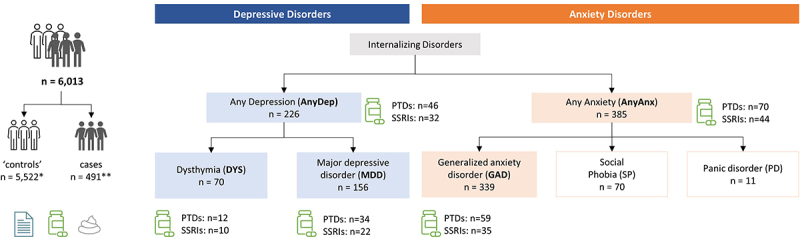
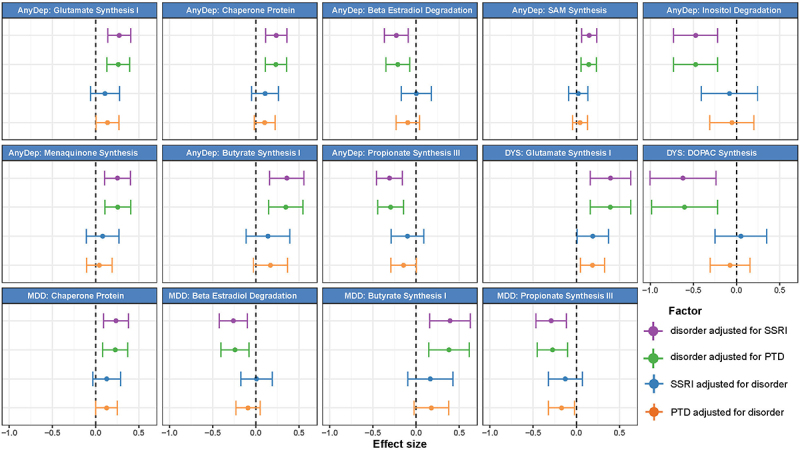
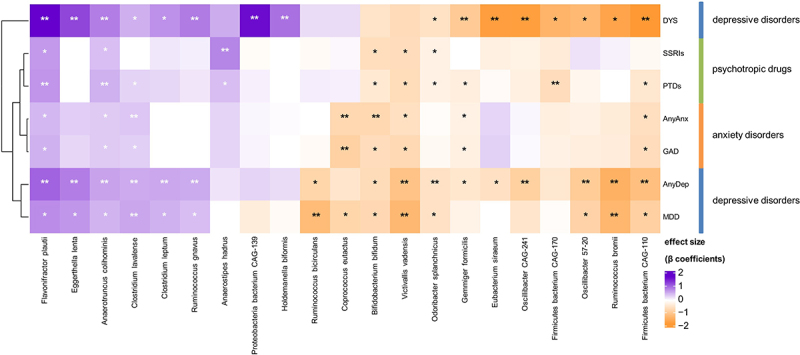
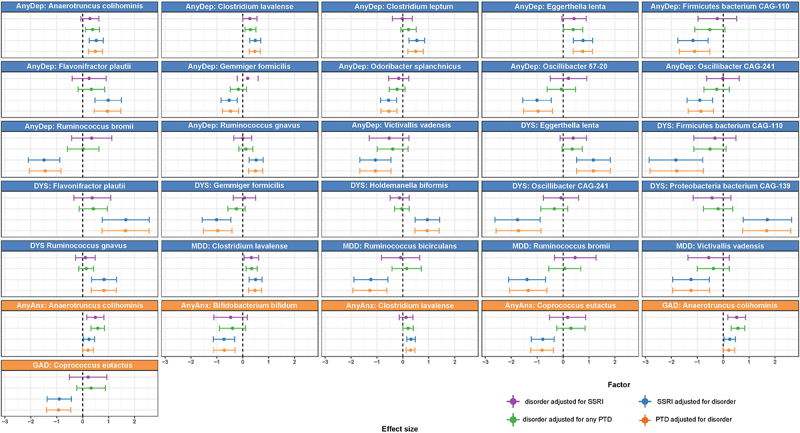
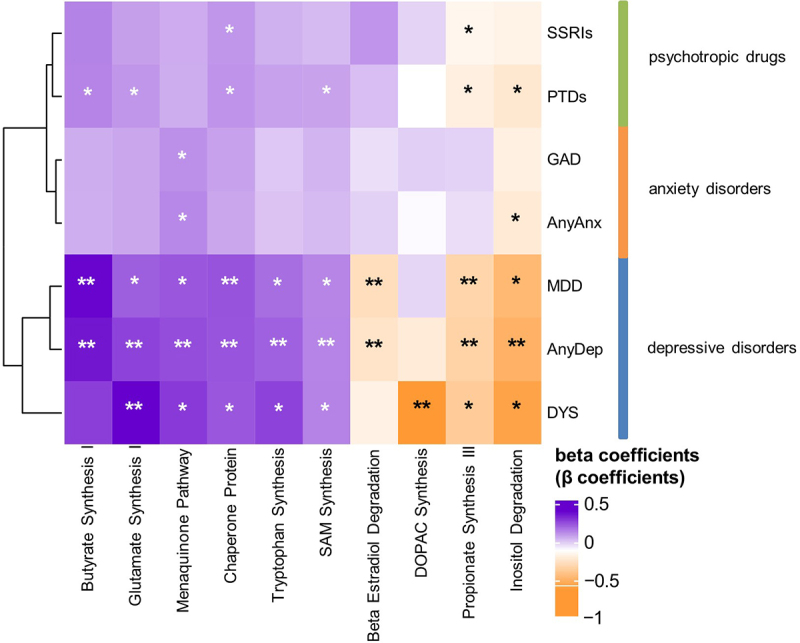
The gut microbiome is involved in the bi-directional relationship of the gut - brain axis. As most studies of this relationship are small and do not account for use of psychotropic drugs (PTDs), we explored the relations of the gut microbiome with several internalizing disorders, while adjusting for PTDs and other relevant medications, in 7,656 Lifelines participants from the Northern Netherlands (5,522 controls and 491 participants with at least one internalizing disorder). Disorders included dysthymia, major depressive disorder (MDD), any depressive disorder (AnyDep: dysthymia or MDD), generalized anxiety disorder (GAD) and any anxiety disorder (AnyAnx: GAD, social phobia and panic disorder). Compared to controls, 17 species were associated with depressive disorders and 3 were associated with anxiety disorders. Around 90% of these associations remained significant (FDR <0.05) after adjustment for PTD use, suggesting that the disorders, not PTD use, drove these associations. Negative associations were observed for the butyrate-producing bacteria in participants with AnyDep and for in AnyAnx participants, along with many others. Tryptophan and glutamate synthesis modules and the 3,4-Dihydroxyphenylacetic acid synthesis module (related to dopamine metabolism) were negatively associated with MDD and/or dysthymia. After additional adjustment for functional gastrointestinal disorders and irritable bowel syndrome, these relations remained either statistically (FDR <0.05) or nominally ( < 0.05) significant. Overall, multiple bacterial species and functional modules were associated with internalizing disorders, including gut - brain relevant components, while associations to PTD use were moderate. These findings suggest that internalizing disorders rather than PTDs are associated with gut microbiome differences relative to controls.
肠道微生物群与肠道-大脑轴的双向关系有关。由于大多数关于这种关系的研究规模较小,且没有考虑到精神药物(PTDs)的使用,因此我们在荷兰北部的 7656 名生命线参与者中(5522 名对照者和 491 名至少有一种内在障碍的参与者),在调整了 PTD 以及其他相关药物的情况下,探索了肠道微生物群与几种内在障碍的关系。障碍包括心境恶劣障碍、重性抑郁障碍(MDD)、任何抑郁障碍(AnyDep:心境恶劣障碍或 MDD)、广泛性焦虑障碍(GAD)和任何焦虑障碍(AnyAnx:GAD、社交恐惧症和惊恐障碍)。与对照组相比,17 种物种与抑郁障碍有关,3 种与焦虑障碍有关。在调整了 PTD 使用后,这些关联中有 90%左右仍然具有统计学意义(FDR <0.05),这表明是障碍而不是 PTD 使用导致了这些关联。在 AnyDep 参与者中,与丁酸产生细菌呈负相关,在 AnyAnx 参与者中,与呈负相关,还有许多其他细菌也是如此。色氨酸和谷氨酸合成模块以及 3,4-二羟基苯乙酸合成模块(与多巴胺代谢有关)与 MDD 和/或心境恶劣障碍呈负相关。在进一步调整功能性胃肠道疾病和肠易激综合征后,这些关系仍然具有统计学意义(FDR <0.05)或具有名义意义(<0.05)。总的来说,多种细菌物种和功能模块与内在障碍有关,包括与肠道-大脑相关的成分,而与 PTD 使用的关联是中等的。这些发现表明,与对照相比,内在障碍而不是 PTDs 与肠道微生物群的差异有关。