Department of Medical Social Sciences, Northwestern University, Feinberg School of Medicine, Chicago, Illinois, USA.
Department of Psychology, University of California, Davis, Davis, California, USA.
Alzheimers Dement. 2024 Mar;20(3):1497-1514. doi: 10.1002/alz.13523. Epub 2023 Nov 29.
The extent to which the Big Five personality traits and subjective well-being (SWB) are discriminatory predictors of clinical manifestation of dementia versus dementia-related neuropathology is unclear.
Using data from eight independent studies (N = 44,531; N = 1703; baseline M = 49 to 81 years, 26 to 61% female; M range = 3.53 to 21.00 years), Bayesian multilevel models tested whether personality traits and SWB differentially predicted neuropsychological and neuropathological characteristics of dementia.
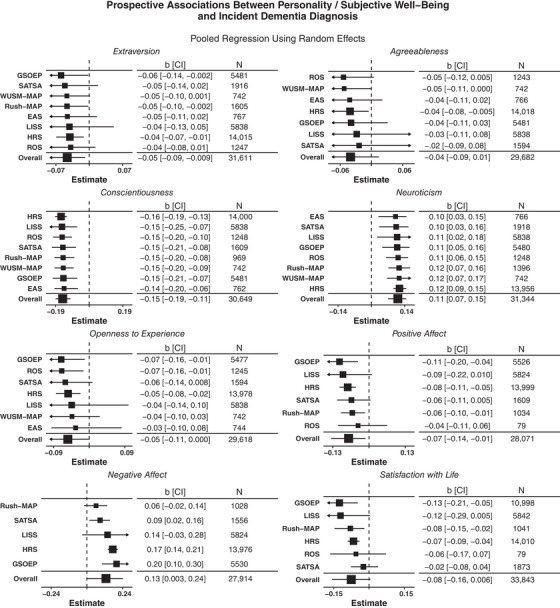
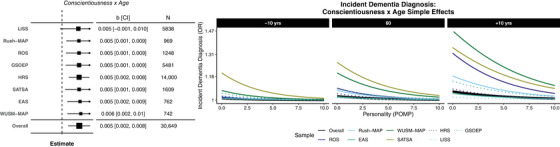
Synthesized and individual study results indicate that high neuroticism and negative affect and low conscientiousness, extraversion, and positive affect were associated with increased risk of long-term dementia diagnosis. There were no consistent associations with neuropathology.
This multistudy project provides robust, conceptually replicated and extended evidence that psychosocial factors are strong predictors of dementia diagnosis but not consistently associated with neuropathology at autopsy.
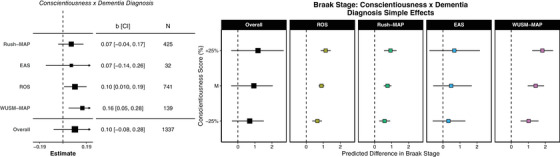
N(+), C(-), E(-), PA(-), and NA(+) were associated with incident diagnosis. Results were consistent despite self-report versus clinical diagnosis of dementia. Psychological factors were not associated with neuropathology at autopsy. Individuals with higher conscientiousness and no diagnosis had less neuropathology. High C individuals may withstand neuropathology for longer before death.
五大人格特质和主观幸福感(SWB)在多大程度上可以区分痴呆症的临床表现与痴呆症相关的神经病理学尚不清楚。
使用来自八项独立研究的数据(N=44531;N=1703;基线 M=49 至 81 岁,26%至 61%为女性;M 范围=3.53 至 21.00 岁),贝叶斯多层次模型检验了人格特质和 SWB 是否可以区分预测痴呆症的神经心理学和神经病理学特征。
综合和个别研究结果表明,高神经质和负性情绪以及低尽责性、外向性和正性情绪与长期痴呆诊断风险增加有关。但与神经病理学无一致关联。
本多研究项目提供了强有力的、概念上复制和扩展的证据,表明心理社会因素是痴呆症诊断的强有力预测因素,但与尸检时的神经病理学无一致关联。
N(+)、C(-)、E(-)、PA(-)和 NA(+)与首发诊断相关。尽管使用自我报告还是临床诊断痴呆症,结果仍然一致。心理因素与尸检时的神经病理学无关。尽责性较高且无诊断的个体神经病理学较少。高 C 个体可能在死亡前更长时间内耐受神经病理学。