
创伤性脑损伤与肠道微生物群关系的研究新趋势与重点:一项可视化研究
Emerging trends and focus of research on the relationship between traumatic brain injury and gut microbiota: a visualized study.
作者信息
Du Qiujing, Li Qijie, Liao Guangneng, Li Jiafei, Ye Peiling, Zhang Qi, Gong Xiaotong, Yang Jiaju, Li Ka
机构信息
West China Hospital, Sichuan University/ West China School of Nursing, Sichuan University, Chengdu, China.
Animal Experiment Center, West China Hospital, Sichuan University, Chengdu, China.
出版信息
Front Microbiol. 2023 Nov 3;14:1278438. doi: 10.3389/fmicb.2023.1278438. eCollection 2023.
BACKGROUND
Traumatic brain injury (TBI) is one of the most serious types of trauma and imposes a heavy social and economic burden on healthcare systems worldwide. The development of emerging biotechnologies is uncovering the relationship between TBI and gut flora, and gut flora as a potential intervention target is of increasing interest to researchers. Nevertheless, there is a paucity of research employing bibliometric methodologies to scrutinize the interrelation between these two. Therefore, this study visualized the relationship between TBI and gut flora based on bibliometric methods to reveal research trends and hotspots in the field. The ultimate objective is to catalyze progress in the preclinical and clinical evolution of strategies for treating and managing TBI.
METHODS
Terms related to TBI and gut microbiota were combined to search the Scopus database for relevant documents from inception to February 2023. Visual analysis was performed using CiteSpace and VOSviewer.
RESULTS
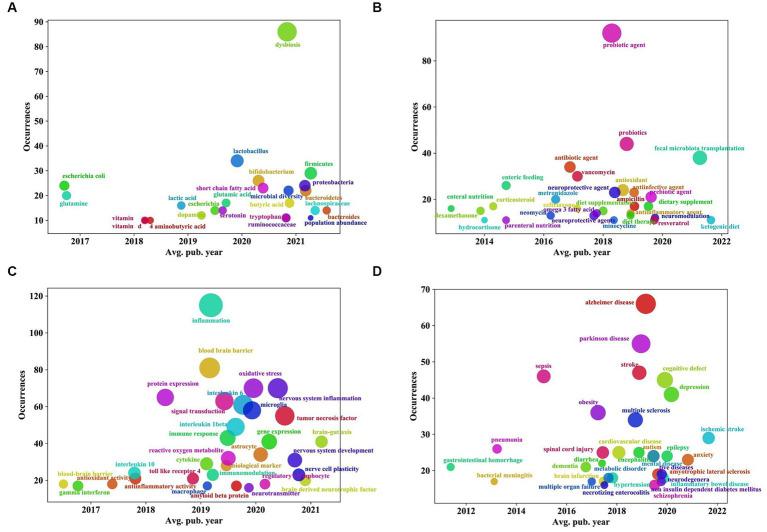
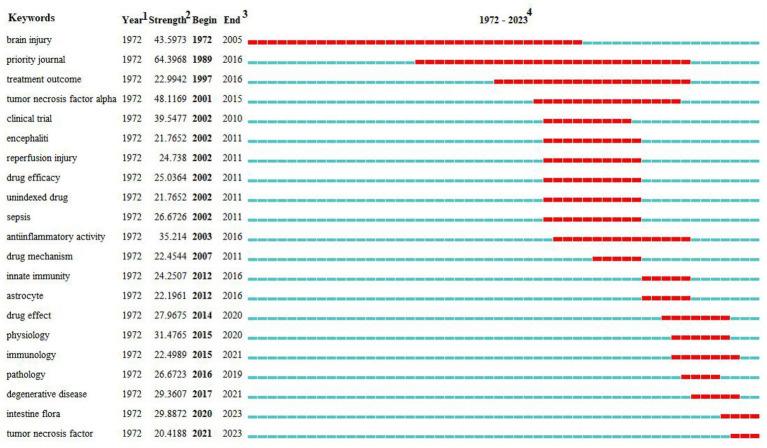
From September 1972 to February 2023, 2,957 documents published from 98 countries or regions were analyzed. The number of published studies on the relationship between TBI and gut flora has risen exponentially, with the United States, China, and the United Kingdom being representative of countries publishing in related fields. Research has formed strong collaborations around highly productive authors, but there is a relative lack of international cooperation. Research in this area is mainly published in high-impact journals in the field of neurology. The "intestinal microbiota and its metabolites," "interventions," "mechanism of action" and "other diseases associated with traumatic brain injury" are the most promising and valuable research sites. Targeting the gut flora to elucidate the mechanisms for the development of the course of TBI and to develop precisely targeted interventions and clinical management of TBI comorbidities are of great significant research direction and of interest to researchers.
CONCLUSION
The findings suggest that close attention should be paid to the relationship between gut microbiota and TBI, especially the interaction, potential mechanisms, development of emerging interventions, and treatment of TBI comorbidities. Further investigation is needed to understand the causal relationship between gut flora and TBI and its specific mechanisms, especially the "brain-gut microbial axis."
背景
创伤性脑损伤(TBI)是最严重的创伤类型之一,给全球医疗系统带来了沉重的社会和经济负担。新兴生物技术的发展正在揭示TBI与肠道菌群之间的关系,肠道菌群作为一个潜在的干预靶点越来越受到研究人员的关注。然而,运用文献计量学方法来审视这两者之间相互关系的研究却很匮乏。因此,本研究基于文献计量学方法可视化了TBI与肠道菌群之间的关系,以揭示该领域的研究趋势和热点。最终目标是推动TBI治疗和管理策略在临床前和临床进展方面取得进步。
方法
将与TBI和肠道微生物群相关的术语相结合,在Scopus数据库中检索从数据库建立到2023年2月的相关文献。使用CiteSpace和VOSviewer进行可视化分析。
结果
从1972年9月到2023年2月,对来自98个国家或地区发表的2957篇文献进行了分析。关于TBI与肠道菌群关系的已发表研究数量呈指数增长,美国、中国和英国是相关领域发表文献的代表国家。研究围绕高产作者形成了强大的合作,但国际合作相对较少。该领域的研究主要发表在神经学领域的高影响力期刊上。“肠道微生物群及其代谢产物”“干预措施”“作用机制”以及“与创伤性脑损伤相关的其他疾病”是最有前景和价值的研究点。针对肠道菌群阐明TBI病程发展机制以及开发精准靶向干预措施和TBI合并症的临床管理是具有重大意义的研究方向,并且受到研究人员的关注。
结论
研究结果表明,应密切关注肠道微生物群与TBI之间的关系,特别是相互作用、潜在机制、新兴干预措施的开发以及TBI合并症的治疗。需要进一步研究以了解肠道菌群与TBI之间的因果关系及其具体机制,尤其是“脑-肠-微生物轴”。


 Zotero 插件