Khatri Resham B, Endalamaw Aklilu, Erku Daniel, Wolka Eskinder, Nigatu Frehiwot, Zewdie Anteneh, Assefa Yibeltal
Health Social Science and Development Research Institute, Kathmandu, Nepal.
School of Public Health, University of Queensland, Brisbane, Australia.
Arch Public Health. 2023 Nov 30;81(1):208. doi: 10.1186/s13690-023-01223-y.
Natural and human-made public health emergencies (PHEs), such as armed conflicts, floods, and disease outbreaks, influence health systems including interruption of delivery and utilization of health services, and increased health service needs. However, the intensity and types of impacts of these PHEs vary across countries due to several associated factors. This scoping review aimed to synthesise available evidence on PHEs, their preparedness, impacts, and responses.
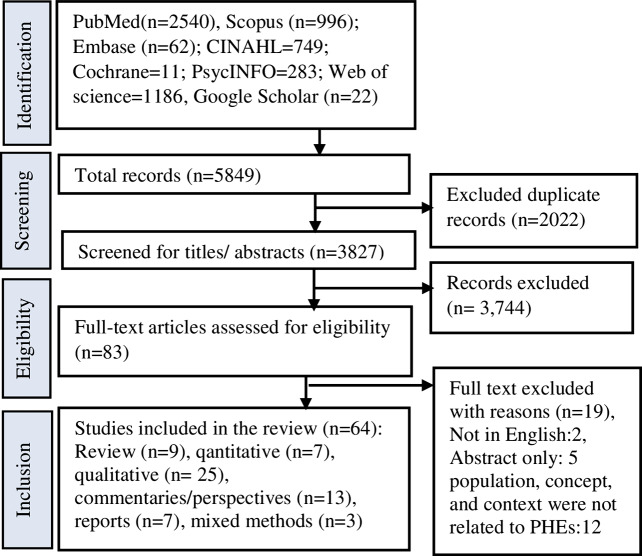
We conducted a scoping review of published evidence. Studies were identified using search terms related to two concepts: health security and primary health care. We used Preferred Reporting Items for Systematic Reviews and Meta-Analyses extension for scoping reviews (PRISMA-ScR) guidelines to select studies. We adapted the review framework of Arksey and O'Malley. Data were analyzed using a thematic analysis approach and explained under three stages of PHEs: preparedness, impacts, and responses.
A total of 64 studies were included in this review. Health systems of many low- and middle-income countries had inadequate preparedness to absorb the shocks of PHEs, limited surveillance, and monitoring of risks. Health systems have been overburdened with interrupted health services, increased need for health services, poor health resilience, and health inequities. Strategies of response to the impact of PHEs included integrated services such as public health and primary care, communication and partnership across sectors, use of digital tools, multisectoral coordination and actions, system approach to responses, multidisciplinary providers, and planning for resilient health systems.
Public health emergencies have high impacts in countries with weak health systems, inadequate preparedness, and inadequate surveillance mechanisms. Better health system preparedness is required to absorb the impact, respond to the consequences, and adapt for future PHEs. Some potential response strategies could be ensuring need-based health services, monitoring and surveillance of post-emergency outbreaks, and multisectoral actions to engage sectors to address the collateral impacts of PHEs. Mitigation strategies for future PHEs could include risk assessment, disaster preparedness, and setting digital alarm systems for monitoring and surveillance.
自然和人为的公共卫生突发事件(PHEs),如武装冲突、洪水和疾病暴发,会影响卫生系统,包括卫生服务的提供和利用中断,以及卫生服务需求增加。然而,由于若干相关因素,这些公共卫生突发事件的影响强度和类型在不同国家有所不同。本范围综述旨在综合关于公共卫生突发事件、其防范措施、影响及应对措施的现有证据。
我们对已发表的证据进行了范围综述。使用与两个概念相关的检索词来识别研究:卫生安全和初级卫生保健。我们采用系统评价和Meta分析的首选报告项目扩展版(PRISMA-ScR)指南来选择研究。我们采用了阿克西和奥马利的综述框架。使用主题分析方法对数据进行分析,并在公共卫生突发事件的三个阶段进行解释:防范、影响和应对。
本综述共纳入64项研究。许多低收入和中等收入国家的卫生系统在应对公共卫生突发事件冲击方面准备不足,风险监测有限。卫生系统因卫生服务中断、卫生服务需求增加、健康恢复力差和卫生不公平而不堪重负。应对公共卫生突发事件影响的策略包括综合服务,如公共卫生和初级保健、跨部门沟通与伙伴关系、数字工具的使用、多部门协调与行动、应对的系统方法、多学科提供者以及建设有恢复力的卫生系统的规划。
公共卫生突发事件对卫生系统薄弱、准备不足和监测机制不完善的国家影响巨大。需要更好的卫生系统准备来承受影响、应对后果并适应未来的公共卫生突发事件。一些潜在的应对策略可以是确保基于需求的卫生服务、对紧急情况后暴发的监测以及多部门行动以促使各部门应对公共卫生突发事件的附带影响。未来公共卫生突发事件的缓解策略可以包括风险评估、备灾以及设置数字警报系统进行监测。