
药物葡糖醛酸苷的肝血窦输出增加是小鼠肝硬化中的一种代偿机制。
Increased sinusoidal export of drug glucuronides is a compensative mechanism in liver cirrhosis of mice.
作者信息
Fendt Rebekka, Ghallab Ahmed, Myllys Maiju, Hofmann Ute, Hassan Reham, Hobloss Zaynab, González Daniela, Brackhagen Lisa, Marchan Rosemarie, Edlund Karolina, Seddek Abdel-Latif, Abdelmageed Noha, Blank Lars M, Schlender Jan-Frederik, Holland Christian H, Hengstler Jan G, Kuepfer Lars
机构信息
Institute for Systems Medicine with Focus on Organ Interaction, University Hospital RWTH Aachen, Aachen, Germany.
Leibniz Research Centre for Working Environment and Human Factors, Technical University Dortmund, Dortmund, Germany.
出版信息
Front Pharmacol. 2023 Nov 20;14:1279357. doi: 10.3389/fphar.2023.1279357. eCollection 2023.
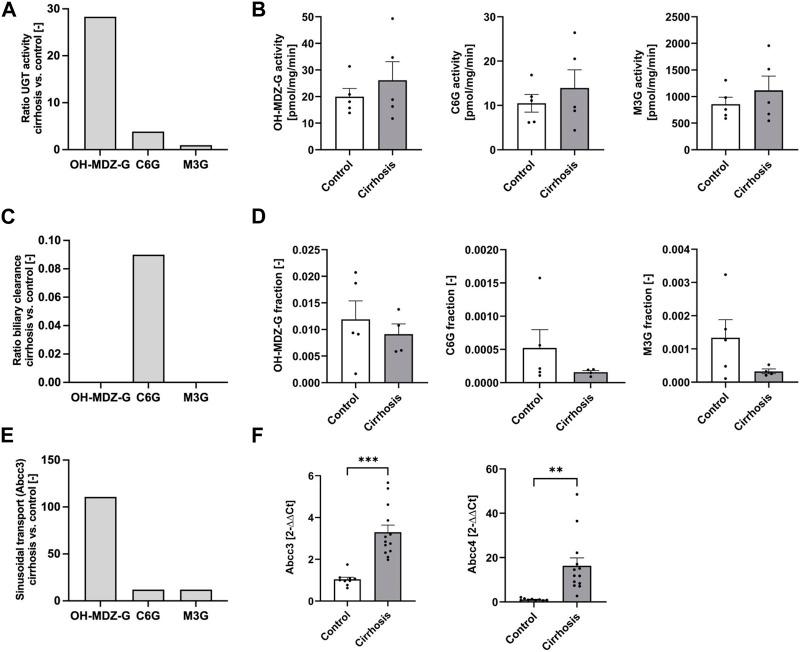
Liver cirrhosis is known to affect drug pharmacokinetics, but the functional assessment of the underlying pathophysiological alterations in drug metabolism is difficult. Cirrhosis in mice was induced by repeated treatment with carbon tetrachloride for 12 months. A cocktail of six drugs was administered, and parent compounds as well as phase I and II metabolites were quantified in blood, bile, and urine in a time-dependent manner. Pharmacokinetics were modeled in relation to the altered expression of metabolizing enzymes. In discrepancy with computational predictions, a strong increase of glucuronides in blood was observed in cirrhotic mice compared to vehicle controls. The deviation between experimental findings and computational simulations observed by analyzing different hypotheses could be explained by increased sinusoidal export and corresponded to increased expression of export carriers ( and ). Formation of phase I metabolites and clearance of the parent compounds were surprisingly robust in cirrhosis, although the phase I enzymes critical for the metabolism of the administered drugs in healthy mice, and , were downregulated in cirrhotic livers. RNA-sequencing revealed the upregulation of numerous other phase I metabolizing enzymes which may compensate for the lost CYP isoenzymes. Comparison of genome-wide data of cirrhotic mouse and human liver tissue revealed similar features of expression changes, including increased sinusoidal export and reduced uptake carriers. Liver cirrhosis leads to increased blood concentrations of glucuronides because of increased export from hepatocytes into the sinusoidal blood. Although individual metabolic pathways are massively altered in cirrhosis, the overall clearance of the parent compounds was relatively robust due to compensatory mechanisms.
已知肝硬化会影响药物的药代动力学,但对药物代谢中潜在病理生理改变的功能评估却很困难。通过用四氯化碳反复处理12个月诱导小鼠肝硬化。给予六种药物的混合物,并随时间对血液、胆汁和尿液中的母体化合物以及I相和II相代谢物进行定量。根据代谢酶表达的改变对药代动力学进行建模。与计算预测结果不同,与载体对照相比,在肝硬化小鼠的血液中观察到葡糖醛酸苷显著增加。通过分析不同假设观察到的实验结果与计算模拟之间的偏差可以用窦状隙转运增加来解释,并且与转运载体(和)的表达增加相对应。尽管在健康小鼠中对所给药药物代谢至关重要的I相酶在肝硬化肝脏中下调,但I相代谢物的形成和母体化合物的清除在肝硬化中出人意料地强劲。RNA测序揭示了许多其他I相代谢酶的上调,这可能补偿了丢失的细胞色素P450同工酶。对肝硬化小鼠和人类肝脏组织的全基因组数据进行比较,发现了相似的表达变化特征,包括窦状隙转运增加和摄取载体减少。肝硬化导致葡糖醛酸苷的血药浓度升高,因为从肝细胞向窦状隙血液中的转运增加。尽管在肝硬化中各个代谢途径发生了大量改变,但由于代偿机制,母体化合物的总体清除相对强劲。


 Zotero 插件