Jiang Dian, Chen Xi, Huang Jundan, Wu Lina, Chen Yifei, Feng Hui, Hu Mingyue
Xiangya School of Nursing, Central South University, Changsha, Hunan, China.
Xiangya-Oceanwide Health Management Research Institute, Central South University, Changsha, Hunan, China.
Front Aging Neurosci. 2023 Nov 22;15:1302879. doi: 10.3389/fnagi.2023.1302879. eCollection 2023.
Motoric cognitive risk syndrome (MCR) is a pre-dementia symptom strongly predicting cognitive decline and dementia. Although advancements in elucidating the epidemiology of MCR, the evidence about the association between sarcopenia, sarcopenia parameters, and MCR remains scarce.
The purpose of this study was to determine the associations between sarcopenia, sarcopenia parameters, and MCR among community-dwelling Chinese older adults.
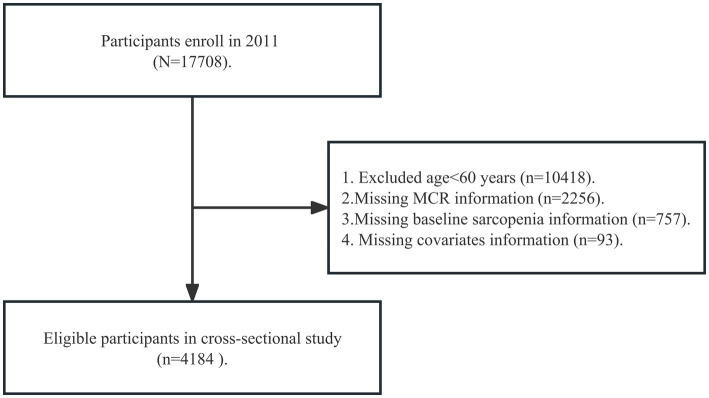
A total of 4,184 community-dwelling older adults from the China Health and Retirement Longitudinal Study (CHARLS) in the 2011 waves were included. Sarcopenia was diagnosed according to the Asian Working Group for Sarcopenia criteria. Sarcopenia parameters included handgrip strength (HGS), height-adjusted appendicular skeletal muscle mass (ASM/Ht), and five-times sit-to-stand test time (FTSSTT). MCR was defined as subjective cognitive complaints and slow gait speed without dementia or impaired mobility. The associations between sarcopenia, sarcopenia parameters, and MCR were conducted using the logistic regression model. The restricted cubic spline with four knots were performed to determine the nonlinear and linear relationships between HGS, ASM/Ht, FTSSTT, and MCR.
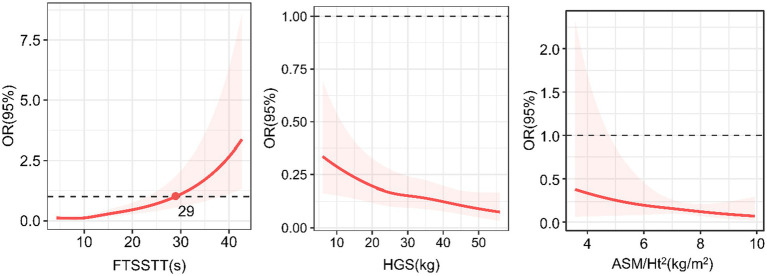
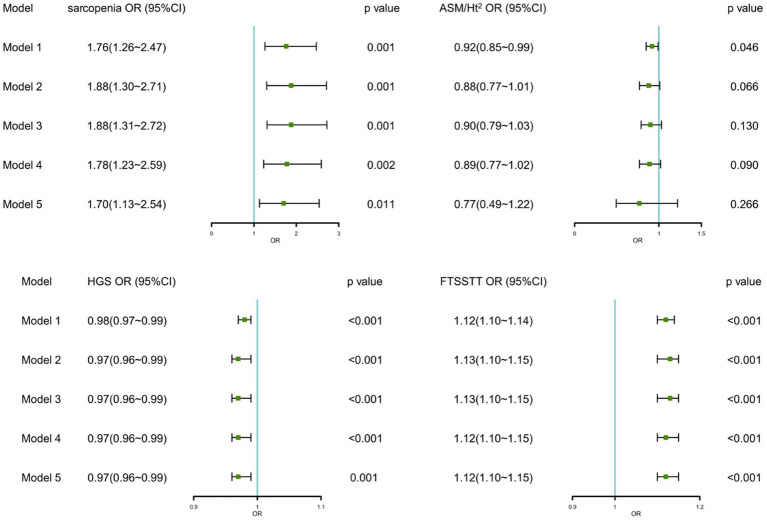
The prevalence of MCR in wave 2011 of CHARLS was 11.2%. After adjustment for potential confounders, we found sarcopenia [odd ratio (OR) (95% CI): 1.70 (1.13 ~ 2.54), = 0.011], lower HGS [0.97 (0.96 ~ 0.99), = 0.001], and more FTSSTT [1.12 (1.10 ~ 1.15), < 0.001] were significantly associated with a higher risk of MCR. There was an inverse linear dose-response between HGS and MCR ( for overall = 0.008, p for nonlinearity =0.776). The nonlinear relationship between FTSSTT and MCR was found ( for overall <0.001, for nonlinearity = 0.025) with FTSSTT ≥29 s being associated with a higher risk of MCR. A dose-response relationship was not found between ASM/Ht and MCR ( for overall =0.589).
Sarcopenia, lower HGS, and higher FTSSTT are associated with MCR among older adults in China, while the latter two exhibit a dose-response relationship with MCR. It is suggested that timely identification and management of sarcopenia and its parameters may help delay the progression of cognitive impairment and promote healthy aging.
运动认知风险综合征(MCR)是一种痴呆前症状,强烈预示着认知能力下降和痴呆。尽管在阐明MCR的流行病学方面取得了进展,但关于肌肉减少症、肌肉减少症参数与MCR之间关联的证据仍然很少。
本研究的目的是确定中国社区居住的老年人中肌肉减少症、肌肉减少症参数与MCR之间的关联。
纳入了2011年中国健康与养老追踪调查(CHARLS)中4184名社区居住的老年人。根据亚洲肌肉减少症工作组的标准诊断肌肉减少症。肌肉减少症参数包括握力(HGS)、身高校正的四肢骨骼肌质量(ASM/Ht)和五次坐立试验时间(FTSSTT)。MCR被定义为无痴呆或行动障碍的主观认知主诉和步态缓慢。使用逻辑回归模型分析肌肉减少症、肌肉减少症参数与MCR之间的关联。采用带有四个节点的受限立方样条来确定HGS、ASM/Ht、FTSSTT与MCR之间的非线性和线性关系。
CHARLS 2011年的MCR患病率为11.2%。在调整潜在混杂因素后,我们发现肌肉减少症[比值比(OR)(95%CI):1.70(1.13~2.54),P = 0.011]、较低的HGS[0.97(0.96~0.99),P = 0.001]和较长的FTSSTT[1.12(1.10~1.15),P < 0.001]与较高的MCR风险显著相关。HGS与MCR之间存在反向线性剂量反应关系(总体P = 0.008,非线性P = 0.776)。发现FTSSTT与MCR之间存在非线性关系(总体P < 0.001,非线性P = 0.025),FTSSTT≥29秒与较高的MCR风险相关。未发现ASM/Ht与MCR之间存在剂量反应关系(总体P = 0.589)。
在中国老年人中,肌肉减少症、较低的HGS和较长的FTSSTT与MCR相关,后两者与MCR呈剂量反应关系。建议及时识别和管理肌肉减少症及其参数可能有助于延缓认知障碍的进展并促进健康老龄化。