Chen Yuqing, He Qiu, Zhao Yun, Zhou Wang, Xiao Peitao, Gao Peng, Tavajohi Naser, Tu Jian, Li Baohua, He Xiangming, Xing Lidan, Fan Xiulin, Liu Jilei
College of Materials Science and Engineering, Hunan Joint International Laboratory of Advanced Materials and Technology for Clean Energy, Hunan Province Key Laboratory for Advanced Carbon Materials and Applied Technology, Hunan University, Changsha, 410082, People's Republic of China.
College of Materials Science and Engineering, Sichuan University, Chengdu, 610065, P. R. China.
Nat Commun. 2023 Dec 14;14(1):8326. doi: 10.1038/s41467-023-43163-9.
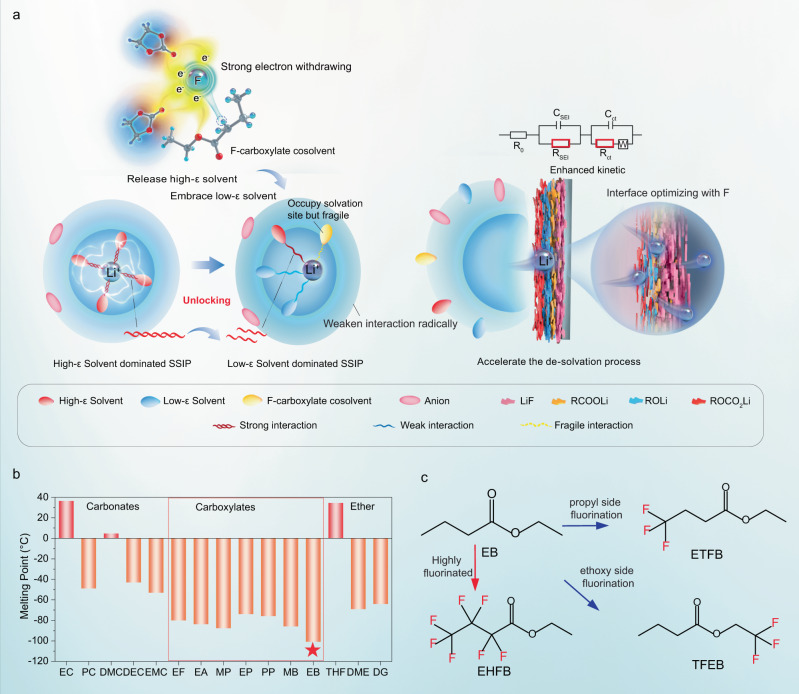
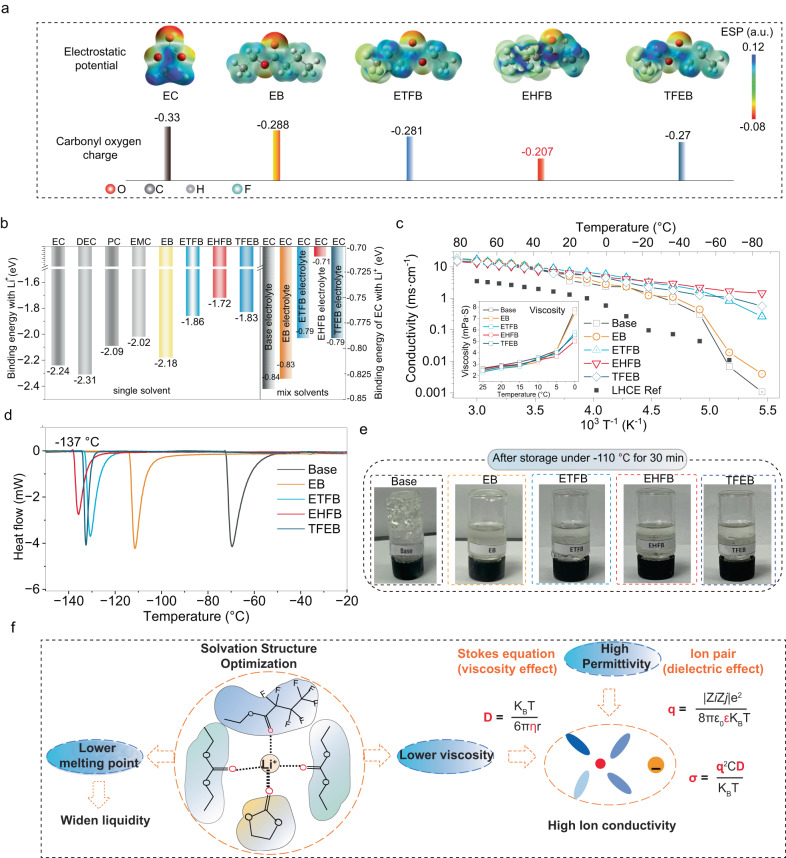
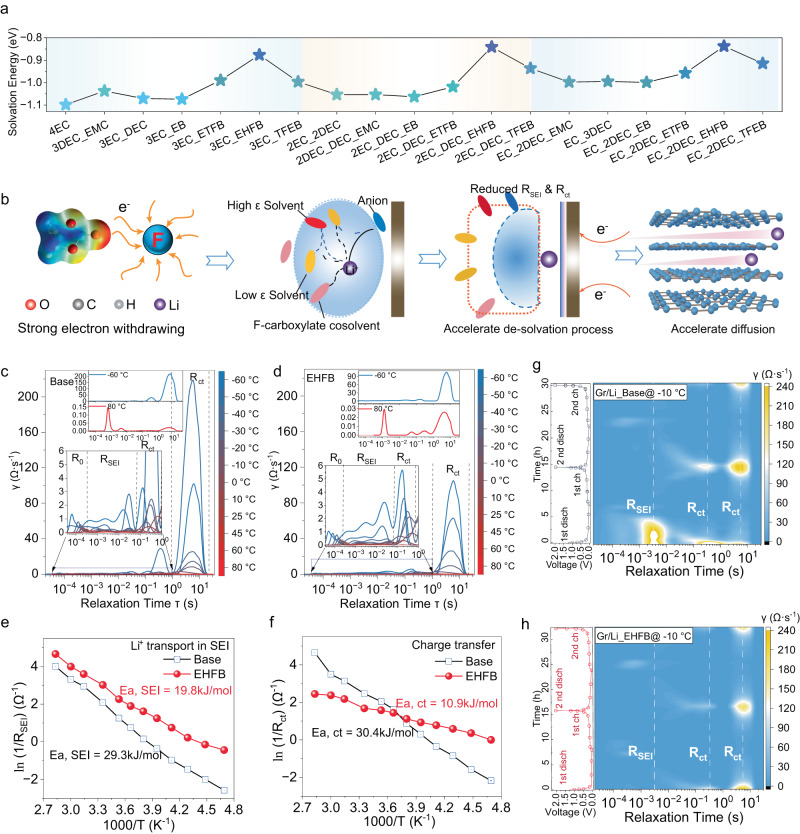
Low temperatures severely impair the performance of lithium-ion batteries, which demand powerful electrolytes with wide liquidity ranges, facilitated ion diffusion, and lower desolvation energy. The keys lie in establishing mild interactions between Li and solvent molecules internally, which are hard to achieve in commercial ethylene-carbonate based electrolytes. Herein, we tailor the solvation structure with low-ε solvent-dominated coordination, and unlock ethylene-carbonate via electronegativity regulation of carbonyl oxygen. The modified electrolyte exhibits high ion conductivity (1.46 mS·cm) at -90 °C, and remains liquid at -110 °C. Consequently, 4.5 V graphite-based pouch cells achieve ~98% capacity over 200 cycles at -10 °C without lithium dendrite. These cells also retain ~60% of their room-temperature discharge capacity at -70 °C, and miraculously retain discharge functionality even at ~-100 °C after being fully charged at 25 °C. This strategy of disrupting solvation dominance of ethylene-carbonate through molecular charge engineering, opens new avenues for advanced electrolyte design.
低温会严重损害锂离子电池的性能,而锂离子电池需要具有宽流动性范围、促进离子扩散和较低去溶剂化能的强力电解质。关键在于在内部建立锂与溶剂分子之间的温和相互作用,这在基于碳酸亚乙酯的商业电解质中很难实现。在此,我们通过以低介电常数溶剂为主导的配位来定制溶剂化结构,并通过羰基氧的电负性调节来解锁碳酸亚乙酯。改性电解质在-90°C时表现出高离子电导率(1.46 mS·cm),并在-110°C时保持液态。因此,4.5V石墨基软包电池在-10°C下200次循环中实现了约98%的容量,且无锂枝晶。这些电池在-70°C时还保留了约60%的室温放电容量,并且在25°C完全充电后,即使在约-100°C时也奇迹般地保留了放电功能。这种通过分子电荷工程破坏碳酸亚乙酯溶剂化优势的策略,为先进电解质设计开辟了新途径。