División de Ciencias Económico Administrativas, Universidad de Guanajuato, CP. 36250 Guanajuato, Mexico.
Nestlé Research Center, Vers-chez-les-Blanc, PO Box 44, 1000 Lausanne 26, Switzerland.
Int J Environ Res Public Health. 2020 Feb 25;17(5):1466. doi: 10.3390/ijerph17051466.
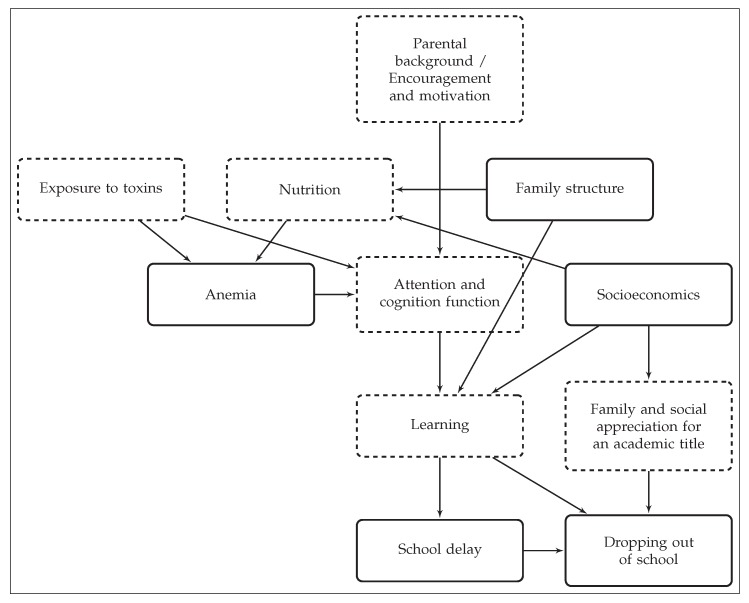
In school age children and adolescents, anemia might cause lower cognitive function and attention span, which in turn could diminish human capital accumulation. As children born in low-income households are more likely to be anemic, this may prevent many individuals from overcoming the intergenerational poverty traps. In this paper, we used data from the Mexican National Health and Nutrition Survey 2012 and focused on a sample of adolescents between 12 and 19 years of age to study the relationship between attending school without delay-our proxy for school performance-and anemia. We found a statistically significant association between the two variables. If this relationship is causal, the economic burden linked to the loss of school years could well exceed the costs associated with programs aimed at reducing the prevalence of anemia in vulnerable populations. Our results provide additional support to the existing literature on anemia as a significant barrier to school achievement.
在学龄儿童和青少年中,贫血可能导致认知功能和注意力持续时间下降,进而可能减少人力资本积累。由于出生在低收入家庭的儿童更容易贫血,这可能会阻止许多人摆脱代际贫困陷阱。本文利用 2012 年墨西哥国家健康和营养调查的数据,重点研究了 12 至 19 岁青少年样本,研究了按时上学(我们的学业表现替代指标)与贫血之间的关系。我们发现这两个变量之间存在统计学上的显著关联。如果这种关系是因果关系,那么与失去学年相关的经济负担很可能超过旨在降低弱势群体贫血患病率的项目相关成本。我们的研究结果为贫血作为学业成就的重要障碍这一现有文献提供了更多支持。