Rettie Stephen A, Juergens David, Adebomi Victor, Bueso Yensi Flores, Zhao Qinqin, Leveille Alexandria N, Liu Andi, Bera Asim K, Wilms Joana A, Üffing Alina, Kang Alex, Brackenbrough Evans, Lamb Mila, Gerben Stacey R, Murray Analisa, Levine Paul M, Schneider Maika, Vasireddy Vibha, Ovchinnikov Sergey, Weiergräber Oliver H, Willbold Dieter, Kritzer Joshua A, Mougous Joseph D, Baker David, DiMaio Frank, Bhardwaj Gaurav
Department of Medicinal Chemistry, University of Washington, Seattle, WA, USA.
Institute for Protein Design, University of Washington, Seattle, WA, USA.
bioRxiv. 2024 Nov 18:2024.11.18.622547. doi: 10.1101/2024.11.18.622547.
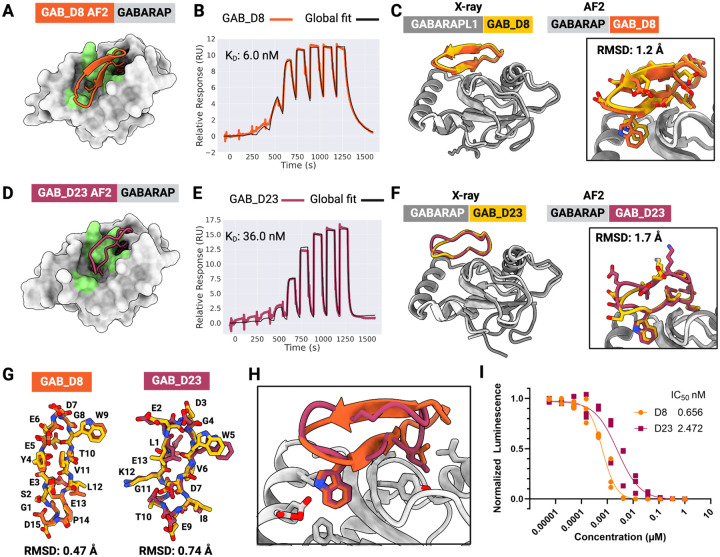
The development of macrocyclic binders to therapeutic proteins typically relies on large-scale screening methods that are resource-intensive and provide little control over binding mode. Despite considerable progress in physics-based methods for peptide design and deep-learning methods for protein design, there are currently no robust approaches for design of protein-binding macrocycles. Here, we introduce RFpeptides, a denoising diffusion-based pipeline for designing macrocyclic peptide binders against protein targets of interest. We test 20 or fewer designed macrocycles against each of four diverse proteins and obtain medium to high-affinity binders against all selected targets. Designs against MCL1 and MDM2 demonstrate K between 1-10 μM, and the best anti-GABARAP macrocycle binds with a K of 6 nM and a sub-nanomolar IC . For one of the targets, RbtA, we obtain a high-affinity binder with K < 10 nM despite starting from the target sequence alone due to the lack of an experimentally determined target structure. X-ray structures determined for macrocycle-bound MCL1, GABARAP, and RbtA complexes match very closely with the computational design models, with three out of the four structures demonstrating Ca RMSD of less than 1.5 Å to the design models. In contrast to library screening approaches for which determining binding mode can be a major bottleneck, the binding modes of RFpeptides-generated macrocycles are known by design, which should greatly facilitate downstream optimization. RFpeptides thus provides a powerful framework for rapid and custom design of macrocyclic peptides for diagnostic and therapeutic applications.
大环结合剂用于治疗性蛋白质的开发通常依赖于大规模筛选方法,这些方法资源密集且对结合模式几乎没有控制能力。尽管基于物理学的肽设计方法和基于深度学习的蛋白质设计方法取得了相当大的进展,但目前尚无用于设计蛋白质结合大环化合物的稳健方法。在此,我们介绍了RFpeptides,这是一种基于去噪扩散的流程,用于设计针对感兴趣蛋白质靶标的大环肽结合剂。我们针对四种不同的蛋白质中的每一种测试了20个或更少设计的大环化合物,并获得了针对所有选定靶标的中等到高亲和力的结合剂。针对MCL1和MDM2的设计显示解离常数(K)在1至10 μM之间,最佳的抗GABARAP大环化合物以6 nM的K值和亚纳摩尔级的半数抑制浓度(IC)结合。对于其中一个靶标RbtA,尽管由于缺乏实验确定的靶标结构而仅从靶标序列开始,我们仍获得了K < 10 nM的高亲和力结合剂。针对与大环化合物结合的MCL1、GABARAP和RbtA复合物测定的X射线结构与计算设计模型非常匹配,四个结构中有三个与设计模型的均方根偏差(Ca RMSD)小于1.5 Å。与文库筛选方法不同,确定结合模式可能是主要瓶颈,而RFpeptides生成的大环化合物的结合模式通过设计是已知的,这将极大地促进下游优化。因此,RFpeptides为用于诊断和治疗应用的大环肽的快速定制设计提供了一个强大的框架。