School of the Built Environment, Oxford Brookes University, Oxford, UK.
The IDEC Institute & Network for Education and Research On Peace and Sustainability (NERPS), Hiroshima University, Higashi-Hiroshima, Japan.
J Urban Health. 2024 Feb;101(1):120-140. doi: 10.1007/s11524-023-00798-9. Epub 2023 Dec 18.
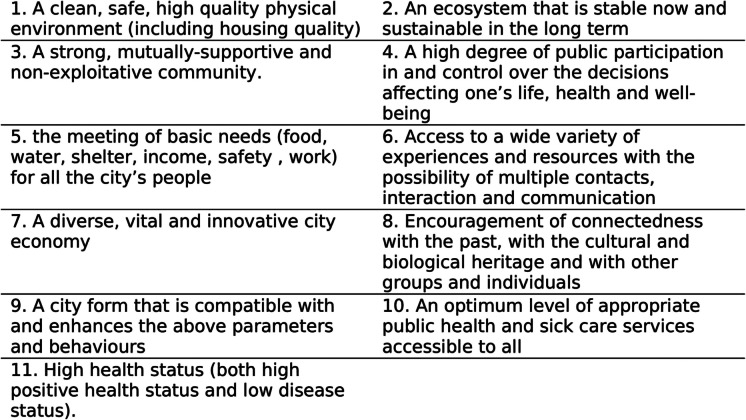
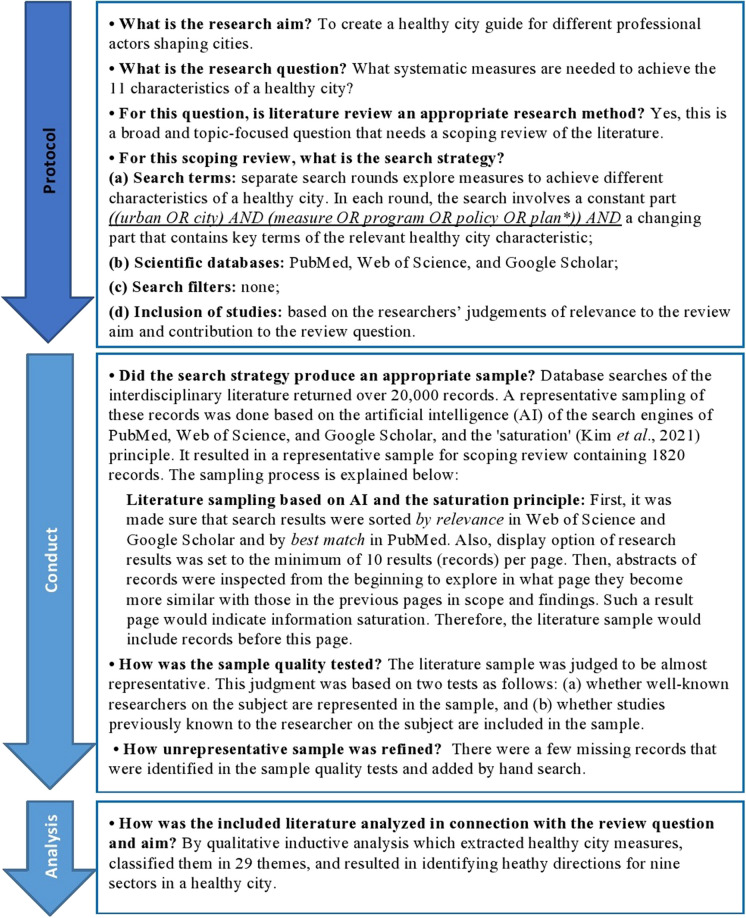
This scoping review of the literature explores the following question: what systematic measures are needed to achieve a healthy city? The World Health Organization (WHO) suggests 11 characteristics of a healthy city. Measures contributing to these characteristics are extracted and classified into 29 themes. Implementation of some of these measures is illustrated by examples from Freiburg, Greater Vancouver, Singapore, Seattle, New York City, London, Nantes, Exeter, Copenhagen, and Washington, DC. The identified measures and examples indicate that a healthy city is a system of healthy sectors. A discussion section suggests healthy directions for nine sectors in a healthy city. These sectors include transportation, housing, schools, city planning, local government, environmental management, retail, heritage, and healthcare. Future work is advised to put more focus on characteristic 5 (i.e., the meeting of basic needs for all the city's people) and characteristic 10 (i.e., public health and sick care services accessible to all) of a healthy city.
实现健康城市需要哪些系统措施?世界卫生组织(WHO)提出了健康城市的 11 个特征。提取促进这些特征的措施,并将其分类为 29 个主题。通过弗莱堡、大温哥华、新加坡、西雅图、纽约市、伦敦、南特、埃克塞特、哥本哈根和华盛顿特区的例子说明了其中一些措施的实施情况。确定的措施和示例表明,健康城市是一个健康部门的系统。讨论部分为健康城市的九个部门提出了健康方向。这些部门包括交通、住房、学校、城市规划、地方政府、环境管理、零售、遗产和医疗保健。建议未来的工作更加关注健康城市的特征 5(即满足城市所有人的基本需求)和特征 10(即所有人都能获得的公共卫生和疾病护理服务)。