Yang Huihua, Chen Dahong, Wu Yafei, Zhou Heming, Diao Wenjing, Liu Gaolin, Li Qin
Department of Clinical Pharmacy, Shanghai General Hospital, Shanghai Jiao Tong University School of Medicine, Shanghai, China.
Department of Pharmacy, Zhongshan Hospital, Fudan University, Shanghai, China.
Cancer Metab. 2023 Dec 18;11(1):27. doi: 10.1186/s40170-023-00311-5.
Hepatocellular carcinoma (HCC) is a principal type of liver cancer with high incidence and mortality rates. Regorafenib is a novel oral multikinase inhibitor for second-line therapy for advanced HCC. However, resistance to regorafenib is gradually becoming a dilemma for HCC and the mechanism remains unclear. In this study, we aimed to reveal the metabolic profiles of regorafenib-resistant cells and the key role and mechanism of the most relevant metabolic pathway in regorafenib resistance.
Metabolomics was performed to detect the metabolic alteration between drug-sensitive and regorafenib-resistant cells. Colony formation assay, CCK-8 assay and flow cytometry were applied to observe cell colony formation, cell proliferation and apoptosis, respectively. The protein and mRNA levels were detected by western blot and RT-qPCR. Cell lines of Glucose-6-phosphate dehydrogenase(G6PD) knockdown in regorafenib-resistant cells or G6PD overexpression in HCC cell lines were stably established by lentivirus infection technique. G6PD activity, NADPH level, NADPH/NADP ratio, the ratio of ROS positive cells, GSH level, and GSH/GSSG ratio were detected to evaluate the anti-oxidative stress ability of cells. Phosphorylation levels of NADK were evaluated by immunoprecipitation.
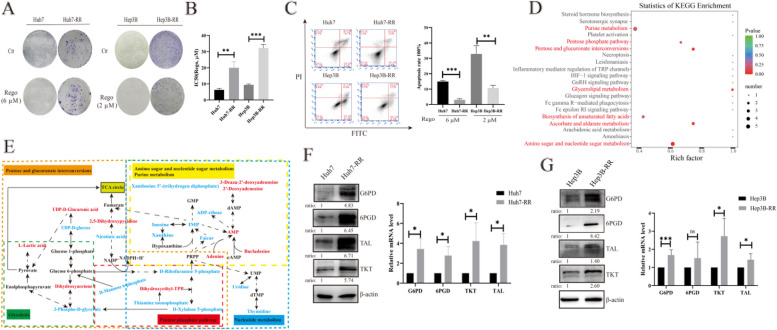
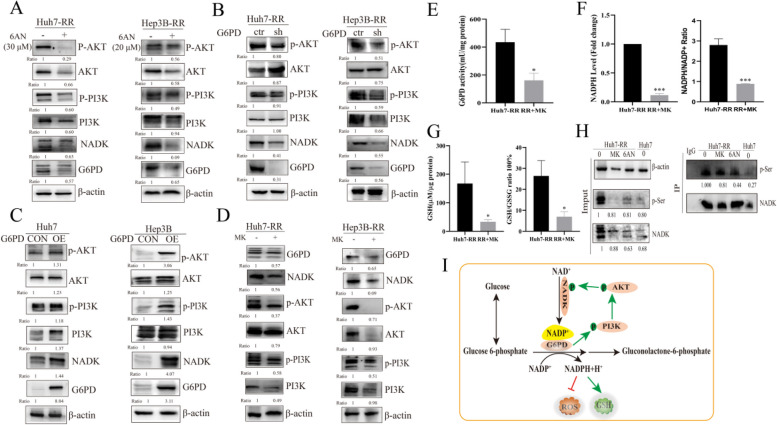
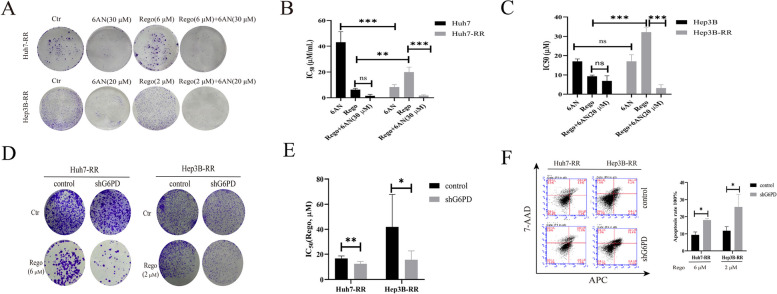
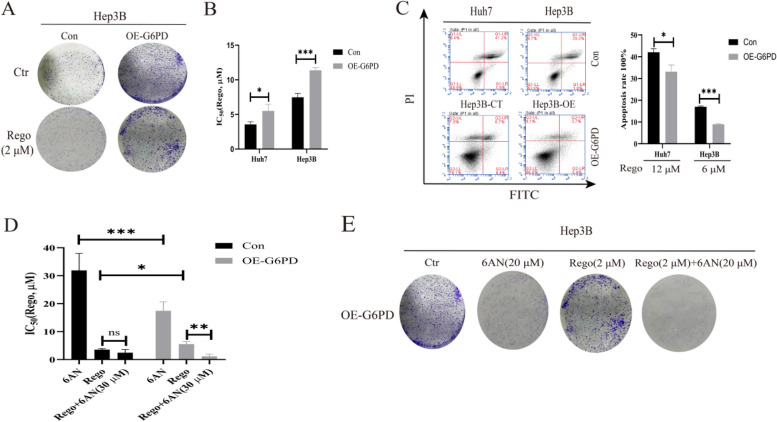
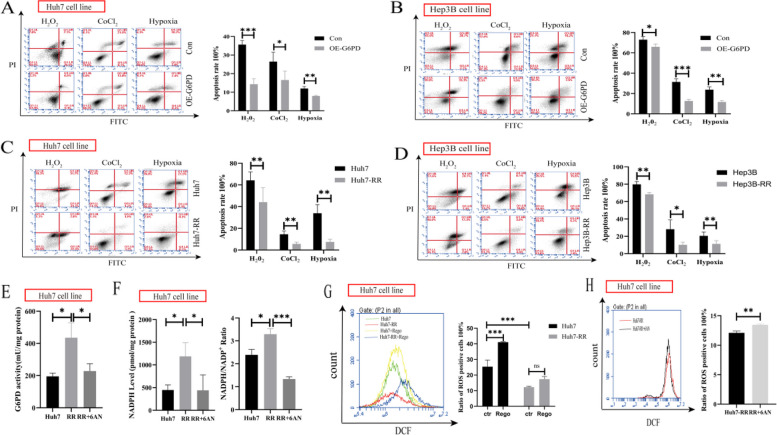
Metabonomics analysis revealed that pentose phosphate pathway (PPP) was the most relevant metabolic pathway in regorafenib resistance in HCC. Compared with drug-sensitive cells, G6PD enzyme activity, NADPH level and NADPH/NADP ratio were increased in regorafenib-resistant cells, but the ratio of ROS positive cells and the apoptosis rate under the conditions of oxidative stress were decreased. Furthermore, G6PD suppression using shRNA or an inhibitor, sensitized regorafenib-resistant cells to regorafenib. In contrast, G6PD overexpression blunted the effects of regorafenib to drug-sensitive cells. Mechanistically, G6PD, the rate-limiting enzyme of PPP, regulated the PI3K/AKT activation. Furthermore, PI3K/AKT inhibition decreased G6PD protein expression, G6PD enzymatic activity and the capacity of PPP to anti-oxidative stress possibly by inhibited the expression and phosphorylation of NADK.
Taken together, a feedback loop of PPP and PI3K/AKT signal pathway drives regorafenib-resistance in HCC and targeting the feedback loop could be a promising approach to overcome drug resistance.
肝细胞癌(HCC)是肝癌的主要类型,发病率和死亡率都很高。瑞戈非尼是一种新型口服多激酶抑制剂,用于晚期HCC的二线治疗。然而,对瑞戈非尼产生耐药性正逐渐成为HCC治疗中的一个难题,其机制仍不清楚。在本研究中,我们旨在揭示瑞戈非尼耐药细胞的代谢谱以及最相关代谢途径在瑞戈非尼耐药中的关键作用和机制。
采用代谢组学方法检测药物敏感细胞和瑞戈非尼耐药细胞之间的代谢变化。分别应用集落形成试验、CCK-8试验和流式细胞术观察细胞集落形成、细胞增殖和凋亡情况。通过蛋白质印迹法和RT-qPCR检测蛋白质和mRNA水平。利用慢病毒感染技术在瑞戈非尼耐药细胞中稳定建立葡萄糖-6-磷酸脱氢酶(G6PD)敲低的细胞系,或在HCC细胞系中稳定建立G6PD过表达的细胞系。检测G6PD活性、NADPH水平、NADPH/NADP比值、ROS阳性细胞比例、GSH水平和GSH/GSSG比值,以评估细胞的抗氧化应激能力。通过免疫沉淀法评估NADK的磷酸化水平。
代谢组学分析显示,磷酸戊糖途径(PPP)是HCC对瑞戈非尼耐药中最相关的代谢途径。与药物敏感细胞相比,瑞戈非尼耐药细胞中的G6PD酶活性、NADPH水平和NADPH/NADP比值升高,但在氧化应激条件下ROS阳性细胞比例和凋亡率降低。此外,使用shRNA或抑制剂抑制G6PD可使瑞戈非尼耐药细胞对瑞戈非尼敏感。相反,G6PD过表达减弱了瑞戈非尼对药物敏感细胞的作用。机制上,PPP的限速酶G6PD调节PI3K/AKT的激活。此外,PI3K/AKT抑制可能通过抑制NADK的表达和磷酸化来降低G6PD蛋白表达、G6PD酶活性以及PPP的抗氧化应激能力。
综上所述,PPP与PI3K/AKT信号通路的反馈环驱动HCC对瑞戈非尼的耐药,针对该反馈环可能是克服耐药的一种有前景的方法。